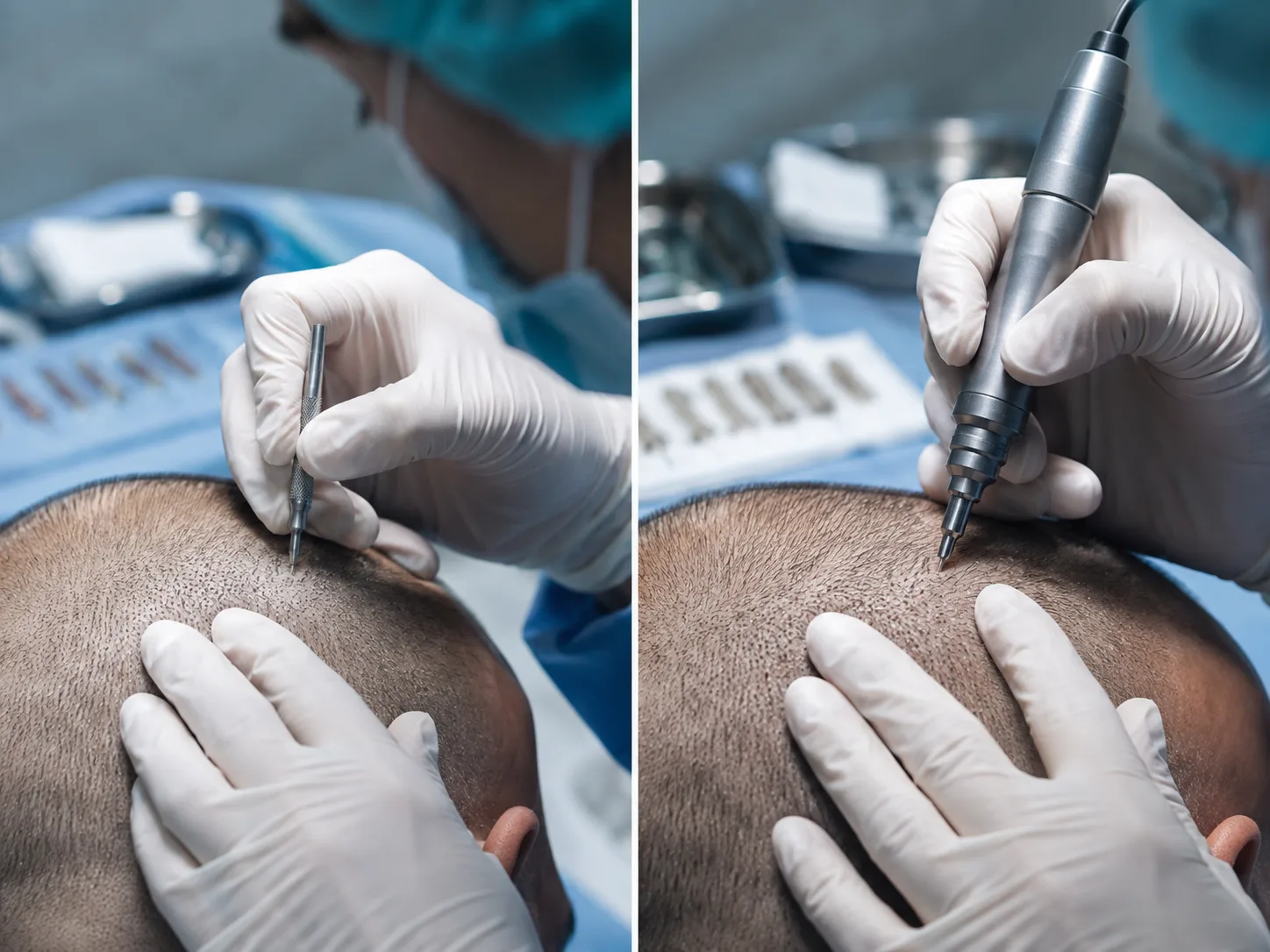
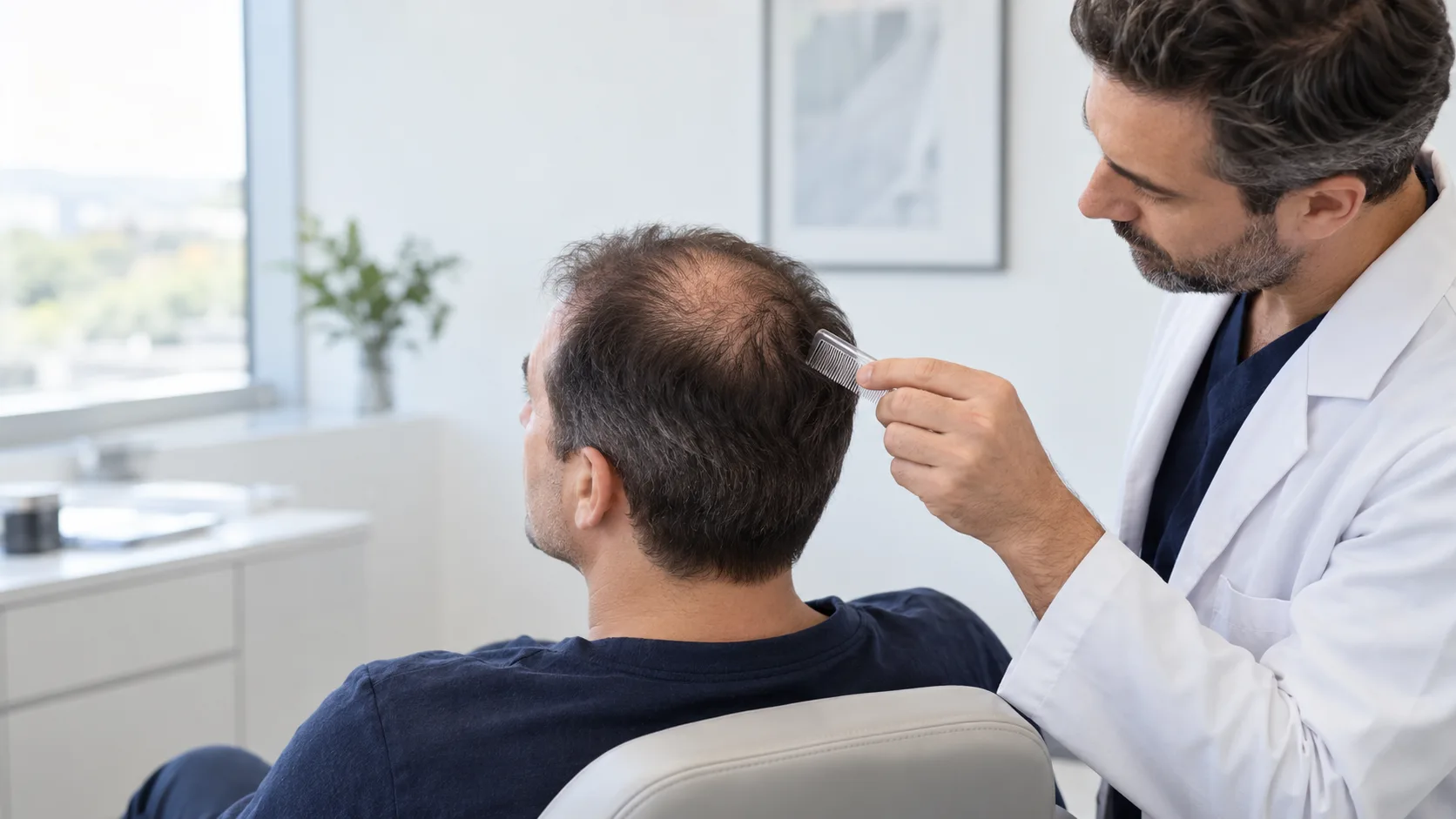
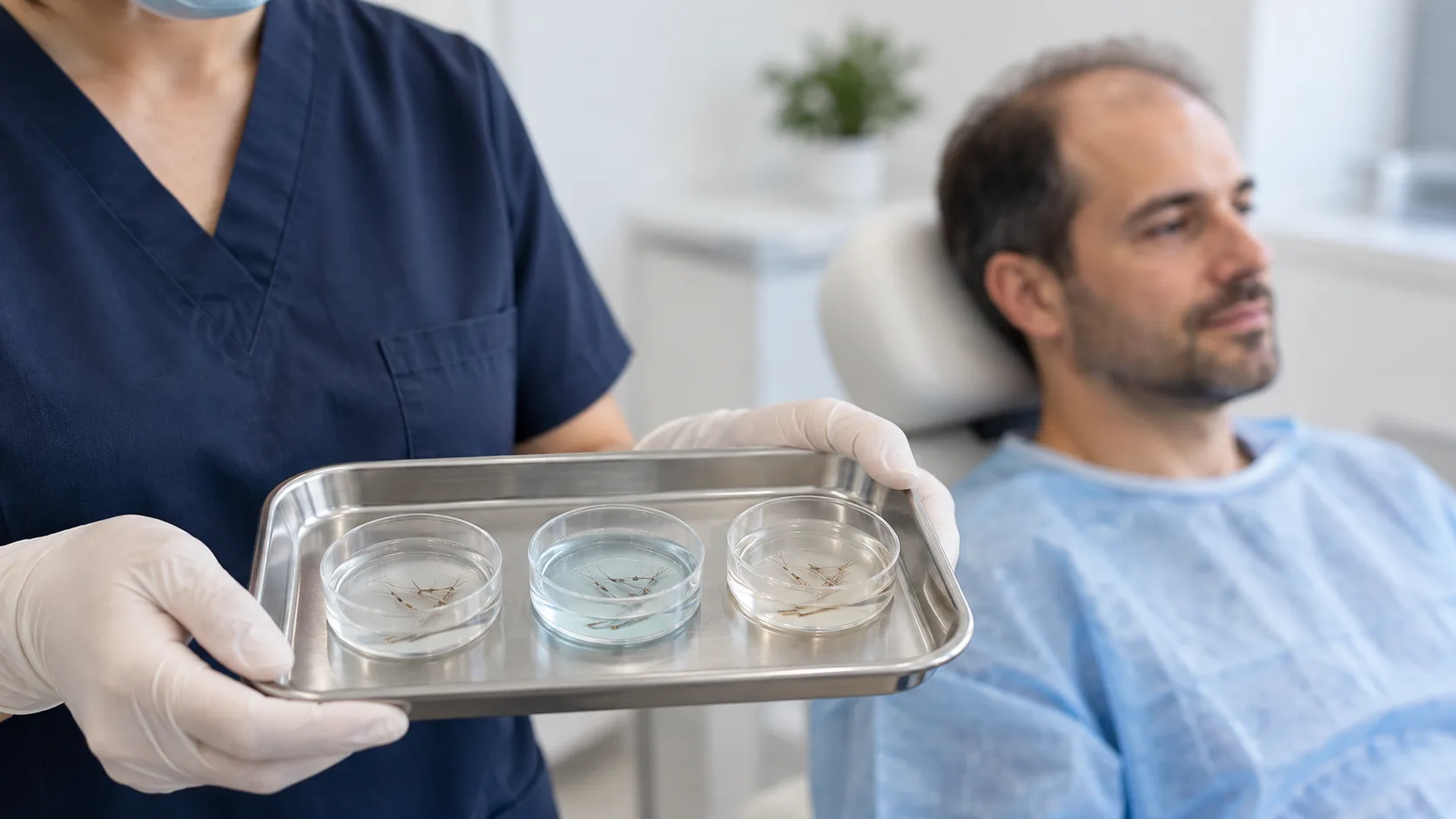
Beide Techniken entfernen einzelne follikuläre Einheiten aus dem Spenderbereich. Keine Methode garantiert eine automatische Überlegenheit. Das Können des Chirurgen bestimmt das Ergebnis mehr als das Werkzeug selbst.
Die Follikuläre Einheitsextraktion, oder FUE, ist die führende Technik zur Entnahme von Spenderhaaren in der modernen Haarwiederherstellung. Chirurgen entnehmen einzelne follikuläre Einheiten direkt von der Kopfhaut. Diese Grefts werden dann in dünneren oder kahlen Bereichen eingepflanzt. Das Extraktionsgerät spielt eine entscheidende Rolle in diesem Prozess. Zwei Hauptansätze dominieren das Feld: Manuelle FUE und motorisierte FUE. Manuelle FUE beruht auf handbetriebener Rotation eines zylindrischen Punchs. Motorisierte FUE verwendet einen elektrischen Mikromotor, um den Punch anzutreiben. FUE beschreibt die Methode der Exzision. Die Werkzeuge, die für diese Exzision verwendet werden, können erheblich variieren. Bietet die manuelle Extraktion eine bessere Kontrolle über die Grefts? Manchmal tut sie das. Verbessert die motorisierte Extraktion die Effizienz? Oft tut sie das. Welche Technik bietet eine bessere Erhaltung des Spenderbereichs? Beide können den Spenderbereich erhalten, wenn die Chirurgen die richtige Technik anwenden. Der wissenschaftliche Konsens besagt, dass keine Technik universell überlegen ist. Die Ergebnisse hängen stark vom Fachwissen des Chirurgen, den Eigenschaften des Patienten, den Anforderungen an die Grefts und der Extraktionstechnik ab (Sharma 2019).
Was ist FUE-Haartransplantation?
FUE entfernt einzelne follikuläre Einheiten, ohne einen Streifen Kopfhaut abzuschneiden. Diese Methode hinterlässt kleine Punktnarben anstelle einer linearen Narbe.
Die Follikuläre Einheitsextraktion ist eine chirurgische Methode. Chirurgen ernten einzelne follikuläre Einheiten aus dem Spenderbereich. Jede Einheit enthält ein bis vier Haarfollikel. Chirurgen verwenden einen kleinen zylindrischen Punch, um die Haut um jede Einheit zu ritzen. Dann heben sie den Greft vorsichtig mit einer Pinzette heraus. Dieser Ansatz unterscheidet sich von der Follikulären Einheitentransplantation oder FUT. FUT entfernt einen Streifen Kopfhaut aus dem Spenderbereich. Techniker zerteilen diesen Streifen anschließend in einzelne Grefts. FUE vermeidet die lineare Narbe, die mit FUT verbunden ist. Der Spenderbereich liefert die Grefts. Der Empfängerbereich erhält die Grefts. Der Chirurg muss beide Bereiche für einen langfristigen Erfolg erhalten (Sharma 2019).
Wie funktioniert die FUE-Haartransplantation?
Der Eingriff folgt einer klaren Abfolge. Zuerst bewertet der Chirurg den Patienten und plant die Operation. Zweitens bereitet das Team den Spenderbereich vor. Drittens schneidet der Chirurg einzelne follikuläre Einheiten aus. Viertens extrahiert das Team die Grefts sorgfältig. Fünftens inspizieren und bereiten Techniker die Grefts unter Vergrößerung vor. Sechstens erstellt der Chirurg Empfängerstätten. Siebtens implantiert das Team die Grefts. Achtens erhält der Patient postoperative Pflegeanweisungen. Jeder Schritt erfordert Präzision. Jeder Schritt beeinflusst das Endergebnis.
Die Extraktionsphase schützt die Integrität der follikulären Einheit. Eine mangelhafte Extraktion führt zu einer Transsektion des Transplantats. Die Transsektion schädigt den Follikel und verringert die Überlebensrate. Mechanisches Trauma während der Extraktion kann Transplantate zerdrücken oder reißen. Überernte verringert die Spenderzone. Der Patient hat ein begrenztes Spenderangebot. Mangelhafte Extraktion schädigt auch das Überleben des Transplantats nach der Implantation. Der Spenderbereich muss über Jahre hinweg natürlich aussehen. Jede Entscheidung bezüglich der Extraktion beeinflusst die langfristigen Ergebnisse (Parsley 2010).
Was ist manuelle FUE?
Manuelle FUE verwendet einen handgeführten Punch, den der Chirurg von Hand dreht. Der Chirurg spürt jede Veränderung des Gewebewiderstands.
Was ist manuelle FUE?
Die manuelle FUE verwendet einen handgeführten Punch. Der Chirurg bedient diesen Punch direkt mit den Fingern. Das Werkzeug benötigt keinen elektrischen Motor. Der Chirurg führt eine manuelle Dreh- oder Oszillationsbewegung aus. Diese Aktion schneidet das Gewebe um die follikuläre Einheit. Der Chirurg kontrolliert jeden Aspekt der Bewegung. Die Technik erfordert feine motorische Koordination. Sie erfordert auch ständige visuelle Aufmerksamkeit.
Wie funktioniert die manuelle FUE?
Der Chirurg identifiziert zunächst die follikuläre Einheit. Er richtet den Punch mit der natürlichen Haarwuchsrichtung aus. Er übt kontrollierten Druck nach unten aus. Er dreht oder oszilliert den Punch manuell. Diese Bewegung trennt das Transplantat vom umgebenden Gewebe. Er gibt das Transplantat sanft frei. Er extrahiert das Transplantat mit feinen Pinzetten. Er inspiziert das Transplantat vor der Implantation. Jedes Transplantat erhält individuelle Aufmerksamkeit. Jeder Winkel wird an den spezifischen Follikel angepasst.
Welche Rolle spielt das taktile Feedback bei der manuellen FUE?
Die direkte Handkontrolle ermöglicht es dem Chirurgen, den Gewebewiderstand wahrzunehmen. Die Finger registrieren Veränderungen im Haarwinkel. Sie spüren die Follikelrichtung. Sie fühlen die Dicke der Kopfhaut. Sie bemerken die Krümmung der Follikel. Dieses taktile Feedback hilft in technisch schwierigen Spenderbereichen. Gekrümmte Follikel stellen selbst erfahrene Chirurgen vor Herausforderungen. Die Hand kann sich sofort anpassen, wenn der Widerstand sich ändert. Diese Anpassungsfähigkeit ist besonders wichtig in der Nähe der Schläfen oder des Nackens (Sharma 2019).
Wie beeinflusst die Punchgröße die manuelle FUE?
Chirurgen verwenden häufig Punches mit kleinem Durchmesser. Diese reichen von 0,8 mm bis 1,0 mm. Der Durchmesser des Punches steht in direktem Zusammenhang mit der Transplantatgröße. Er steht auch im Zusammenhang mit dem Haardurchmesser. Er muss der Anatomie der follikulären Einheit entsprechen. Kleinere Punches reduzieren das Trauma im Spenderbereich. Der Chirurg muss jedoch den Punch individuell auswählen. Es gibt keinen universellen Durchmesser, der für jeden Patienten geeignet ist. Der Chirurg passt den Punch an das spezifische Transplantat an.
Was ist motorisierte FUE?
Die motorisierte FUE verwendet einen Mikromotor, um den Punch zu drehen. Der Chirurg leitet jedoch jede Bewegung.
Was ist motorisierte FUE?
Die motorisierte FUE verbindet den Punch mit einem elektrischen Handstück. Ein Mikromotor treibt die Rotation an. Der Chirurg hält das stiftförmige Gerät. Er führt den Punch in die Kopfhaut. Der Motor liefert eine konstante rotierende oder oszillierende Kraft. Dies unterscheidet sich von der vollautomatisierten FUE. Die International Society of Hair Restoration Surgery, oder ISHRS, weist speziell darauf hin, dass "automatisierte FUE" Patienten irreführen kann. Das Verfahren bleibt stark abhängig vom Operator. Der Motor unterstützt den Chirurgen. Er ersetzt nicht den Chirurgen (Watts 2025).
Wie funktioniert die motorisierte FUE?
Der Chirurg positioniert den Punch über der follikulären Einheit. Er wählt die entsprechenden Motoreinstellungen. Er aktiviert die Rotation oder Oszillation. Er führt den Punch mit gleichmäßigem Druck durch das Gewebe. Er gibt das Transplantat frei und extrahiert es. Er inspiziert und bewahrt das Transplantat. Das Fußpedal oder die Handsteuerung regelt die Motorleistung. Der Chirurg passt die Geschwindigkeit während des Verfahrens an.
Welche Geräte werden bei der motorisierten FUE verwendet?
Die Geräte variieren in mehreren Parametern. Der Rotationsmodus ist unterschiedlich. Der Oszillationsmodus ist unterschiedlich. Die Rotationsgeschwindigkeit liegt zwischen 800 und 2000 Umdrehungen pro Minute. Das Drehmoment variiert. Das Design des Punches umfasst scharfe, stumpfe und hybride Spitzen. Mechanismen zur Tiefenkontrolle schützen das Follikel-Bulb. Die Ergonomie des Handstücks beeinflusst den Komfort des Chirurgen. Einige Systeme bieten Saugunterstützung. Andere verwenden vibrationsdämpfende Technologie. Jede Variable verändert die Extraktionserfahrung.
Automatisiert die motorisierte FUE die Chirurgie?
Der Motor automatisiert lediglich die Drehung des Bohres. Der Chirurg kontrolliert weiterhin die Positionierung. Er kontrolliert den Winkel. Er kontrolliert die Tiefe. Er kontrolliert den Druck. Er wählt die Einstellungen aus. Er überwacht die Qualität der Transplantate. Technologie beseitigt nicht die Notwendigkeit chirurgischen Urteilsvermögens. Der Chirurg muss nach wie vor den richtigen Ansatz für jedes Follikel wählen. Das Gerät unterstützt die Hand. Es ersetzt nicht den Geist (Watts 2025).
Was sind die wesentlichen Unterschiede zwischen manueller FUE und motorisierter FUE?
Manuelle FUE bietet mehr taktiles Feedback. Motorisierte FUE bietet eine höhere Extraktionsgeschwindigkeit. Beide erfordern eine erfahrene chirurgische Kontrolle.
Merkmal | Manuelle FUE | Motorisierte FUE |
Bohrbewegung | Handgesteuert | Motorunterstützt |
Taktiles Feedback | Direkt | Reduziert im Vergleich zur manuellen |
Extraktionsgeschwindigkeit | Im Allgemeinen langsamer | Im Allgemeinen schneller |
Erschöpfung des Chirurgen | Größer während langer Sitzungen | Geringere wiederholte Handbewegung |
Kontrolle | Hochgradig abhängig vom Chirurgen | Der Chirurg steuert die Positionierung und Einstellungen |
Große Sitzungen | Potenziell anspruchsvoller | Im Allgemeinen effizienter |
Gekrümmte Follikel | Kann starke taktile Anpassungsfähigkeit bieten | Erfordert angemessene Einstellungen und Technik |
Ausrüstung | Einfacher | Erfordert Mikromotorsystem |
Risiko der Transektion | Hängt von der Technik ab | Hängt von Technik und Einstellungen ab |
Bewahrung des Spenders | Hängt von der Entnahmestrategie ab | Hängt von der Entnahmestrategie ab |
Ergebnis | Primär vom Chirurgen abhängig | Primär vom Chirurgen abhängig |
Die chirurgische Geschwindigkeit variiert erheblich je nach Chirurg. Sie variiert je nach Patientenanatomie. Sie variiert je nach Eigenschaften der Transplantate. Sie variiert je nach Teamarbeitsabläufen. Sie variiert je nach Komplexität des Falls. Es gibt keine feste Zahl für Transplantate pro Tag, die einen wissenschaftlichen Konstanten darstellt.
Welche Technik bietet eine bessere Extraktionsgenauigkeit?
Keine der Techniken garantiert automatisch Präzision. Das Geschick und die Technik des Chirurgen bestimmen die Präzision.
Die Ausrichtung des Hohls bestimmt die Präzision. Der Haarwachswinkel ist wichtig. Die Follikeltiefe ist entscheidend. Die Follikelkrümmung spielt eine Rolle. Die Eigenschaften der Kopfhaut sind von Bedeutung. Die Erfahrung des Chirurgen ist am wichtigsten. Auch das Design des Hohls beeinflusst die Ergebnisse. Jeder Faktor interagiert mit den anderen. Der Chirurg muss alle Faktoren berücksichtigen.
Wie beeinflusst taktile Kontrolle die Präzision bei der manuellen FUE?
Direktes Feedback des Gewebes ermöglicht es dem Chirurgen, sich während der Extraktion anzupassen. Die Hand spürt Widerstandsänderungen. Sie passt die Trajektorie sofort an. Diese Anpassungsfähigkeit kann bei schrägen Follikeln helfen. Sie kann bei flachen oder tiefen Zwiebeln Unterstützung bieten. Der Chirurg modifiziert jede Extraktion individuell.
Wie beeinflusst mechanische Konsistenz die Präzision bei der motorisierten FUE?
Konstante Rotation reduziert variable manuelle Bewegungen. Der Motor hält eine gleichmäßige Geschwindigkeit. Diese Konsistenz kann bei geraden Follikeln helfen. Sie kann in Bereichen mit einheitlicher Anatomie hilfreich sein. Mechanische Unterstützung reduziert sich wiederholende Handbewegungen. Dies verringert Mikrov_variationen in der Rotationsgeschwindigkeit.
Welche Technik ist präziser?
Es gibt keine Beweise dafür, dass eine Technik von Natur aus präziser ist. Das Können des Bedieners und die korrekte Technik bleiben zentral. Die ISHRS bestätigt, dass es kein einzelnes universell "bestes" FUE-Verfahren gibt. Die Hand und der Verstand des Chirurgen sind wichtiger als das spezifische Gerät (Sharma 2019).
Welche Technik führt zu weniger Grefttransektionen?
Beide Techniken können niedrige Transsektionraten erreichen. Die Technik des Chirurgen ist wichtiger als das Gerät.
Was ist eine Grefttransektion?
Eine Transektion bedeutet, die follikuläre Einheit während der Extraktion zu durchtrennen oder zu beschädigen. Ein transektierter Greft könnte die Transplantation nicht überstehen. Selbst eine teilweise Transektion verringert die Lebensfähigkeit. Der Follikel benötigt intakte Strukturen, um neues Haar zu wachsen. Die dermale Papille und der Wulstbereich müssen unbeschädigt bleiben.
Welche Faktoren erhöhen das Risiko einer Transektion?
Ein falscher Hohlwinkel erhöht das Risiko. Eine falsche Hohltiefe erhöht das Risiko. Krümmungen der Follikel erhöhen das Risiko. Schlechte Sichtbarkeit erhöht das Risiko. Unzureichende Ausbildung des Chirurgen erhöht das Risiko. Eine unangemessene Hohlwahl erhöht das Risiko. Übermäßige mechanische Kraft erhöht das Risiko. Jeder Faktor verstärkt die anderen.
Wie beeinflusst die manuelle FUE das Risiko einer Transektion?
Taktile Rückmeldung hilft dem Chirurgen, die Extraktionsbahn zu modifizieren. Die Hand kann stoppen oder die Richtung ändern, wenn sich der Widerstand falsch anfühlt. Diese Anpassungsfähigkeit kann die Transektion in erfahrenen Händen reduzieren. Allerdings hängt die manuelle Rotation auch von einer konstanten Handkontrolle ab. Müdigkeit kann das Risiko einer Transektion bei langen Sitzungen erhöhen.
Wie beeinflusst die motorisierte FUE das Risiko einer Transektion?
Angemessene Geschwindigkeit, Bewegung, Hohlgestaltung und Bedienerkontrolle reduzieren die Transektion. Eine motorisierte Extraktion beseitigt oder schafft nicht automatisch Transektionen. Falsche Einstellungen können das Risiko erhöhen. Hohe Geschwindigkeit bei schlechter Ausrichtung schädigt die Follikel. Die richtigen Einstellungen mit guter Technik schützen die Grefts.
Wie können Chirurgen die Transektion minimieren?
Chirurgen müssen den Patienten richtig einschätzen. Sie müssen Vergrößerung verwenden. Sie müssen den Punch korrekt ausrichten. Sie müssen geeignete Einstellungen wählen. Sie müssen konservativ ernten. Sie müssen eine erfahrene chirurgische Technik anwenden. Diese Schritte sind wichtiger als die Auswahl des Geräts (Parsley 2010).
Welche Technik bewahrt das Spendergebiet besser?
Beide Techniken können das Spendergebiet bewahren. Die Ernte-Strategie ist wichtiger als das Gerät.
Warum ist die Erhaltung des Spendergebiets wichtig?
Die Spenderressourcen sind begrenzt. Jeder Patient hat eine begrenzte Anzahl gesunder Follikel. Eine langfristige Haarwiederherstellungsplanung erfordert sorgfältige Erhaltung. Zukünftige Eingriffe benötigen möglicherweise zusätzliche Transplantate. Überernteverfahren führen zu sichtbarem Haarausfall. Es schädigt das Spendergebiet dauerhaft. Strategische Erhaltung sorgt für natürliche Dichte über Jahrzehnte.
Was ist die Homogenisierung des Spendergebiets?
Die Homogenisierung des Spendergebiets bedeutet das gleichmäßige Verteilen der Entnahmeorte. Chirurgen vermeiden konzentrierte Ernte. Sie erhalten die natürliche Spenderdichte über die gesamte Zone. Dieser Ansatz verhindert fleckigen Haarausfall. Er bewahrt das ästhetische Erscheinungsbild des Spendergebiets. Ein angemessener Abstand zwischen den Entnahmeorten unterstützt die Heilung.
Wie verwaltet die manuelle FUE das Spendergebiet?
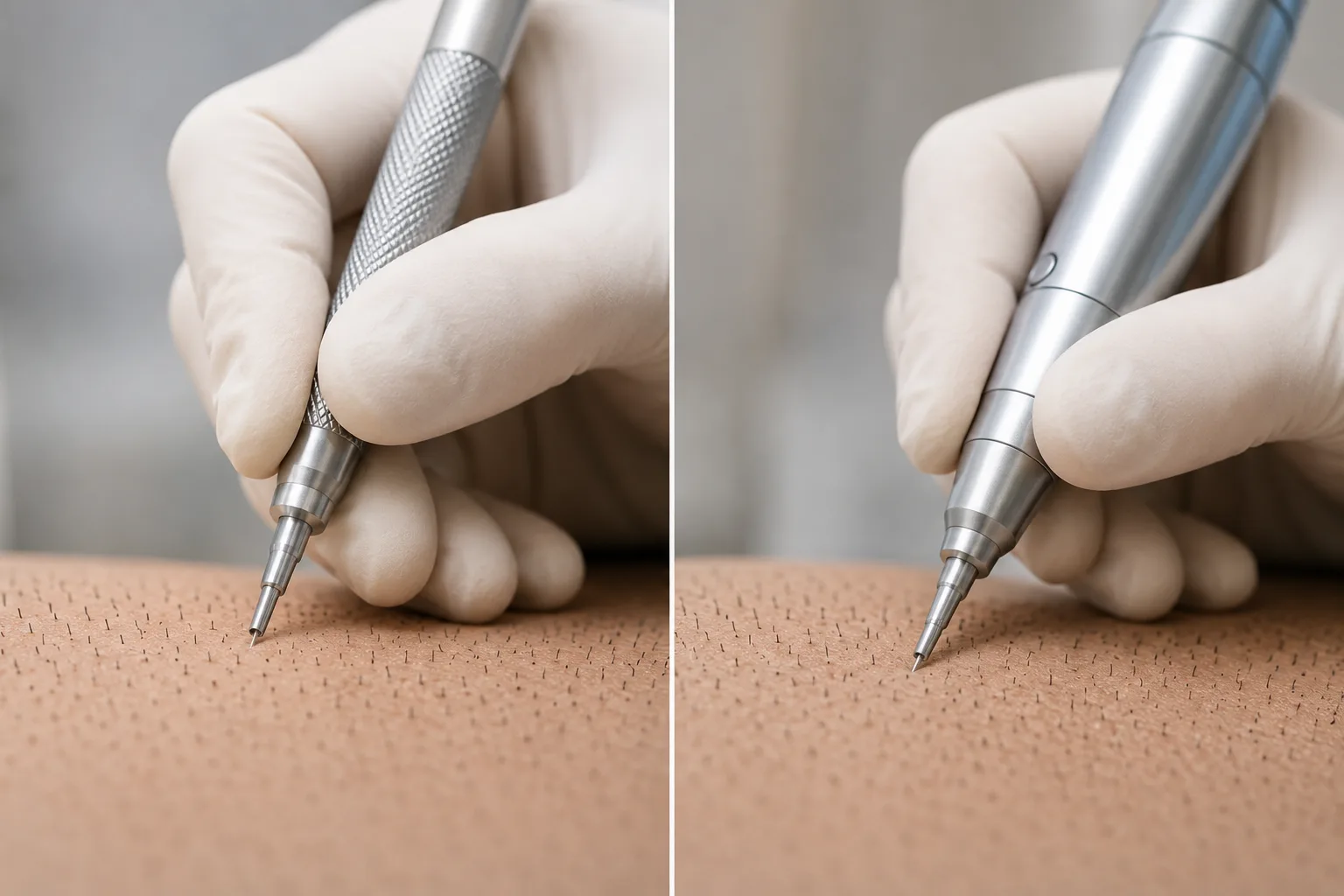
Die manuelle FUE erlaubt eine individuelle Entnahme. Der Chirurg kann die Platzierung jedes Punches gemäß der Anatomie des Spenders anpassen. Sie können Bereiche mit niedrigerer Dichte vermeiden. Sie können die Entnahmen präzise abstandshalten. Dieser individualisierte Ansatz unterstützt die Homogenisierung. Der Chirurg sieht und fühlt jeden Entnahmeort.
Wie verwaltet die motorisierte FUE das Spendergebiet?
Die Motorisierung bestimmt nicht von Natur aus die Erhaltung des Spenders. Der angemessene Abstand, die Wahl des Punches und die Ernte-Strategie bleiben entscheidend. Der Chirurg muss das Entnahme-Muster immer noch planen. Der Motor wählt nicht aus, wo geerntet wird. Die Strategie des Chirurgen schützt das Spendergebiet. ASMED betont die Homogenisierung des Spendergebiets und die individuelle Entnahme als wichtige Prinzipien der FUE-Ernte.
Welche Technik ist schneller: Manuelle FUE oder motorisierte FUE?
Die motorisierte FUE extrahiert im Allgemeinen schneller Transplantate. Die manuelle FUE dauert in der Regel länger. Geschwindigkeit allein bestimmt nicht die Qualität.
Wie lange dauert eine manuelle FUE?
Die manuelle Rotation macht die Entnahme arbeitsintensiver. Der Chirurg dreht jeden Punch von Hand. Dies erfordert sich wiederholende Bewegungen des Handgelenks und der Finger. Lange Sitzungen erhöhen die Ermüdung des Chirurgen. Ermüdung kann die Entnahme weiter verlangsamen. Eine Sitzung von zweitausend Transplantaten kann mit manueller Entnahme allein acht Stunden oder mehr dauern (Watts 2025).
Wie lange dauert eine motorisierte FUE?
Die motorisierte Unterstützung erhöht die Effizienz der Entnahme. Das Gerät sorgt für eine konstante Rotation. Der Chirurg konzentriert sich auf die Führung statt auf die Rotation. Diese Effizienz reduziert die Entnahmezeit pro Transplantat. Eine Studie im Journal of Dermatological Case Reports hat gezeigt, dass die motorisierte FUE die Operationszeit um bis zu dreißig Prozent im Vergleich zur manuellen Entnahme reduzieren kann (Watts 2025).
Bedeutet schnellere Entnahme bessere Ergebnisse?
Geschwindigkeit allein bestimmt nicht die Qualität der Transplantate. Sorgfältige Entnahme und Umgang mit Transplantaten sind wichtiger. Ein schnelles, aber nachlässiges Verfahren schädigt Transplantate. Ein langsames, aber sorgfältiges Verfahren bewahrt sie. Die Effizienz des Verfahrens mit sorgfältiger Technik in Einklang bringen. Das Überleben der Transplantate hängt von der Handhabung, der Hydratation und der Implantationszeit ab.
Sind motorisierte FUE-Methoden besser für große Greft-Sitzungen?
Motorisierte Systeme können sich bei größeren Entnahmeanforderungen als praktisch erweisen. Sie reduzieren die wiederholte Belastung des Chirurgen. Sie halten während der gesamten Sitzung eine konstante Geschwindigkeit aufrecht. Große Greft-Sitzungen sind jedoch nicht automatisch für jeden Patienten geeignet. Das Spenderareal muss die Entnahme unterstützen. Das Team muss die Grefts ordnungsgemäß verwalten. Die Anatomie des Patienten muss eine sichere Extraktion zulassen.
Welche Technik funktioniert besser für unterschiedliche Haartypen?
Der Haartyp sollte die Extraktionsstrategie beeinflussen. Kein Gerät ist für alle Haartypen universell überlegen.
Wie geht jede Technik mit glattem Haar um?
Glattes Haar zeigt oft eine vorhersehbare Follikelorientierung. Der Haarschaft orientiert sich mit dem subkutanen Follikel. Diese Vorhersagbarkeit vereinfacht die Ausrichtung des Punchs. Sowohl manuelle als auch motorisierte Techniken können glattes Haar effektiv ernten. Die motorisierte Konsistenz kann mit gleichmäßigen Winkeln helfen.
Wie geht jede Technik mit lockigem und welligem Haar um?
Lockiges und welliges Haar stellt die Krümmung des subkutanen Follikels dar. Der Haarschaft tritt in einem bestimmten Winkel aus der Kopfhaut heraus. Der Follikel krümmt sich unter der Oberfläche. Diese Krümmung stellt eine Herausforderung für die Ausrichtung des Punchs dar. Die manuelle FUE erlaubt es dem Chirurgen, die Krümmung zu fühlen und sich anzupassen. Die motorisierte FUE erfordert eine sorgfältige Wahl des Winkels und geeignete Einstellungen. Beide Methoden können mit der richtigen Technik erfolgreich sein.
Wie geht jede Technik mit Afro-haar um?
Afro-haar bringt zusätzliche technische Herausforderungen mit sich. Hochgradig gekrümmte Follikel biegen sich scharf unter der Kopfhaut. Der Punch muss dieser Krümmung folgen. Eine falsche Ausrichtung durchtrennt den Follikel. Die Erfahrung des Chirurgen mit diesem Haartyp ist von großer Bedeutung. Manuelle Kontrolle kann einigen Chirurgen helfen, scharfe Kurven zu navigieren. Motorisierte Systeme mit Oszillation können die Verdrehungsbelastung verringern. Kein Gerät ersetzt die Erfahrung mit Afro-haar.
Wie geht jede Technik mit feinem Haar um?
Feines Haar produziert kleine follikuläre Einheiten. Diese Einheiten benötigen entsprechend kleine Punches. Große Punches beschädigen den Greft und das umgebende Gewebe. Beide Techniken können kleine Punches verwenden. Der Chirurg muss den richtigen Durchmesser auswählen. Feines Haar erfordert eine sanfte Handhabung, unabhängig von der Extraktionsmethode.
Wie geht jede Technik mit dickem oder grobem Haar um?
Dickes oder grobes Haar produziert größere Greft-Dimensionen. Diese Grefts benötigen einen angemessenen Punch-Durchmesser. Der Chirurg muss die Extraktion sorgfältig planen. Dickes Haar wächst oft aus robusten Follikeln. Beide Techniken können grobes Haar ernten. Der Punch muss den Greft aufnehmen, ohne übermäßigen Schnitt.
Welche Technik eignet sich für unterschiedliche Patientenprofile?
Das Patientenprofil leitet die Auswahl der Technik. Der Chirurg muss die Methode an die Einzelperson anpassen.
Welche Technik funktioniert am besten für kleine bis moderate Greft-Anforderungen?
Die manuelle Extraktion eignet sich gut für kleine bis moderate Sitzungen. Der Chirurg kann sich auf jeden Greft konzentrieren. Er kann die Grefts einzeln auswählen. Er kann das Tempo kontrollieren. Sitzungen mit fünfhundert bis tausendfünfhundert Grefts funktionieren oft gut mit manueller Extraktion. Der Chirurg behält währenddessen eine hohe Konzentration.
Welche Technik funktioniert am besten für große Greft-Anforderungen?
Die motorisierte Extraktion eignet sich für größere Greft-Anforderungen. Die Effizienz hilft, zweitausend bis viertausend Grefts zu ernten. Der Motor hält die Geschwindigkeit ohne Ermüdung des Chirurgen aufrecht. Das Team kann die Grefts kontinuierlich verarbeiten. Das Spenderareal muss jedoch die Ernte unterstützen. Die Klinik muss die Greft-Erhaltung sorgfältig verwalten.
Welche Technik funktioniert am besten für Spenderbereiche mit geringer Dichte?
Spenderbereiche mit geringer Dichte erfordern eine konservative Entnahme. Der Chirurg muss weniger Grefts pro Quadratzentimeter entnehmen. Er muss die verbleibenden Follikel bewahren. Beide Techniken können konservativ entnehmen. Die manuelle Entnahme ermöglicht möglicherweise eine selektivere Auswahl der Grefts. Die motorisierte Entnahme erfordert sorgfältige Abstände. Die Strategie ist wichtiger als das Gerät.
Welche Technik funktioniert am besten für narbige Spenderbereiche?
Narbige Spenderbereiche stellen technische Herausforderungen dar. Frühere Operationen verändern die Gewebequalität. Narben beeinflussen die Follikelwinkel. Der Chirurg muss mit unregelmäßigen anatomischen Gegebenheiten umgehen. Manuelle Kontrolle kann dem Chirurgen helfen, Gewebeveränderungen zu spüren. Die motorisierte Entnahme erfordert angepasste Einstellungen. Die Erfahrung mit narbigem Gewebe ist am wichtigsten.
Welche Technik funktioniert am besten für die Revision von Haartransplantationen?
Frühere Verfahren verändern die Anatomie des Spenders. Verbleibende Follikel können in ungewöhnlichen Winkeln sitzen. Der Chirurg muss die vorhandenen Entnahmestellen berücksichtigen. Er muss eine Überernte vermeiden. Beide Techniken können Revisionarbeiten durchführen. Die Vertrautheit des Chirurgen mit dem spezifischen Fall ist am wichtigsten.
Welche Technik funktioniert am besten bei fortgeschrittenem Haarausfall?
Fortgeschrittener Haarausfall erfordert viele Grefts. Es erfordert auch eine Planung für die langfristige Zukunft. Der Chirurg muss die aktuellen Bedürfnisse mit der zukünftigen Reserve des Spenders in Einklang bringen. Große Sitzungen können den Spenderbereich erschöpfen. Der Chirurg muss die Einschränkungen des Spenders realistisch einschätzen. Beide Techniken können fortgeschrittenen Haarausfall behandeln. Der Gesamtplan ist wichtiger als das spezifische Werkzeug.
Was sind die Vorteile von Manual FUE?
Manual FUE bietet direkte Kontrolle, taktiles Feedback und individuelle Entnahme. Diese Vorteile unterstützen spezifische klinische Situationen.
Was sind die Hauptvorteile von Manual FUE?
Die direkte Kontrolle durch den Chirurgen ist der Hauptvorteil. Der Chirurg spürt jeden Follikel. Größeres taktiles Feedback hilft bei komplexen Winkeln. Die individuelle Entnahme passt sich jedem Greft an. Die Technik passt sich während der Sitzung an wechselnde Follikelwinkel an. Sie funktioniert gut in komplexen Spenderbereichen. Sie unterstützt sorgfältig geplante kleine oder mittlere Sitzungen. Diese Vorteile helfen erfahrenen Chirurgen, hervorragende Ergebnisse zu erzielen. Allerdings stellen diese Vorteile potenzielle Vorteile dar, anstatt eine garantierte klinische Überlegenheit zu gewährleisten.
Was sind die Einschränkungen von Manual FUE?
Manual FUE erfordert mehr Zeit und körperlichen Aufwand. Diese Einschränkungen wirken sich auf lange Sitzungen aus.
Welche Herausforderungen stellt Manual FUE?
Längere Entnahmezeiten begrenzen die tägliche Anzahl an Grefts. Höhere physische Anforderungen an den Chirurgen erhöhen die Ermüdung. Eine größere Abhängigkeit von manueller Geschicklichkeit erhöht die Schwierigkeit. Die Technik erweist sich als potenziell weniger effizient für sehr große Sitzungen. Sie verlangt eine steilere technische Lernkurve. FUE erfordert erhebliches Hand-Augen-Koordination, technisches Geschick, Geduld und Erfahrung, unabhängig von dem spezifischen Erntegerät. Manual FUE verstärkt diese Anforderungen.
Was sind die Vorteile von Motorized FUE?
Motorisierte FUE bietet Effizienz und Konsistenz. Diese Vorteile unterstützen größere Sitzungen und längere Verfahren.
Was sind die Hauptvorteile von Motorized FUE?
Eine höhere Entnahmeeffizienz ermöglicht mehr Grefts pro Stunde. Reduzierte repetitive Handbewegungen verringern die Ermüdung des Chirurgen. Eine potenziell kürzere Operationszeit kommt dem Patienten zugute. Die Technik erweist sich als praktisch für größere Greft-Sitzungen. Konsistente mechanische Bewegungen reduzieren variable manuelle Drehungen. Einstellbare Geräteeinstellungen ermöglichen es dem Chirurgen, die Einstellungen anzupassen. Diese Vorteile machen motorisierte FUE wertvoll in Hochvolumenpraxen.
Was sind die Einschränkungen der motorisierten FUE?
Die motorisierte FUE hängt von korrekten Einstellungen und dem Können des Bedieners ab. Das Gerät garantiert keinen Erfolg.
Welche Herausforderungen bietet die motorisierte FUE?
Die Abhängigkeit von den richtigen Geräteeinstellungen schafft eine Lernkurve. Eine mangelhafte Technik kann dennoch zur Transektion führen. Weniger direktes taktiles Feedback kann die Fähigkeit des Chirurgen, Widerstand zu spüren, verringern. Die Abhängigkeit von der Ausrüstung bedeutet, dass Wartung und Kalibrierung wichtig sind. Technologie ersetzt nicht die chirurgische Expertise. Die ISHRS betont, dass selbst die gerätegestützte FUE stark vom Können der Person abhängt, die das Handstück bedient und die Grafts extrahiert.
Produziert die manuelle FUE bessere Ergebnisse als die motorisierte FUE?
Es gibt keine Beweise dafür, dass die manuelle FUE automatisch überlegene Ergebnisse liefert. Beide Techniken können ausgezeichnete Ergebnisse erzielen.
Wie beeinflusst jede Technik die Graft-Überlebensrate?
Das Überleben der Grafts hängt von der Lebensfähigkeit der follikulären Einheiten ab. Die Extraktionsmethode spielt eine Rolle. Allerdings sind die Handhabung und Implantation der Grafts gleichermaßen wichtig. Studien zeigen vergleichbare Überlebensraten für beide Techniken. Die wissenschaftliche Literatur berichtet von Graft-Überlebensraten von über neunzig Prozent mit beiden Methoden, wenn sie richtig durchgeführt werden. Eine Studie fand keinen signifikanten Unterschied in der Überlebensrate zwischen manueller und motorisierter Extraktion (Watts 2025). Die Technik des Chirurgen überwiegt die Wahl des Geräts.
Wie beeinflusst jede Technik das Haarwachstum?
Das Haarwachstum nach einer Transplantation hängt von mehreren Faktoren ab. Die Lebensfähigkeit der Grafts ist wichtig. Die Blutversorgung des Empfängergebiets ist entscheidend. Die postoperative Pflege spielt eine Rolle. Die Extraktionstechnik kontrolliert das Wachstum nach der Implantation nicht direkt. Sowohl die manuelle als auch die motorisierte FUE können robustes Haarwachstum erzeugen. Die Implantationstechnik des Chirurgen und die Biologie des Patienten bestimmen die Wachstumsformen.
Wie beeinflusst jede Technik das natürliche Aussehen?
Das natürliche Aussehen hängt von der Gestaltung der Haarlinie ab. Es hängt von der Verteilung der Grafts ab. Es hängt von Winkel, Richtung und Dichte ab. Die Gestaltung des Empfängergebiets bestimmt, wie natürlich das Ergebnis aussieht. Das Extraktionsgerät gestaltet nicht die Haarlinie. Es setzt die Grafts nicht ein. Beide Techniken liefern Grafts, die natürlich aussehen können, wenn sie gut implantiert werden.
Wie beeinflusst jede Technik das Aussehen des Spenderbereichs?
Das Aussehen des Spenderbereichs hängt von der Verteilung der Extraktionen ab. Es hängt vom Überernte ab. Kleine, gleichmäßig verteilte Extraktionen heilen mit minimal sichtbaren Abzeichen. Große oder gebündelte Extraktionen können zu auffälligem Dünnerwerden führen. Größe, Abstand und Erntestrategie haben einen starken Einfluss auf das Aussehen des Spenderbereichs. Beide Techniken können gute oder schlechte Ergebnisse im Spenderbereich erzielen.
Wie beeinflusst jede Technik die Patientenzufriedenheit?
Patienten bewerten ästhetische Ergebnisse. Ihnen sind Dichte, Abdeckung und Natürlichkeit wichtig. Sie beurteilen nicht das spezifische Extraktionsgerät. Studien verbinden die Zufriedenheit mit natürlichem Aussehen, Dichte und Gestaltung der Haarlinie. Beide Techniken führen zu zufriedenen Patienten, wenn sie gut durchgeführt werden.
Was sagt die Evidenz über die Ergebnisse aus?
Evidenz unterstützt nicht die automatische Überlegenheit einer der Techniken. Die Kompetenz des Chirurgen, die Auswahl der Patienten, das Management des Spenders, die Handhabung der Grafts und die Gestaltung des Empfängergebiets bestimmen die Ergebnisse. Diese Schlussfolgerung stimmt mit der Position der ISHRS überein, dass es für jeden Patienten keine beste FUE-Methode gibt.
Spielt die Erfahrung des Chirurgen eine größere Rolle als das FUE-Gerät?
Ja. Die Erfahrung des Chirurgen ist wichtiger als das Gerät. Das Werkzeug arbeitet sich nicht selbst.
Wie wichtig ist die Schulung des Chirurgen?
Eine angemessene Schulung lehrt die Ausrichtung des Punches. Sie lehrt die Auswahl des Winkels. Sie lehrt die Tiefenkontrolle. Sie lehrt das Management des Spenderbereichs. Ein ausgebildeter Chirurg erzielt mit jedem Gerät bessere Ergebnisse. Ein unausgebildeter Chirurg schädigt die Transplantate mit jedem Gerät.
Warum ist Erfahrung mit spezifischen Haartypen wichtig?
Verschiedene Haartypen verhalten sich unter der Kopfhaut unterschiedlich. Lockiges Haar biegt sich unvorhersehbar. Feines Haar beschädigt leicht. Afro-texturiertes Haar erfordert ein besonderes Bewusstsein für den Winkel. Chirurgen, die mit spezifischen Haartypen gearbeitet haben, verstehen diese Muster. Sie antizipieren Herausforderungen, bevor sie entstehen.
Warum ist Erfahrung mit der spezifischen Entnahmemethode wichtig?
Manuelle FUE erfordert verfeinerte Handkontrolle. Motorisierte FUE erfordert Verständnis der Geräteeinstellungen. Chirurgen müssen ihre gewählte Methode beherrschen. Sie müssen wissen, wie sie sich an verschiedene Kopfhauttypen anpassen können. Erfahrung mit der spezifischen Technik reduziert die Transektion. Sie verbessert die Geschwindigkeit. Sie schützt die Transplantate.
Warum ist die Einbeziehung des Arztes während der Entnahme wichtig?
Patienten sollten fragen, wer die Entnahme durchführt. Einige Kliniken delegieren die Entnahme an Techniker. Die Einbeziehung des Arztes gewährleistet medizinisches Urteilsvermögen während des Verfahrens. Der Chirurg kann die Strategie in Echtzeit anpassen. Sie können den Spenderbereich schützen. Sie können die Transplantate sorgfältig auswählen. Marketing für Geräte kann das Können eines Arztes nicht ersetzen.
Wie beeinflusst die Erfahrung des Chirurgen die Qualitätssicherung der Transplantate?
Erfahrene Chirurgen überprüfen ständig die Transplantate. Sie erkennen beschädigte Follikel sofort. Sie passen die Technik an, wenn sie Transektion sehen. Sie bewahren die Transplantate in optimalen Lösungen. Sie minimieren die Zeit außerhalb des Körpers. Die Qualitätssicherung hängt vom menschlichen Urteilsvermögen ab.
Wie beeinflusst die Erfahrung des Chirurgen das Management des Spenderbereichs?
Erfahrene Chirurgen planen Entnahme-Muster. Sie vermeiden Überernte. Sie erhalten die Homogenität. Sie bewahren die Dichte für zukünftige Eingriffe. Sie erkennen, wenn der Spenderbereich nicht mehr Transplantate unterstützen kann. Dieses Urteil schützt den Patienten langfristig.
Wie beeinflusst die Erfahrung des Chirurgen das Design der Empfänger-Stellen?
Der Chirurg gestaltet die Haarlinie. Sie schaffen Empfänger-Stellen in den richtigen Winkeln. Sie verteilen die Transplantate für natürliche Dichte. Sie planen für zukünftigen Haarverlust. Dieses Design bestimmt das endgültige ästhetische Ergebnis. Kein Extraktionsgerät leistet diese kreative Arbeit.
Manuelle FUE vs. motorisierte FUE: Für welche sollten Sie sich entscheiden?
Wählen Sie basierend auf klinischen Bedürfnissen, nicht auf Marketingbehauptungen. Der Chirurg sollte den Ansatz empfehlen, der zu Ihrer Anatomie passt.
Wann sollten Sie manuelle FUE in Betracht ziehen?
Manuelle FUE kann geeignet sein, wenn der Chirurg maximale Handkontrolle benötigt. Sie kann helfen, wenn der Spenderbereich komplexe Follikelwinkel aufweist. Sie kann Patienten mit lockigem oder stark gekrümmtem Haar zugutekommen. Sie kann gut funktionieren, wenn die Anforderungen an die Transplantate relativ begrenzt sind. Sie kann die Überarbeitung oder das spezialisierte Management des Spenders unterstützen. Der Chirurg sollte erläutern, warum die manuelle Entnahme zu Ihrem spezifischen Fall passt.
Wann sollten Sie motorisierte FUE in Betracht ziehen?
Motorisierte FUE kann geeignet sein, wenn eine größere Anzahl von Transplantaten entnommen werden muss. Sie kann helfen, wenn eine effiziente Entnahme wichtig ist. Sie kann gut funktionieren, wenn der Spenderbereich über geeignete Dichte und Anatomie verfügt. Es erfordert, dass der Chirurg umfangreiche Erfahrungen mit dem gewählten motorisierten System hat. Der Chirurg sollte Vertrautheit mit dem Gerät demonstrieren.
Was sollte die endgültige Entscheidung leiten?
Die endgültige Entscheidung sollte Ihr Haarausfallmuster berücksichtigen. Sie sollte die Dichtheit des Spenderbereichs berücksichtigen. Sie sollte die Eigenschaften der Follikel berücksichtigen. Sie sollte den Haartyp berücksichtigen. Sie sollte die Krümmung der Follikel berücksichtigen. Sie sollte frühere Transplantationen berücksichtigen. Sie sollte die Anzahl der benötigten Grafts berücksichtigen. Sie sollte das langfristige Angebot an Spenderhaaren berücksichtigen. Am wichtigsten ist, dass die Expertise des Chirurgen berücksichtigt werden sollte. Der Chirurg muss die Technik an Ihre einzigartige Anatomie anpassen.
Wie sollten Sie einen Haartransplantationschirurgen für FUE auswählen?
Bewerten Sie den Chirurgen, nicht den Gerätenamen. Die Person hinter dem Werkzeug bestimmt Ihr Ergebnis.
Fragen Sie, wer die Extraktion durchführt. Der Chirurg sollte diesen kritischen Schritt selbst durchführen oder direkt überwachen. Techniker können unterstützen. Der Arzt muss jedoch medizinische Entscheidungen während der Extraktion kontrollieren. Stellen Sie diese Frage während der Beratung direkt.
Warum sollten Sie Vorher-nachher-Fälle überprüfen?
Überprüfen Sie Fälle mit ähnlichem Haartyp und Haarverlustmuster. Achten Sie auf die Ergebnisse im Spenderbereich, nicht nur auf die Haarlinie. Fragen Sie nach Ergebnissen ein Jahr nach der Operation. Kurzfristige Fotos können irreführend sein. Langfristige Ergebnisse zeigen wahres Können.
Warum sollten Sie die Erfahrung des Chirurgen mit Ihrem Haartyp überprüfen?
Fragen Sie, wie viele Patienten mit Ihrem Haartyp der Chirurg behandelt hat. Lockiges Haar, feines Haar und Afro-Haar erfordern jeweils spezifische Erfahrung. Der Chirurg sollte seinen Ansatz zu Ihren speziellen Follikeleigenschaften erklären.
Warum sollten Sie nach den erwarteten Graftzahlen fragen?
Fragen Sie, wie der Chirurg die Graftzahlen berechnet. Die Anzahl sollte mit Ihrem Spenderangebot übereinstimmen. Sie sollte Ihren realistischen Abdeckungszielen entsprechen. Übermäßig hohe Zahlen können auf das Risiko der Überernte hindeuten. Konservative Zahlen können auf sorgfältige Planung hindeuten.
Warum sollten Sie fragen, wie die Dichte des Spenderhaars bewertet wird?
Der Chirurg sollte die Dichte des Spenderhaars objektiv messen. Er kann Trichoskopie oder digitale Analysen verwenden. Er sollte Ihre Spenderkapazität erklären. Er sollte erläutern, wie viele Grafts Sie entbehren können, ohne sichtbare Ausdünnung zu zeigen.
Warum sollten Sie fragen, wie die Transektion überwacht wird?
Fragen Sie, wie der Chirurg die Transektion während des Verfahrens überwacht. Untersuchen sie die Grafts unter Vergrößerung? Passen sie die Technik an, wenn die Transektion ansteigt? Wie hoch ist ihre typische Transektionrate? Expertenchirurgen erreichen Raten von unter fünf Prozent.
Warum sollten Sie fragen, wie die Klinik den Spenderbereich schützt?
Fragen Sie nach der Erntestrategie. Praktiziert die Klinik Homogenisierung? Vermeiden sie gruppierte Extraktionen? Wie planen sie für zukünftige Verfahren? Der Spenderbereich ist eine endliche Ressource. Die Klinik muss ihn schützen.
Warum sollten Sie verstehen, wer die Haarlinie gestaltet?
Die Haarlinie bestimmt Ihr Erscheinungsbild. Fragen Sie, wer sie entwirft. Der Chirurg sollte sie persönlich gestalten. Er sollte Ihre Gesichtsstruktur berücksichtigen. Er sollte eine altersgerechte Rückbildung planen. Er sollte seine Designphilosophie mit Ihnen besprechen.
Warum sollten Sie eine Klinik nicht nur nach dem Gerätenamen auswählen?
Marketingabteilungen bewerben Gerätenamen. Sie werben mit "neuster Technologie." Das Gerät entnimmt die Transplantate nicht selbst. Der Chirurg entnimmt die Transplantate. Wählen Sie basierend auf der Fähigkeit, Erfahrung und Ethik des Chirurgen. Wählen Sie nicht nur nach Markennamen.
Was sind die gängigen Mythen über manuelle FUE im Vergleich zur motorisierten FUE?
Marketing erzeugt Mythen. Die Wissenschaft enthüllt die Wahrheit. Beide Techniken haben Stärken und Einschränkungen.
Ist manuelle FUE immer besser?
Nein. Keine Entnahmemethode ist universell überlegen. Manuelle FUE bietet Kontrolle. Sie erfordert jedoch auch mehr Zeit und körperlichen Einsatz. Sie führt nicht automatisch zu besseren Ergebnissen. Die Ausführung des Chirurgen ist wichtiger als der Methodenname.
Ist motorisierte FUE vollständig automatisiert?
Nein. Der Chirurg bleibt verantwortlich für die Positionierung, Einstellungen, Entnahme und Handhabung der Transplantate. Der Motor dreht das Punch. Er wählt keine Winkel. Er überwacht nicht die Qualität. Er gestaltet nicht die Haarlinie. Der Chirurg trifft jede kritische Entscheidung.
Schädigt motorisierte FUE immer mehr Follikel?
Nein. Der Transplantatschaden hängt von Technik, Einstellungen, Anatomie und Geschick des Operateurs ab. Motorisierte FUE mit den richtigen Einstellungen produziert hervorragende Transplantatqualität. Motorisierte FUE mit schlechten Einstellungen schädigt Transplantate. Der Bediener bestimmt das Ergebnis.
Lässt manuelle FUE immer weniger Narben zurück?
Nein. Die Größe des Punchs, die Verteilung der Entnahme und die Erntetechnik beeinflussen stark das Erscheinungsbild des Spenderbereichs. Ein manueller Chirurg, der zu nah erntet, kann sichtbare Ausdünnung verursachen. Ein motorisierter Chirurg, der die Entnahmen richtig verteilt, kann die natürliche Dichte bewahren.
Bedeutet schnellere FUE niedrigere Qualität?
Nein. Effizienz und Qualität schließen sich nicht gegenseitig aus. Ein gut organisiertes Team kann Transplantate schnell implantieren, ohne Schäden zu verursachen. Richtige chirurgische Prinzipien erlauben sowohl Geschwindigkeit als auch Qualität. Schlechte Technik schädigt Transplantate unabhängig von der Geschwindigkeit.
Bestimmt das Gerät die endgültige Haarlinie?
Nein. Die Gestaltung der Haarlinie und die Erstellung des Empfängerbereichs spielen eine wesentliche Rolle im endgültigen ästhetischen Ergebnis. Das Entnahmegerät erntet Transplantate. Es platziert sie nicht. Es winkelt sie nicht an. Es gestaltet nicht die Haarlinie. Der Chirurg führt diese künstlerischen Schritte aus.
Häufig gestellte Fragen: Manuelle FUE vs. motorisierte FUE
Ist manuelle FUE besser als motorisierte FUE?
Keine der beiden Techniken ist automatisch besser. Das Geschick des Chirurgen und Ihre spezifische Anatomie bestimmen die bessere Wahl. Beide Methoden können hervorragende Ergebnisse erzielen.
Ist motorisierte FUE sicherer als manuelle FUE?
Beide Techniken sind sicher, wenn sie von qualifizierten Chirurgen durchgeführt werden. Die Sicherheit hängt von den chirurgischen Standards und nicht von der Gerätekategorie ab. Sterile Techniken und die richtige Anästhesie gelten für beide Methoden gleichermaßen.
Welche FUE-Methode hat die niedrigste Transektionrate?
Die Transektionraten hängen mehr von der Erfahrung des Chirurgen als von der Art des Geräts ab. Erfahrene Chirurgen erreichen mit beiden Techniken Raten von unter fünf Prozent. Anfängerchirurgen produzieren mit beiden Geräten höhere Raten.
Ist manuelles FUE besser für krauses Haar?
Manuelles FUE kann einigen Chirurgen helfen, gekrümmte Follikel durch taktiles Feedback besser zu navigieren. Erfahrene Chirurgen können jedoch auch mit motorisierten Systemen effektiv krauses Haar ernten. Die Erfahrung mit krausem Haar ist wichtiger als das spezifische Werkzeug.
Ist motorisiertes FUE besser für große Transplantations-Sitzungen?
Motorisiertes FUE unterstützt im Allgemeinen größere Sitzungen aufgrund einer schnelleren Entnahme. Der Motor reduziert die Ermüdung des Chirurgen. Der Entnahmebereich muss jedoch die Ernte unterstützen. Das Management der Transplantate muss sorgfältig erfolgen.
Bietet manuelles FUE eine bessere Transplantatüberlebensrate?
Studien zeigen vergleichbare Überlebensraten für beide Techniken. Die Überlebensrate der Transplantate übersteigt neunzig Prozent bei beiden Methoden, wenn die Chirurgen das Verfahren ordnungsgemäß durchführen. Handhabung und Implantation beeinflussen das Überleben mehr als die Entnahmetechnik (Watts 2025).
Beschädigt motorisiertes FUE den Entnahmebereich?
Motorisiertes FUE schädigt den Entnahmebereich nicht zwangsläufig. Eine schlechte Erntestrategie schädigt den Entnahmebereich. Richtiges Abständen und eine konservative Entnahme schützen ihn unabhängig vom Gerät.
Dauert manuelles FUE länger?
Ja. Manuelles FUE dauert in der Regel länger, da der Chirurg jeden Stanzsatz von Hand dreht. Sitzungen können im Vergleich zur motorisierten Entnahme um zwanzig bis dreißig Prozent verlängert werden.
Reduziert motorisiertes FUE die Ermüdung des Chirurgen?
Ja. Motorisiertes FUE reduziert repetitive Handbewegungen. Dies hilft dem Chirurgen, eine konstante Leistung während langer Sitzungen aufrechtzuerhalten. Geringere Ermüdung kann die Qualität der Transplantate bei langen Eingriffen verbessern.
Welche FUE-Technik erzeugt natürlichere Ergebnisse?
Beide Techniken können natürliche Ergebnisse erzielen. Natürlichkeit hängt vom Design der Haarlinie, der Verteilung der Transplantate und dem Implantationswinkel ab. Die Entnahmemethode bestimmt nicht direkt das endgültige ästhetische Erscheinungsbild.
Welche Methode ist besser für afro-texturiertes Haar?
Afro-texturiertes Haar erfordert Erfahrung mit stark gekrümmten Follikeln. Einige Chirurgen bevorzugen manuelle Kontrolle. Andere verwenden erfolgreich motorisierte Oszillation. Die spezifische Erfahrung des Chirurgen mit afro-texturiertem Haar ist am wichtigsten.
Können manuelles und motorisiertes FUE beide permanente Ergebnisse erzielen?
Ja. Beide Techniken extrahieren permanente Follikel aus dem Spenderbereich. Diese Follikel behalten ihre genetische Widerstandskraft gegen Haarausfall. Sie wachsen dauerhaft im Empfängerbereich, wenn sie richtig behandelt werden.
Wie beeinflusst die Punch-Größe die FUE-Entnahme?
Die Punch-Größe muss zum Greft passen. Kleine Punches reduzieren das Trauma. Übermäßig kleine Punches können große Grefts durchtrennen. Der Chirurg wählt den Durchmesser basierend auf der Haarstärke und der Größe der follikulären Einheit.
Spielt der Chirurg oder das Gerät eine wichtigere Rolle?
Der Chirurg ist wichtiger. Das Gerät unterstützt die Entnahme. Der Chirurg kontrolliert jede wichtige Entscheidung. Die ISHRS und mehrere Studien bestätigen, dass die Fähigkeit des Chirurgen die Ergebnisse zuverlässiger vorhersagt als die Wahl des Geräts (Sharma 2019; Watts 2025).
Wie sollte ich zwischen manueller FUE und motorisierter FUE wählen?
Vertrauen Sie der Empfehlung Ihres Chirurgen. Er sollte erklären, welche Technik zu Ihrem Haartyp, der Spenderdichte und den Greft-Anforderungen passt. Fragen Sie, warum er einen Ansatz dem anderen vorzieht. Die Erklärung sollte auf Ihrer spezifischen Anatomie beruhen.
Fazit: Was ist das endgültige Urteil über manuelle FUE vs. motorisierte FUE?
Manuelle und motorisierte FUE nutzen unterschiedliche Mechanismen, um dasselbe grundlegende Ziel zu erreichen. Beide schneiden follikuläre Einheiten aus dem Spenderbereich heraus. Manuelle FUE betont die direkte Handkontrolle und taktile Rückmeldung. Motorisierte FUE hebt mechanische Unterstützung und Effizienz der Entnahme hervor. Keine Technik ist universell überlegen. Die Patientenanatomie, die Haarmerkmale, die Spenderdichte, die Greft-Anforderungen und vorherige Eingriffe sollten die Technikwahl leiten. Die Expertise des Chirurgen und das Management des Spenderbereichs sind wichtiger als der Marketingname des Extraktionsgeräts. Wählen Sie einen erfahrenen Haarwiederherstellungschirurgen, der erklären kann, warum ein spezifischer Extraktionsansatz zu Ihrer Anatomie und Ihrem langfristigen Wiederherstellungsplan passt. Das beste Gerät ist das, das sich in den Händen eines fähigen, ethischen Chirurgen befindet, der Ihre individuellen Bedürfnisse priorisiert.
Literaturverzeichnis
Beehner, Michael L., und Ronald Shapiro. "Überblick über Studien zum Überleben von Greft-Haaren."HaarexplantationThieme, 2024.
Limmer, Bob. "Überleben von Mikrografts."HaarersatzHerausgegeben von Stough D. und Haber R., Mosby, 1996, S. 147-149.
Parsley, William M. "Überblick über Faktoren, die das Wachstum und Überleben von follikulären Grefts beeinflussen."PubMed Central2010.
Sharma, Rahul. "Follikuläre Einheit Extraktion (FUE) Haartransplantation: Herausforderungen voraus."PubMed Central, 2019.
Unger, Walter. "Wirkung der schnellen Übertragung von Transplantaten vom Spenderbereich zur Empfängerstelle." Haartransplantation, 4. Aufl., herausgegeben von Unger W. und Shapiro R., Marcel Dekker, 2004, S. 295.
Watts, Johnaiah. "Innovationen bei der Follikularen Einheitsextraktion: Die Zukunft der Haartransplantationen."Journal für dermatologische Fallberichte, vol. 18, nr. 1, 2025, S. 29-38.