What Is Hair Made Of? Understanding the Structure of a Single Hair Strand
Hair is a keratinized biological fiber made mainly of protein, water, lipids, pigment, and minerals. Only the structures beneath the skin are alive; the visible strand is dead, hardened tissue.
Hair is one of the most studied biological materials in science. Each strand begins as living cells inside the skin, then hardens into a fiber built from keratin, a tough structural protein. According to Robbins, the hair fiber contains roughly 65 to 95 percent protein, with water, lipids, melanin pigment, and trace minerals filling out the rest (Robbins 2012). Understanding this structure matters because hair health, styling results, breakage patterns, and hair loss all trace back to it. This article explains hair composition layer by layer, from amino acids to the follicle, using semantic SEO structure so every question finds a clear answer.
What Are the Main Components of Human Hair?
Keratin protein, water, lipids, melanin pigment, and minerals. Keratin dominates and forms the mechanical backbone of the fiber.
Hair is a composite material, not a single substance. Keratin makes up most of the fiber and provides strength. Water occupies the inner structure and affects flexibility. Lipids coat the surface and control moisture exchange. Melanin pigments give hair its color. Minerals such as zinc, copper, and calcium appear in trace amounts and support fiber stability (Robbins 2012). Each component plays a distinct role, and together they explain why hair behaves the way it does.
Component | Approximate Share | Primary Role |
Keratin protein | 65 to 95 percent | Strength and structure |
Water | Up to 30 percent in humid air | Flexibility and elasticity |
Lipids | 1 to 9 percent | Surface protection, moisture control |
Melanin | Varies by individual | Color |
Minerals | Trace amounts | Fiber stability |
What Is Keratin and Why Is It Essential to Hair?
Keratin is a fibrous structural protein built from amino acids. It gives hair its strength, elasticity, and shape through a unique bonding system.
Keratin belongs to a family of proteins called intermediate filaments. Alpha-keratin, the form found in human hair, folds into a helical shape and packs into strong fibers (Bragulla and Homberger 2009). A sulfur-containing amino acid called cysteine drives this strength. Two cysteine molecules form a disulfide bond, a cross-link that locks keratin chains together. This bond system lets hair stretch, bend, and return to its original shape. Chemical treatments such as perms work precisely by breaking and reforming these disulfide bonds (Robbins 2012). Hair also contains beta-keratin-like regions, but alpha-keratin dominates the cortex and defines most mechanical properties.
What Are the Three Layers of a Hair Shaft?
The cuticle, cortex, and medulla. The cuticle protects, the cortex carries strength and color, and the medulla sits at the core, sometimes absent.
A cross-section of a hair shaft shows three concentric layers. The table below summarizes them before each layer receives a detailed section.
Layer | Position | Main Function | Cell Type |
Cuticle | Outer surface | Protection, friction control | Flat overlapping scales |
Cortex | Middle bulk | Strength, elasticity, color | Elongated keratinized cells |
Medulla | Central core | Uncertain, possibly structural | Loose cells with air spaces |
What Is the Hair Cuticle?
The cuticle is the outer protective layer of overlapping scale-like cells. It controls how hair interacts with water, chemicals, heat, and friction.
The cuticle consists of five to ten layers of flat, overlapping cells, each covered by a lipid membrane (Robbins 2012). These scales point from root to tip, like shingles on a roof. Healthy cuticles lie flat, so hair feels smooth and reflects light. Raised or missing scales cause roughness, tangling, and breakage. Heat styling, chemical processing, UV exposure, and mechanical friction all lift these scales, and once the cuticle erodes, the cortex underneath loses protection.
What Is the Hair Cortex?
The cortex forms most of the hair fiber and contains keratin bundles plus melanin pigment. It determines strength, texture, and color.
The cortex makes up roughly 90 percent of the fiber's mass. Elongated cortical cells run parallel to the strand, packed with keratin filaments cross-linked by disulfide bonds (Bragulla and Homberger 2009). Bundles of these filaments align into larger structures called macrofibrils. The cortex also holds the melanin granules that produce natural hair color. Because the cortex carries the fiber's mechanical load, damage here shows up as weakness, splitting, and loss of elasticity.
What Is the Hair Medulla?
The medulla is the loose central core of some hairs, made of cells and air spaces. It is often absent, especially in fine or light hair.
The medulla sits at the center of the shaft, built from loosely arranged cells with air pockets between them (Robbins 2012). Thick, coarse hairs usually contain a medulla, while fine vellus hairs often lack one entirely. Scientists still debate its exact function, though it may add stiffness to thick fibers. Its presence or absence creates a simple classification: medullated hair has a core, non-medullated hair does not.
What Is the Difference Between the Hair Shaft and Hair Root?
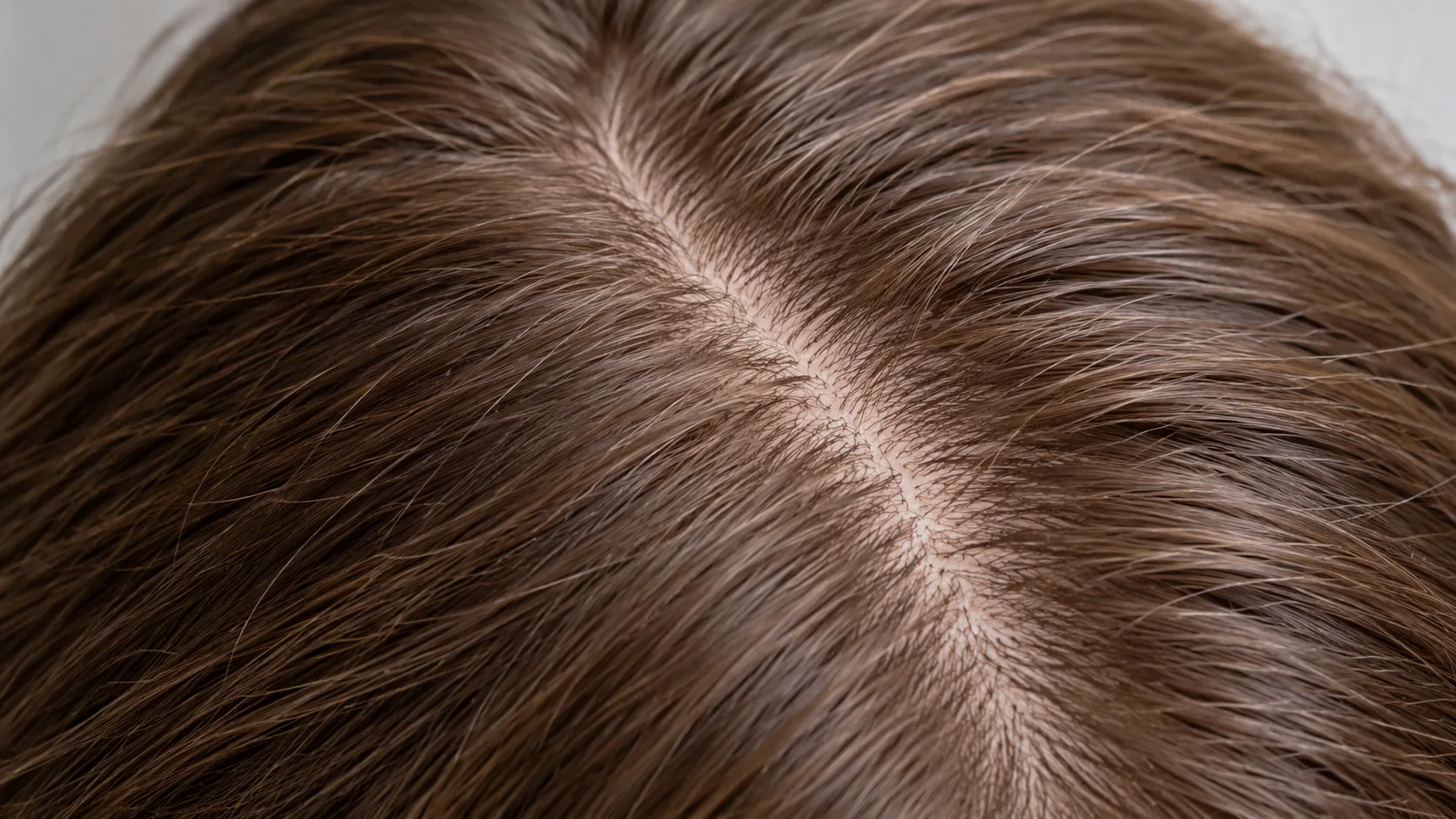
The shaft is the visible dead portion above the skin. The root is the living, growing portion inside the follicle.
Every hair has two anatomical zones. The hair shaft extends above the skin surface and consists entirely of hardened, keratinized cells. The hair root lies below the surface, anchored inside a structure called the follicle (NCBI 2023). The root is the only part that grows. Once cells keratinize and rise into the shaft, they die. This single fact explains why trimming hair does not affect growth and why only follicle health determines whether new hair forms.
What Structures Make Up a Hair Follicle?
The follicle is a mini-organ with sheaths, glands, muscles, and nerves that produces, lubricates, and senses each hair.
The follicle contains specialized regions and supporting structures:
Infundibulum: the funnel-shaped upper section near the skin surface
Isthmus and bulge: the middle zone housing stem cells that regenerate the follicle
Inferior follicle: the lower zone containing the hair bulb and matrix
Outer and inner root sheaths: protective sleeves that guide the growing fiber
Arrector pili muscle: a tiny muscle that makes hair stand upright
Sebaceous gland: produces sebum, the natural oil that lubricates hair and skin
Nerve fibers: wrap the follicle and detect touch
Together these parts coordinate hair production, growth, sensation, and lubrication.
What Happens Inside the Hair Bulb?
The bulb contains the dermal papilla and the hair matrix, where new cells form, keratinize, and receive pigment.
The hair bulb is the enlarged base of the follicle. Inside it, the dermal papilla connects to blood vessels and delivers oxygen and nutrients. Surrounding the papilla, the hair matrix hosts some of the most rapidly dividing cells in the human body (Schneider, Schmidt-Ullrich, and Paus 2009). Matrix cells multiply, move upward, fill with keratin, and harden. Melanocytes inject melanin into these cells during formation. The result is a continuous stream of keratinized cells emerging as the hair shaft.
How Does a New Hair Strand Form?
Matrix cells divide, differentiate, fill with keratin, and push upward as dead, hardened cells that form the visible shaft.
The process follows a clear sequence. Matrix cells near the dermal papilla divide rapidly. As they move upward, they switch on keratin genes, lose their nuclei, and die. Keratinization hardens each cell, and the stacked cells compress into a solid fiber (Bragulla and Homberger 2009). The strand then travels through the follicle canal and emerges through the skin. The visible shaft contains no living cells, no blood supply, and no nerves.
What Determines Hair Color?
Melanocytes produce two pigments, eumelanin and pheomelanin. Their ratio sets every natural hair color.
Melanocytes in the hair bulb manufacture melanin and transfer it into forming hair cells (Schneider, Schmidt-Ullrich, and Paus 2009). Eumelanin produces brown and black shades. Pheomelanin produces red and yellow shades. Black hair holds dense eumelanin; blonde hair holds little of either pigment; red hair holds abundant pheomelanin. With age, melanocytes slow production, pigment fades, and hair appears gray or white. Structural changes inside aging fibers also scatter light, which adds to the silver appearance (Robbins 2012).
Why Is Some Hair Straight While Other Hair Is Curly?
Follicle shape sets the strand's cross-section. Round shafts grow straight; oval or irregular shafts grow curly.
A straight follicle produces a round fiber that grows evenly in every direction. An asymmetrical or curved follicle produces an oval or flattened cross-section, and the uneven growth rate across that shape bends the fiber into a curl (Thibaut et al. 2005). Tightly coiled hair typically shows a strongly flattened cross-section and a curved follicle. This is a structural difference, not a difference in keratin chemistry, which is why the curl pattern forms before the hair ever exits the skin.
What Gives Hair Its Strength and Flexibility?
Keratin bundles cross-linked by disulfide bonds inside the cortex create strength with elasticity. Damage to these bonds reduces both.
The cortex contains keratin filaments embedded in a protein matrix. Disulfide bonds between cysteine units, plus weaker hydrogen and salt bonds, hold this network together (Robbins 2012). Hydrogen bonds break easily with water and heat, which lets hair stretch during styling, then reform when hair dries. Disulfide bonds resist water and provide permanent shape. Bleach and relaxers attack these strong bonds, which explains why chemically treated hair weakens and breaks more easily.
How Do Water, Lipids, and Minerals Affect Hair Structure?
Water controls flexibility, lipids seal the surface and limit moisture loss, and minerals stabilize the fiber.
Water penetrates the cortex and acts as a plasticizer, keeping hair supple. Dry hair absorbs humidity and swells; very wet hair stretches up to 30 percent of its length (Robbins 2012). Lipids form a protective barrier on the cuticle and slow water movement in and out. Sebum from the sebaceous gland spreads along the shaft and reduces friction. Minerals such as calcium, magnesium, and iron bind to keratin and affect texture and stiffness. Hard water leaves mineral deposits that make hair feel rough, which is a chemical cause with a physical result.
What Is the Hair Growth Cycle and How Does Structure Relate to It?
Hair grows in repeating phases: anagen, catagen, telogen, and exogen. The follicle regenerates each new strand after shedding.
The cycle defines whether a follicle produces hair, rests, or releases it.
Phase | Duration | What Happens |
Anagen | 2 to 7 years | Matrix cells divide; the shaft grows about 1 cm per month |
Catagen | 2 to 3 weeks | Follicle shrinks; the hair separates from the dermal papilla |
Telogen | 3 to 4 months | Follicle rests; the old hair stays in place |
Exogen | Days | The old hair sheds; a new anagen hair pushes it out |
Shedding 50 to 100 hairs daily is normal (NCBI 2023). Excessive loss occurs when follicles are damaged or when many hairs enter telogen at once, a pattern seen in telogen effluvium. Structural shaft problems and follicular disorders are different problems, which leads to an important distinction.
Can Damage to a Hair Strand Be Reversed?
No. The shaft is dead tissue and cannot biologically repair itself. Conditioning can only mask damage.
Once keratinized cells harden and die, the body cannot rebuild them. Split ends cannot fuse back together, and broken disulfide bonds in the shaft cannot regenerate (Robbins 2012). Cosmetic conditioners coat the fiber, smooth the cuticle, and improve appearance temporarily. True restoration only happens in the follicle, where new, undamaged hair forms. This is why damage prevention, through gentle handling, heat protection, and chemical moderation, matters more than repair.
How Does Hair Structure Relate to Hair Loss?
Hair loss is a follicle problem, not a shaft problem. Damaged follicles or disrupted cycles reduce new hair production.
A rough, broken shaft affects appearance but not growth. Hair loss begins in the follicle: androgenetic alopecia shrinks follicles over cycles, alopecia areata attacks follicles with immune cells, and telogen effluvium pushes hairs into premature rest (Schneider, Schmidt-Ullrich, and Paus 2009). Evaluating any hair loss requires assessing follicle biology, cycle timing, and scalp health, because only the follicle decides whether the next hair exists.
Frequently Asked Questions About Hair Structure
Is Hair Made Entirely of Keratin?
No. Keratin dominates, but water, lipids, melanin, and minerals share the fiber. Exact composition varies among individuals (Robbins 2012).
Is the Hair Shaft Living Tissue?
No. Shaft cells keratinize and die before they leave the follicle. Only the root and bulb contain living cells.
What Is the Strongest Part of a Hair Strand?
The cortex, because its keratin bundles and disulfide bonds carry the fiber's mechanical load.
Does Every Hair Have a Medulla?
No. Coarse hairs usually have one; fine hairs often lack it.
Where Is Melanin Found in Hair?
Inside cortex cells, deposited by melanocytes in the bulb during formation.
What Makes Hair Curly or Straight?
Follicle shape and shaft cross-section. Oval shafts curl; round shafts stay straight (Thibaut et al. 2005).
Why Does Hair Turn Gray or White?
Melanocytes slow melanin production with age, and structural changes inside the fiber scatter light.
Can Damaged Hair Repair Itself?
No. The shaft cannot regenerate, though the follicle continuously produces new hair.
Does Hair Composition Differ From Person to Person?
Yes. Pigment, lipid content, and mineral levels vary with genetics, age, diet, and environment.
What Part of the Hair Is Responsible for Growth?
The hair matrix in the bulb, fed by the dermal papilla.
Conclusion: How Understanding Hair Structure Explains Hair Health
Hair is a keratinized fiber with a cuticle, cortex, and medulla, produced by a living follicle that cycles through growth and rest.
Hair operates at four levels at once: the chemical level of keratin, water, lipids, pigment, and minerals; the fiber level of cuticle, cortex, and medulla; the follicular level of root, bulb, matrix, and dermal papilla; and the biological level of cell production, keratinization, pigmentation, and the growth cycle. The visible strand is dead and cannot heal, while the hidden follicle determines every future strand. This distinction explains nearly every practical hair question, from why conditioner cannot fix split ends to why hair loss treatment targets the scalp, not the shaft.
References
Bragulla, Hermann H., and Dominique G. Homberger. "Structure and Functions of Keratin Proteins in Simple, Stratified, Keratinized and Cornified Epithelia." Journal of Anatomy, vol. 214, no. 4, 2009, pp. 516–559.
NCBI. "Anatomy, Hair Follicle." StatPearls, National Center for Biotechnology Information, 2023.
Robbins, Clarence R. Chemical and Physical Behavior of Human Hair. 5th ed., Springer, 2012.
Schneider, Marlon R., Ruth Schmidt-Ullrich, and Ralf Paus. "The Hair Follicle as a Dynamic Miniorgan." Current Biology, vol. 19, no. 3, 2009, pp. R132–R142.
Thibaut, Stanislas, et al. "Human Hair Shape Is Programmed from the Bulb." British Journal of Dermatology, vol. 152, no. 4, 2005, pp. 632–638.