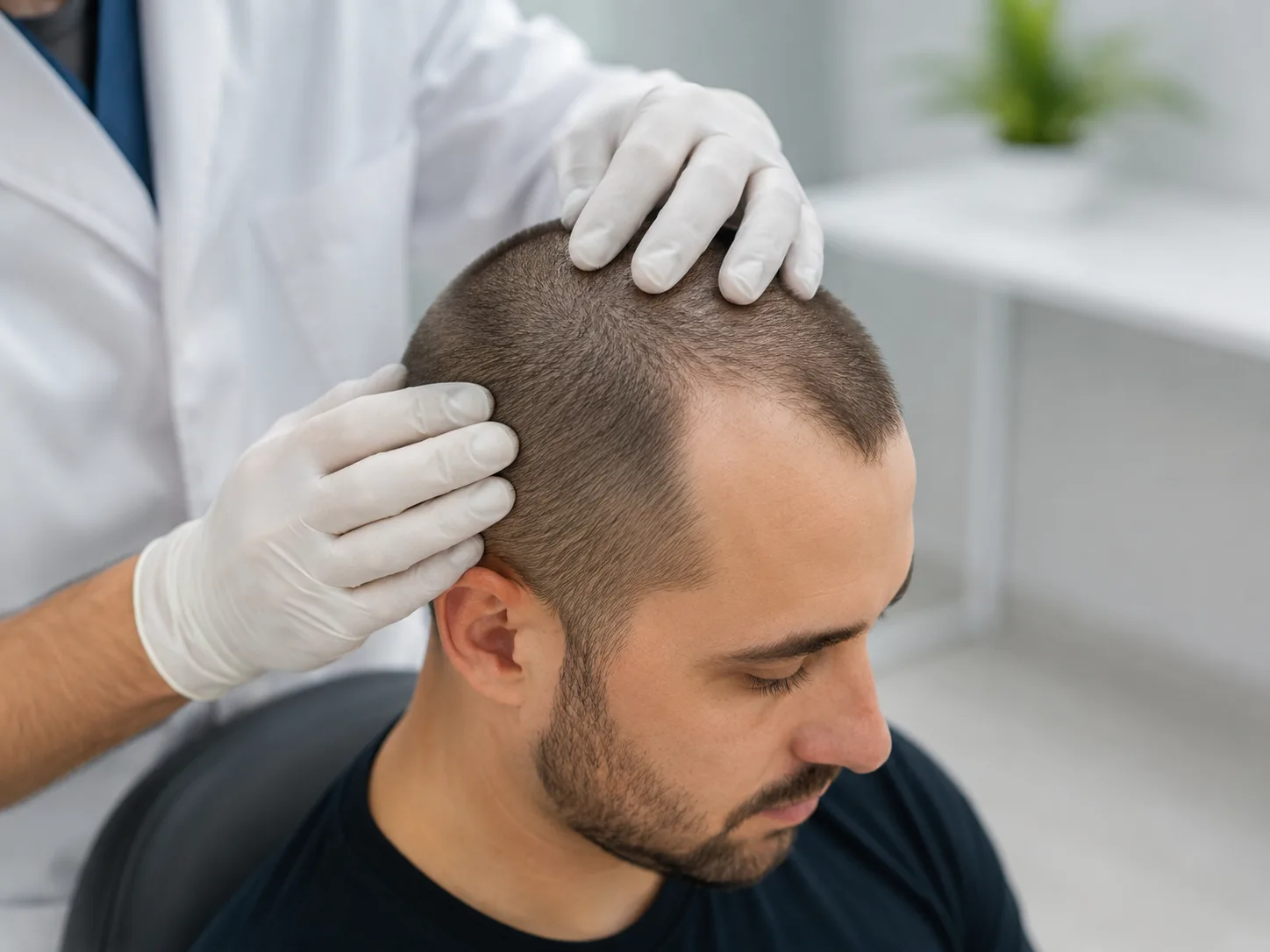
¿Qué es la tecnología de trasplante capilar con micromotor?
Un trasplante capilar con micromotor utiliza un pequeño motor portátil para ayudar a los cirujanos a extraer los folículos capilares durante Extracción de Unidades Foliculares. Este dispositivo motorizado hace girar un pequeño punzón alrededor de cada unidad folicular. El cirujano guía cada movimiento. El motor solo asiste en la extracción. No realiza todo el trasplante por sí solo.
La tecnología de trasplante capilar con micromotor representa un avance importante en la restauración capilar moderna. Los cirujanos han utilizado la Extracción de Unidades Foliculares, o FUE, desde principios de la década de 2000. Rassman y sus colegas introdujeron FUE como una alternativa mínimamente invasiva a la cirugía de tira en 2002 (Rassman et al. 2002). Los primeros cirujanos extrajeron cada injerto a mano. Rotaban un punzón manual para cortar alrededor de cada unidad folicular. Este proceso funcionó bien pero tomó muchas horas. Pronto, los cirujanos buscaron maneras de acelerar la extracción sin dañar los injertos. El micromotor surgió como una respuesta. Este dispositivo conecta un pequeño punzón giratorio a una pieza de mano eléctrica. El motor hace girar el punzón a velocidades controladas. El cirujano sigue decidiendo dónde colocar el punzón, qué tan profundo ir y cuándo detenerse. El micromotor simplemente hace la rotación más rápida y consistente.
Varios factores determinan el éxito de esta tecnología. El diseño del punzón es importante. La velocidad de rotación es importante. El cirujano debe seguir el ángulo natural de cada cabello. El control de la profundidad previene daños. El conocimiento de la anatomía del folículo guía cada decisión. Ningún dispositivo reemplaza estas habilidades. El micromotor ayuda al cirujano. No reemplaza al cirujano.
¿Qué es un micromotor en el trasplante capilar?
Un micromotor en el trasplante capilar es un pequeño motor eléctrico que hace girar un punzón cilíndrico. El cirujano sostiene este dispositivo como si fuera un bolígrafo. El motor se encuentra dentro de una pieza de mano. Un delgado punzón de metal se atornilla en la punta. El cirujano presiona un pedal o botón para iniciar la rotación. El punzón gira alrededor de una unidad folicular. Este movimiento corta la piel y libera el injerto.
Las partes principales incluyen la pieza de mano, el motor, el punzón, un control de velocidad y un mecanismo de rotación u oscilación. La pieza de mano se adapta cómodamente a los dedos del cirujano. El motor proporciona un par constante. El punzón viene en diferentes diámetros, generalmente entre 0.7 mm y 1.2 mm. Los controles de velocidad permiten al cirujano ajustar la velocidad de rotación del punzón. Algunos dispositivos giran completamente en un círculo. Otros oscilan hacia adelante y hacia atrás a través de un arco corto.
Este dispositivo difiere de un punzón manual. Un punzón manual no tiene motor. El cirujano lo gira entre los dedos. Esto toma más tiempo y más movimiento de muñeca. El micromotor automatiza la rotación. El cirujano aún empuja el punzón en la piel. El cirujano aún controla el ángulo y la profundidad. El dispositivo no se mueve por sí mismo. El cirujano dirige cada acción.
Las fuentes clínicas describen la FUE con micromotor como un sistema motorizado portátil. Este sistema asiste al cirujano en la separación de las unidades foliculares del tejido circundante (Ors et al. 2015). El motor realiza la rotación. El cirujano hace el pensamiento.
¿Es un micromotor lo mismo que un motor FUE?
Sí. Estos términos significan lo mismo. Los cirujanos y clínicas utilizan las palabras micromotor, motor FUE y FUE motorizado indistintamente. Todos describen un dispositivo portátil con un punzón motorizado. Algunos fabricantes llaman a su dispositivo micromotor. Otros lo llaman motor FUE. La tecnología subyacente sigue siendo similar.
Sin embargo, el dispositivo difiere del procedimiento general de FUE. FUE se refiere a todo el método de extracción de unidades foliculares individuales. El micromotor es solo una herramienta dentro de ese método. Un cirujano puede realizar FUE con un punzón manual, un punzón motorizado o un sistema robótico. El micromotor no define FUE. Solo asiste en un paso.
¿Es el FUE con micromotor lo mismo que la trasplantación de cabello robótica?
No. Estos son diferentes niveles de tecnología.FUE Manualutiliza rotación manual. FUE con micromotor utiliza un punzón motorizado de mano. FUE robótico utiliza un brazo robótico guiado por computadora. El robot identifica los folículos con cámaras. Calcula los ángulos automáticamente. Mueve el punzón sin guía manual directa.
En el FUE con micromotor, el cirujano sostiene el dispositivo. El cirujano apunta el punzón. El cirujano controla la profundidad. La mano humana nunca deja la herramienta. Los sistemas robóticos reducen algunas variables humanas. Pero también cuestan más y requieren configuraciones específicas. El FUE con micromotor mantiene al cirujano en control directo. Aporta velocidad sin aumentar la automatización. El grado de control humano permanece alto.
¿Cómo funciona la tecnología de trasplante de cabello con micromotor?
El FUE con micromotor sigue una secuencia clara. El cirujano evalúa primero el área donante. Luego, el equipo aplica anestesia. El cirujano selecciona el punzón adecuado. El motor extrae los injertos. Los técnicos retiran y manipulan cada unidad. Finalmente, el equipo prepara e implanta los injertos. El micromotor solo asiste en el paso cuatro. El resto del proceso permanece sin cambios.
Paso 1: Evaluación del área donante
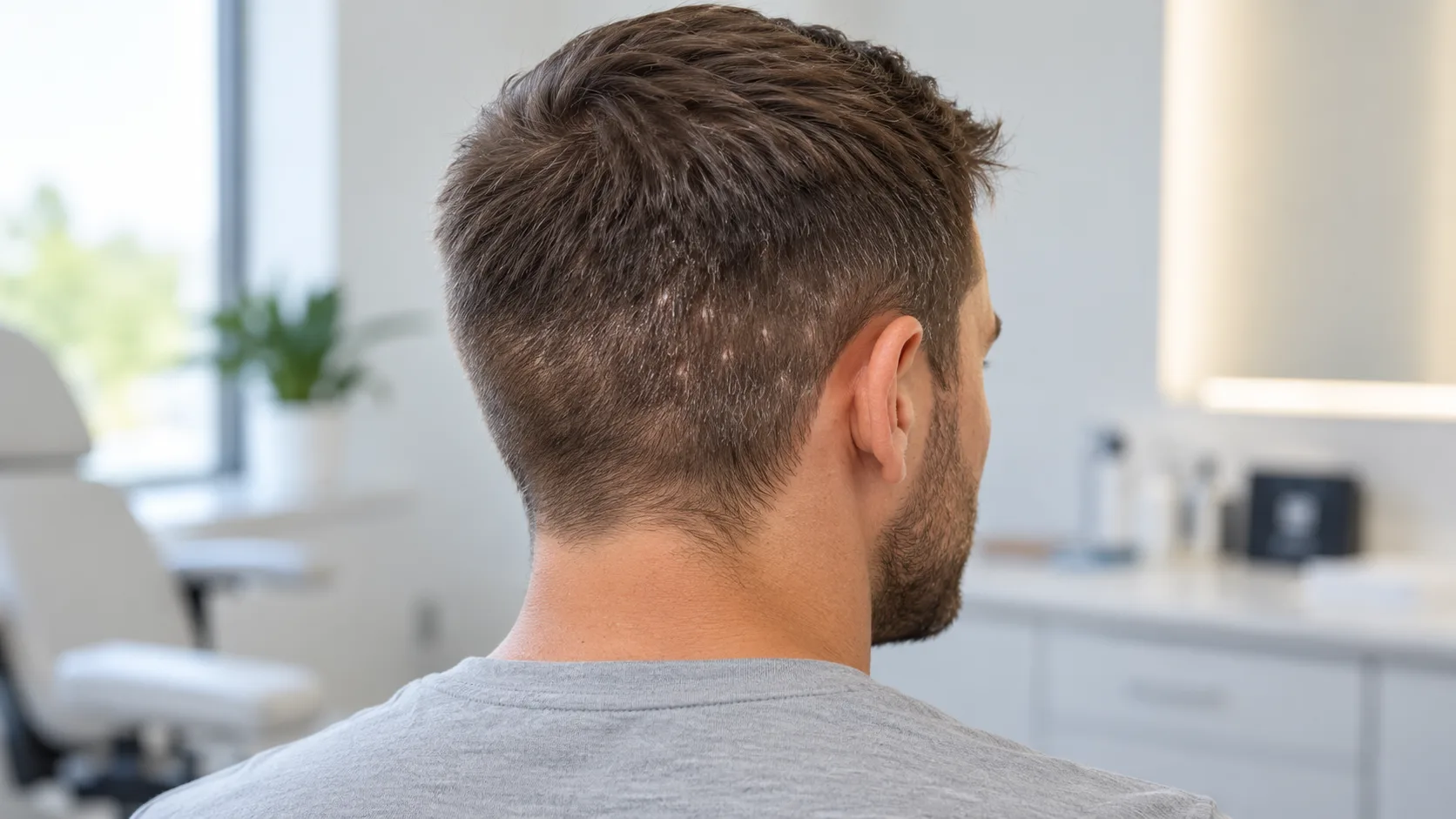
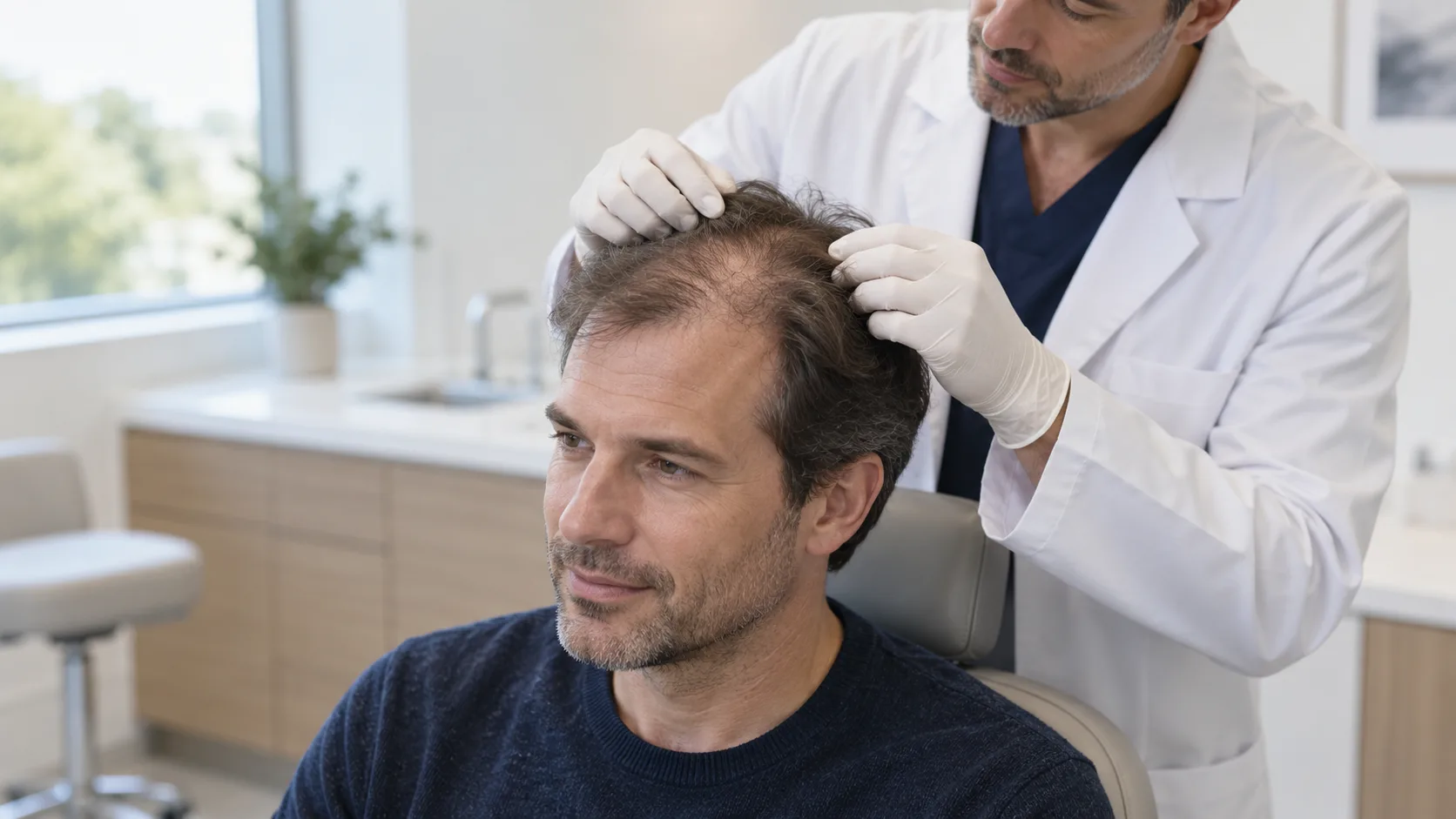
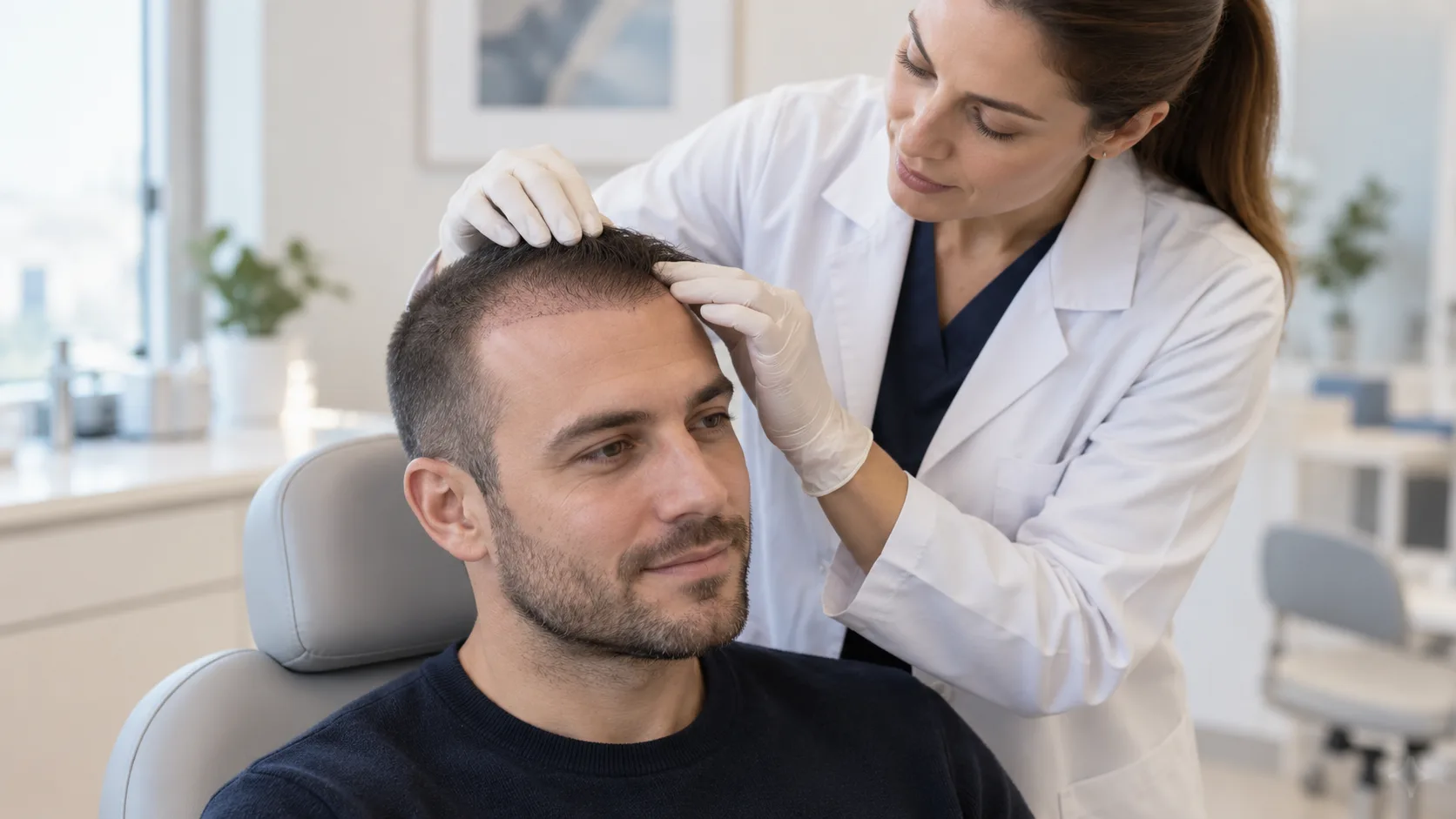
El cirujano evalúa el área donante antes de tocar cualquier dispositivo. El cirujano cuenta la densidad del cabello. El cirujano mapea la distribución folicular. El cirujano nota la dirección y el ángulo de crecimiento del cabello. El cirujano identifica la zona segura del donante. Esta zona generalmente se encuentra en la parte posterior y los lados del cuero cabelludo. El cabello en esta área resiste las hormonas de la calvicie.
El cirujano también decide el tamaño del punzón y los parámetros de extracción durante este paso. El cabello grueso puede necesitar un punzón más grande. El cabello fino puede necesitar uno más pequeño. El cabello rizado puede necesitar atención especial. El cirujano estudia cada detalle antes de comenzar el motor.
Paso 2: Anestesia Local
El equipo médico inyecta anestesia local en el área donante. Esto adormece el cuero cabelludo. El paciente permanece despierto durante el procedimiento. El equipo también puede administrar sedantes suaves. El paciente siente presión pero no dolor. La anestesia local permite que el cirujano trabaje durante muchas horas. El paciente puede hablar, escuchar música o descansar durante la sesión.
Paso 3: Selección del Punzón
El diámetro y el diseño del punzón afectan directamente los resultados. Un punzón que es demasiado grande elimina piel adicional. Esto crea heridas más grandes. Un punzón que es demasiado pequeño puede cortar el folículo. Esto causa transección. El cirujano elige el tamaño del punzón basado en varios factores.
El calibre del cabello importa. Los tallos gruesos necesitan más espacio. Las características de la unidad folicular son importantes. Algunos pacientes tienen grupos de dos o tres cabellos. Otros tienen principalmente cabellos individuales. Las características de la piel son relevantes. La piel grasa o la piel suelta se comportan de manera diferente. El ángulo del cabello también importa. Los ángulos agudos necesitan alineación cuidadosa. El cirujano también considera la preferencia personal y la experiencia. Cole analizó cómo la mecánica del punzón afecta el corte de tejido y el movimiento de los folículos en 2013 (Cole 2013). Su trabajo muestra que la agudeza y el diámetro cambian las fuerzas en cada injerto.
Paso 4: Extracción de Unidades Foliculares Asistida por Motor
El cirujano coloca el punzón sobre la unidad folicular. El cirujano enciende el motor. El punzón rota u oscila. Entra en el cuero cabelludo alrededor del injerto. El movimiento controlado separa la unidad folicular del tejido circundante. El cirujano sigue la trayectoria natural del folículo. Esto significa que el punzón se inclina para coincidir con el ángulo del cabello bajo la piel.
El motor mantiene la rotación constante. El cirujano avanza el punzón a la profundidad correcta. Esta profundidad generalmente alcanza debajo de los puntos de anclaje del músculo arrector pili. Una vez que el punzón libera el injerto, el cirujano detiene el motor. El injerto queda suelto en la piel pero permanece en su lugar.
Paso 5: Extracción y Manipulación del Injerto
El cirujano o técnico retira el injerto con pinzas finas. Un suave tirón levanta la unidad folicular. El equipo debe minimizar el trauma. Evitan apretar el bulbo. Protegen las glándulas sebáceas. Mantienen el injerto húmedo.
El tiempo fuera del cuerpo es muy importante. Parsley y Perez-Meza revisaron los factores de supervivencia del injerto en 2010 (Parsley y Perez-Meza 2010). Descubrieron que los injertos pierden viabilidad con el tiempo fuera del cuero cabelludo. Los equipos colocan los injertos extraídos en una solución de almacenamiento refrigerada inmediatamente. Esto preserva los folículos hasta la implantación.
Paso 6: Preparación e Implantación del Injerto
La tecnología de micromotor solo ayuda con la extracción. La preparación del injerto se realiza por separado. Los técnicos recortan el tejido en exceso bajo microscopios. Cuentan los cabellos por injerto. Clasifican los injertos por tamaño.
La implantación requiere herramientas separadas. El cirujano hace pequeñas incisiones en el área receptora. El cirujano coloca cada injerto en una incisión. El ángulo, la dirección y la distribución determinan cuán natural se ve el resultado. Un injerto colocado en el ángulo incorrecto crecerá en la dirección equivocada. Un empaquetado denso crea plenitud. Una colocación dispersa se ve escasa. La fase de implantación requiere tanta habilidad como la fase de extracción.
¿Cuál es el rol de la velocidad y la rotación en el FUE con micromotor?
La velocidad y la rotación controlan las fuerzas mecánicas en cada injerto. La velocidad de rotación ajustable permite al cirujano adaptar el dispositivo al tejido. Algunos dispositivos rotan continuamente. Otros oscilan a través de un arco corto. La oscilación significa que el punzón se desplaza en un círculo parcial y luego se invierte. Este movimiento de adelante hacia atrás puede reducir la torsión del injerto.
Una velocidad excesiva aumenta el trauma mecánico. Una rotación rápida genera más calor. También aumenta el riesgo de cortar folículos. Un control insuficiente provoca problemas similares. El punzón puede deslizarse por la piel. Puede entrar en el ángulo incorrecto. El cirujano debe ajustar la configuración a la anatomía folicular individual.
Una extracción más rápida no significa automáticamente mejores resultados. Un cirujano apresurado puede dañar más injertos. Un cirujano cauteloso con velocidad moderada puede salvar más folículos. El motor proporciona la rotación. El cirujano proporciona el juicio.
¿Por qué es importante el ángulo del punzón?
El punzón debe seguir la dirección natural del folículo. El cabello sale del cuero cabelludo en un ángulo. Bajo la piel, el folículo continúa en ese ángulo o se curva. El punzón debe alinearse con este camino. Si el punzón entra recto mientras el folículo se inclina hacia un lado, el punzón puede cortar el folículo.
Una angulación incorrecta daña los folículos. El borde afilado corta a través del tallo o bulbo del cabello. Esta lesión mata el injerto. Folículos curvados o impredecibles necesitan atención extra. Algunos pacientes tienen cabello que se curva bajo la piel. El cirujano debe anticipar esta curva. El micromotor hace girar el punzón, pero el cirujano lo apunta.
¿Qué es la transección folicular?
La transección folicular significa cortar a través de un folículo piloso durante la extracción. Un injerto transectado puede no sobrevivir. El bulbo proporciona crecimiento. Si el punzón corta el bulbo, el folículo muere. Incluso la transección parcial debilita el injerto.
Varios factores aumentan el riesgo de transección. Un ángulo incorrecto empuja el folículo hacia el borde del punzón. Una profundidad excesiva corta por debajo del bulbo. Un tamaño de punzón inapropiado aprieta o corta el injerto. Una velocidad excesiva genera cortes incontrolados. La falta de experiencia del operador conduce a decisiones incorrectas. Sharma y colegas discutieron cómo la transección sigue siendo una gran desventaja del FUE en comparación con la cirugía por tiras (Sharma et al. 2019). Minimizar la transección protege cada injerto.
¿Cuáles son las ventajas de la tecnología de trasplante capilar con micromotor?
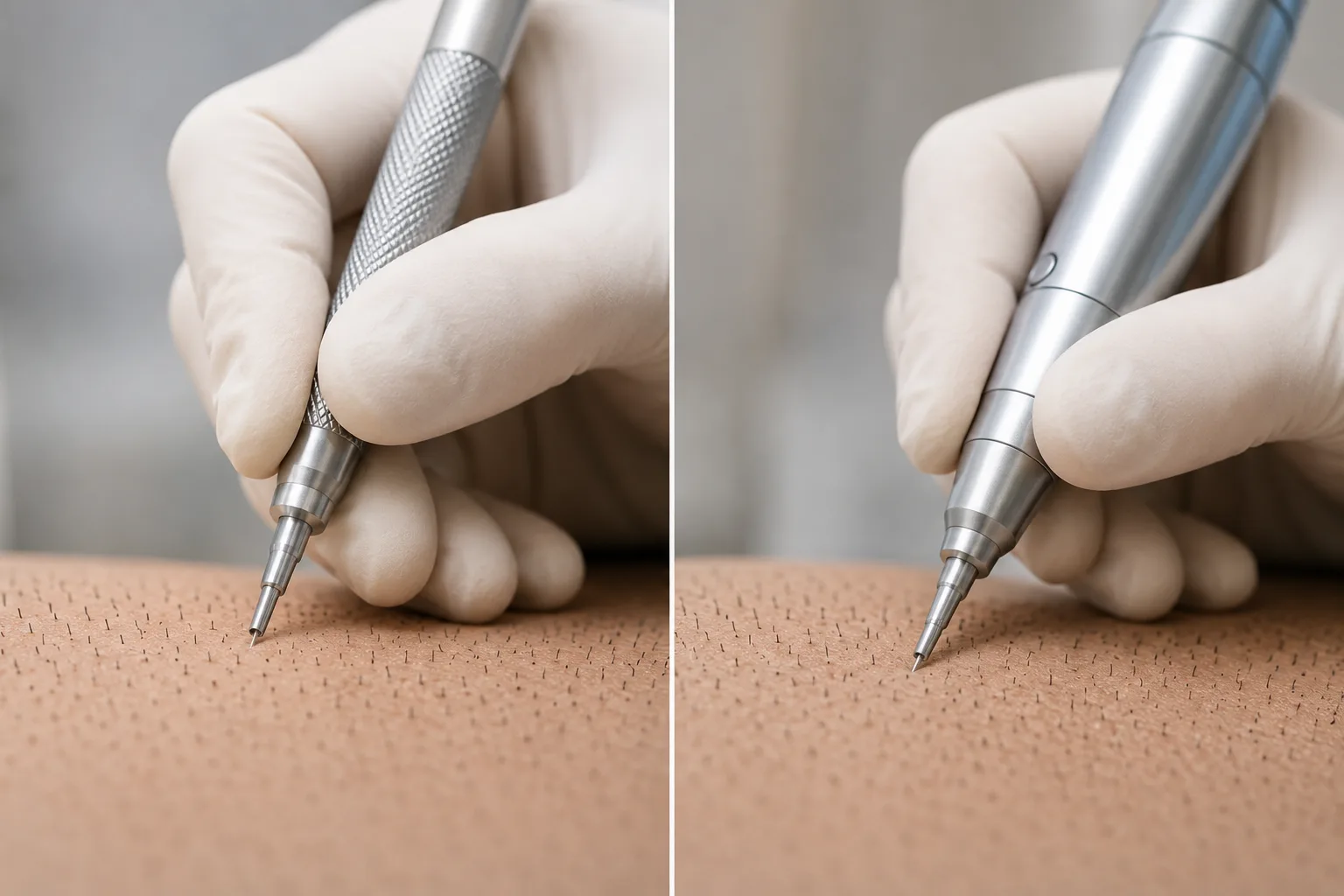
El FUE con micromotor ofrece varias ventajas prácticas. Acelera la extracción. Permite sesiones más grandes. Reduce la fatiga del cirujano. Proporciona un movimiento consistente. Puede acortar el tiempo fuera del cuerpo del injerto. Estas ventajas benefician tanto al equipo quirúrgico como al paciente.
Extracción más rápida del injerto
La rotación motorizada aumenta la eficiencia de extracción. El motor hace girar el punzón suavemente. El cirujano no necesita detenerse a girar la muñeca repetidamente. Esto ahorra segundos por injerto. A lo largo de miles de injertos, esos segundos se suman a horas.
Ors y colegas informaron su experiencia de ocho años con el FUE con micromotor en 2015 (Ors et al. 2015). Trataron a 1,000 pacientes entre 2005 y 2014. La cosecha manual con punzón sirvió a 32 pacientes. La cosecha con micromotor atendió a 968 pacientes. Durante la extracción manual, el equipo trasplantó de 1,000 a 2,000 injertos en 6 a 8 horas. Después de cambiar al micromotor, el recuento promedio de injertos aumentó a aproximadamente 2,500. El tiempo de operación se mantuvo similar. El motor ayudó al equipo a cosechar más injertos en el mismo período.
Capacidad Superior de Extracción de Greft
La extracción motorizada facilita un mayor número de grefts. Algunos pacientes necesitan 3,000 o más grefts. La extracción manual puede requerir dos días. La extracción con micromotor a menudo se completa en un día. Esta eficiencia es importante para los pacientes con pérdida de cabello extensa. También es relevante para pacientes que viajan para la cirugía y tienen tiempo limitado.
Reducción del Movimiento Manual Repetitivo
La ventaja ergonómica beneficia al equipo quirúrgico. La FUE manual requiere miles de rotaciones de la muñeca. Esto causa fatiga. La fatiga lleva a errores. El micromotor automatiza la rotación. El cirujano mueve el mango en lugar de torcer la muñeca. Esto reduce la tensión repetitiva. El equipo se mantiene más alerta durante sesiones más largas.
Movimiento Motorizado Consistente
El motor proporciona un movimiento rotacional u oscilatorio constante. Las manos humanas varían. Algunas rotaciones son rápidas. Algunas son lentas. El motor mantiene una velocidad fija. Esta consistencia ayuda cuando el cirujano encuentra la configuración adecuada. Sin embargo, la consistencia depende de la configuración correcta del dispositivo. También depende de la técnica adecuada del operador. El motor no garantiza perfection. Solo ofrece movimiento uniforme.
Potencial Reducción en el Tiempo de Exposición de los Grefts Fuera del Cuerpo
La extracción más rápida puede reducir el tiempo que los grefts pasan fuera del cuero cabelludo. El equipo extrae los grefts más rápidamente. Los implantan más rápidamente. Esto acorta la ventana de vulnerabilidad. Los grefts sobreviven mejor cuando regresan a la irrigación sanguínea rápidamente. Sin embargo, la supervivencia de los grefts depende de muchos factores. La solución de almacenamiento es importante. La temperatura importa. El manejo cuenta. La velocidad de extracción por sí sola no salva los grefts. Solo crea una oportunidad para un mejor flujo de trabajo.
¿Cuáles son las Desventajas y Riesgos de la FUE con Micromotor?
La FUE con micromotor conlleva riesgos reales. El uso inapropiado daña los folículos. El trauma mecánico afecta el área donante. El calor y la fricción amenazan el tejido. La habilidad del operador sigue siendo esencial. No todos los pacientes se adecuan al mismo enfoque.
Riesgo de Transsección Folicular
El uso inapropiado del micromotor puede aumentar la transsección. La alta velocidad corta agresivamente. Un ángulo incorrecto empuja los folículos hacia la cuchilla. El mal control de profundidad secciona los bulbos. El motor amplifica los errores. Un punch manual se mueve lentamente. Un punch motorizado se mueve rápido. Los errores rápidos causan más daño. El cirujano debe respetar el dispositivo.
Trauma Mecánico en el Área Donante
El movimiento descontrolado del punch traumatiza el tejido. El punch puede desviarse. Puede perforar demasiado profundo. Puede remover demasiado piel. La extracción controlada previene esto. El cirujano debe estabilizar el mango. El cirujano debe avanzar el punch suavemente. Una técnica violenta crea heridas más amplias. Las heridas más amplias sanan con marcas más visibles.
Calor y Fricción
La actividad mecánica excesiva genera calor. La fricción entre el punch y la piel calienta el tejido. El calor daña los folículos. También irrita el cuero cabelludo circundante. Las configuraciones apropiadas del dispositivo previenen esto. Las velocidades más bajas reducen la fricción. Una lubricación adecuada ayuda. El cirujano debe detenerse si el dispositivo se calienta. La técnica es más importante que la velocidad.
Dependencia de la Habilidad del Operador
El micromotor no reemplaza la experiencia quirúrgica. Un novato con un motor rinde peor que un experto con un punch manual. El dispositivo añade variables. El cirujano debe comprender la anatomía del cuero cabelludo. El cirujano debe leer la orientación folicular. El cirujano debe ajustar la velocidad en tiempo real. El conocimiento de la anatomía del folículo capilar guía cada decisión. La tecnología asiste. No educa.
No Es Apropiado para Todos los Pacientes de la Misma Manera
Las diferencias individuales afectan la idoneidad. El cabello rizado se curva bajo la piel. El punch de micromotor puede no seguir esta curva con facilidad. El cabello fino tiene folículos frágiles. La rotación rápida puede transsectarlos. La alta angulación folicular dificulta la alineación. Las áreas donantes cicatrizadas cambian el comportamiento del tejido. La baja densidad donante deja poco margen de error. Procedimientos previos de trasplante de cabello pueden haber alterado el cuero cabelludo. El cirujano debe evaluar a cada paciente de manera individual. El micromotor sirve bien a muchos pacientes. No sirve a todos los pacientes de igual manera.
Micromotor FUE vs FUE Manual
Ambas técnicas extraen unidades foliculares. Ambas requieren habilidad. Ambas pueden producir excelentes resultados. Las diferencias radican en la velocidad, el control y la demanda física. Ninguna técnica se demuestra universalmente superior. La investigación apoya el FUE asistido por micromotor como un enfoque eficiente de recolección. Los resultados aún dependen en gran medida de la técnica y la experiencia del operador (Ors et al. 2015).
Parámetro | FUE Manual | FUE Micromotor |
Mecanismo de extracción | Punch controlado a mano | Punch asistido por motor |
Velocidad de extracción | Generalmente más lento | Generalmente más rápido |
Control del cirujano | Alto control táctil | Alto control visual y posicional con movimiento motorizado |
Grandes sesiones de injertos | Más que requiere tiempo | Potencialmente más eficiente |
Fatiga del operador | Potencialmente más alta | Potencialmente más baja |
Riesgo de transección | Depende de la técnica | Depende fuertemente de la velocidad, ángulo, profundidad y experiencia |
Manejo del injerto | Manual | Manual después de la extracción |
Automatización | No | No; el cirujano permanece en control |
La FUE manual proporciona al cirujano retroalimentación táctil directa. Los dedos sienten el tejido. La muñeca se ajusta instantáneamente. Esto ayuda con ángulos difíciles. La FUE con micromotor proporciona una rotación constante. El ojo guía la pieza de mano. El pie controla la velocidad. Cada método tiene sus fortalezas. Los mejores cirujanos a menudo dominan ambos. Cambian según el paciente y la zona.
¿Qué dice la evidencia científica sobre la FUE con micromotor?
Los estudios científicos respaldan la seguridad y eficiencia de la FUE con micromotor. Sin embargo, los investigadores enfatizan que el cirujano sigue siendo la variable más importante. Los dispositivos ayudan. No garantizan el éxito.
Experiencia clínica de ocho años con FUE con micromotor
Ors y colegas publicaron un estudio pionero en Aesthetic Plastic Surgery en 2015 (Ors et al. 2015). Revisaron 1,000 pacientes de FUE tratados entre 2005 y 2014. Treinta y dos pacientes recibieron extracción manual con punch. Novecientos sesenta y ocho pacientes recibieron extracción con micromotor. El estudio informó que el uso de micromotor permitió aproximadamente 2,500 injertos por sesión, manteniendo un tiempo de operación similar en comparación con las sesiones manuales anteriores. La toma de injertos fue difícil en el 11.1 por ciento de los pacientes, fácil en el 52.2 por ciento y muy fácil en el 36.7 por ciento.
Esta evidencia muestra mejoras en la eficiencia. No prueba que la FUE con micromotor produzca un mejor crecimiento del cabello. El estudio no aleatorizó a los pacientes. No comparó la densidad a largo plazo entre grupos. Simplemente documentó la experiencia del mundo real en una práctica de alto volumen. Los datos sugieren que los cirujanos capacitados pueden extraer más injertos de manera segura con un micromotor.
¿Cuáles son las medidas de resultado más importantes?
Los investigadores hacen un seguimiento de varias métricas clave. La supervivencia de injertos encabeza la lista. Esto mide cuántos folículos trasplantados realmente crecen cabello. La tasa de transección folicular sigue cuántos folículos se dañan durante la extracción. El trauma en el sitio donante mide el tamaño de la herida y la curación. La integridad del injerto evalúa si la unidad extraída permanece completa. La duración del procedimiento registra cuánto tiempo dura la cirugía. El número de injertos cosechados cuenta el rendimiento total. La recuperación del paciente rastrea el tiempo de inactividad y el confort. La densidad capilar a largo plazo evalúa el resultado estético final.
Li y colegas estudiaron megas sesiones de FUE para alopecia androgénetica severa en 2020 (Li et al. 2020). Encontraron que la FUE logró resultados satisfactorios con tasas de supervivencia de folículos capilares superiores al 90 por ciento a uno o dos años. Esto confirma que una FUE bien ejecutada, ya sea manual o motorizada, produce resultados duraderos.
¿Por qué no se debe considerar la tecnología de dispositivos de forma aislada?
Un dispositivo es solo un componente de la FUE. La capacitación del cirujano es más importante. La evaluación del donante guía la extracción segura. La selección del punch afecta el tamaño de la herida. La técnica de extracción determina las tasas de transección. El almacenamiento del injerto preserva la viabilidad. La técnica de implantación crea el aspecto final. El cuidado postoperatorio protege el resultado.
Jimenez-Acosta y Ruifernandez actualizaron la literatura sobre FUE en 2018 (Jimenez-Acosta y Ruifernandez 2018). Enfatizaron que los avances tecnológicos ayudan. Pero los fundamentos quirúrgicos permanecen sin cambios. El cirujano debe entender cada paso. Ningún motor enseña anatomía. Ningún motor diseña una línea de cabello.
¿Puede la tecnología de micromotores mejorar los resultados del implante capilar?
La tecnología de micromotores mejora la eficiencia técnica. No mejora automáticamente los resultados clínicos. La extracción más rápida no garantiza un cabello más denso. No garantiza una apariencia más natural. Los resultados naturales dependen de otros factores.
El diseño de la línea de cabello requiere visión artística. La selección de injertos combina el tipo de cabello con la zona adecuada. La supervivencia del injerto depende del manejo y almacenamiento. El ángulo de implantación debe imitar el crecimiento natural. La dirección del cabello debe fluir correctamente. La gestión del donante preserva los injertos futuros. El cirujano controla todas estas variables. El micromotor solo hace girar el punch.
Un cirujano calificado con un punch manual a menudo supera a un novato con un motor. Los pacientes deben evaluar primero al cirujano. Deben preguntar sobre la capacitación. Deben preguntar sobre la experiencia. El dispositivo cumple un papel de apoyo.
¿Quién puede beneficiarse de la extracción capilar con micromotor?
Varios grupos de pacientes son adecuados para el FUE con micromotor. Los pacientes que necesitan un gran número de injertos se benefician de una cosecha más rápida. Los pacientes que eligen FUE sobre la cirugía en tira obtienen una opción mínimamente invasiva. Los pacientes con suministro de donante adecuado proporcionan suficientes injertos para sesiones eficientes. Los pacientes que desean tiempos de recuperación cortos aprecian las pequeñas heridas por punción. Los pacientes que necesitan una cosecha eficiente durante una gran sesión ahorran tiempo y costos de viaje.
¿Cuándo podría considerarse la FUE manual?
La FUE manual funciona mejor en algunas situaciones. Las áreas de extracción pequeñas o altamente precisas necesitan un control cuidadoso. Los ángulos foliculares difíciles pueden responder mejor a la retroalimentación táctil. Injertos particularmente delicados necesitan una rotación manual suave. Los casos en los que la retroalimentación táctil ayuda al cirujano pueden favorecer la extracción manual.
Esta no es una regla absoluta. La selección de la técnica debe seguir siendo individualizada. Algunos cirujanos expertos utilizan micromotores para cada caso. Otros cambian a punches manuales para zonas específicas. El paciente debe confiar en el juicio del cirujano.
¿Es segura la tecnología de trasplante capilar con micromotor?
Sí. La FUE con micromotor puede ser segura cuando profesionales médicos capacitados la realizan correctamente. La seguridad depende de la técnica adecuada. El cirujano debe seleccionar el tamaño de punch correcto. El cirujano debe establecer la velocidad del motor apropiada. El cirujano debe controlar la profundidad con precisión. El cirujano debe alinear el punch con la dirección folicular. El equipo debe mantener técnica estéril. Deben manejar los injertos con cuidado. Deben preservar el área donante.
Una técnica deficiente causa complicaciones. La transección desperdicia injertos. La sobreexplotación agota el área donante. El trauma tisular excesivo retrasa la curación. La baja supervivencia del injerto produce resultados delgados. La apariencia desigual del donante crea problemas estéticos. Estos riesgos existen con cualquier método FUE. Aumentan cuando el cirujano carece de experiencia.
Cómo elegir una clínica que utilice FUE con micromotor
Los pacientes deben hacer preguntas específicas antes de elegir una clínica. Las respuestas revelan si el equipo entiende la tecnología.
Preguntas para hacer al cirujano
¿Quién realiza la extracción? El cirujano debe extraer los injertos personalmente o supervisar de cerca. ¿Quién controla el micromotor? El cirujano debe operar el dispositivo, no un asistente no capacitado. ¿Qué tamaños de punch utiliza el equipo? La clínica debe variar el tamaño del punch según el paciente. ¿Cómo selecciona el equipo la velocidad de rotación? El cirujano debe ajustar la velocidad según el tipo de cabello y las características de la piel. ¿Cómo evalúa el equipo la dirección folicular? El cirujano debe examinar cuidadosamente el área donante antes de comenzar. ¿Cómo protege el equipo el área donante de la sobreexplotación? La clínica debe planificar patrones de extracción que preserven la densidad. ¿Cómo almacena el equipo los injertos extraídos? Los injertos deben colocarse en una solución refrigerada de inmediato. ¿Cómo monitorea el equipo la supervivencia y transección de injertos? La clínica debe rastrear estas métricas y compartirlas.
Por qué el cirujano importa más que el dispositivo
La tecnología sofisticada no puede compensar una técnica quirúrgica deficiente. Los pacientes deben evaluar primero las calificaciones médicas. Deben preguntar sobre la experiencia en FUE. Deben revisar la documentación de antes y después. Deben preguntar sobre la estrategia de manejo del donante. Deben entender el protocolo quirúrgico. Deben exigir una planificación de tratamiento específica para el paciente.
Un gran cirujano con equipo básico supera a un equipo promedio con un cirujano promedio. El micromotor es una herramienta. El cirujano es el artesano. Los pacientes deben invertir su investigación en la persona que sostiene el dispositivo.
Tecnología de Trasplante Capilar con Micromotor: Principales Conclusiones
Un micromotor es un dispositivo manual alimentado. Los cirujanos lo utilizan principalmente durante la extracción folicular FUE. Puede hacer que la recolección de injertos sea más rápida y eficiente. Puede ayudar durante sesiones FUE más grandes. El dispositivo no realiza el trasplante de manera independiente. La velocidad, profundidad o angulación incorrectas pueden aumentar el trauma folicular. La supervivencia del injerto y los resultados naturales dependen del proceso quirúrgico completo. El dispositivo por sí solo no puede generar un buen resultado. La experiencia del cirujano sigue siendo un factor crítico para una FUE micromotor segura y efectiva.
Preguntas Frecuentes Sobre la Tecnología de Trasplante Capilar con Micromotor
¿Qué es la tecnología de trasplante capilar con micromotor?
La tecnología de trasplante capilar con micromotor utiliza un pequeño motor eléctrico para rotar un punch durante la FUE. El punch corta alrededor de cada unidad folicular. El cirujano guía el dispositivo a mano.
¿Es mejor la FUE con micromotor que la FUE manual?
Ninguna técnica es universalmente mejor. La FUE con micromotor extrae injertos más rápido. La FUE manual ofrece más control táctil. Ambas logran excelentes resultados en manos expertas.
¿Cómo funciona un micromotor en la FUE?
El micromotor hace girar un punch cilíndrico a velocidad ajustable. El punch entra en el cuero cabelludo alrededor de la unidad folicular. La rotación separa el injerto del tejido circundante.
¿Un micromotor daña los folículos capilares?
Un micromotor puede dañar los folículos si el cirujano utiliza configuraciones incorrectas. La velocidad, el ángulo y la profundidad adecuados protegen los injertos. La habilidad previene daños.
¿La FUE con micromotor aumenta la cantidad de injertos que se pueden recolectar?
Sí. Los estudios muestran que la FUE con micromotor permite un mayor número de injertos por sesión. Ors y colegas informaron promedios alrededor de 2,500 injertos con el uso de micromotor en comparación con 1,000 a 2,000 con la extracción manual (Ors et al. 2015).
¿Cuál es la diferencia entre la FUE con micromotor y la FUE manual?
La FUE con micromotor utiliza un punch motorizado. La FUE manual utiliza rotación manual. El micromotor aporta velocidad y consistencia. La FUE manual añade retroalimentación táctil.
¿Es la FUE con micromotor lo mismo que el trasplante capilar robótico?
No. La FUE con micromotor utiliza un dispositivo manual controlado por el cirujano. La FUE robótica utiliza un brazo guiado por computadora. El robot automatiza la identificación y extracción.
¿Cuánto tiempo toma la FUE con micromotor?
El tiempo del procedimiento varía según la cantidad de injertos. Una sesión de 2,000 a 2,500 injertos típicamente toma de 6 a 8 horas. Las sesiones más grandes pueden tardar más.
¿Es seguro el trasplante capilar con micromotor?
Sí, cuando cirujanos capacitados lo realizan correctamente. La seguridad depende de la selección del punch, el control de la velocidad, la gestión de la profundidad y la técnica estéril.
¿Deja cicatrices la FUE con micromotor?
La FUE con micromotor deja pequeñas cicatrices circulares de menos de 1 mm de diámetro. Estas marcas normalmente son invisibles con la longitud de cabello normal. Una técnica adecuada minimiza las cicatrices.
¿Puede usarse la FUE con micromotor para sesiones grandes de trasplante capilar?
Sí. La velocidad de la extracción con micromotor la hace ideal para sesiones grandes. Muchos cirujanos la prefieren para megas sesiones de más de 3,000 injertos.
¿Afecta el micromotor a la supervivencia del injerto?
El micromotor afecta la velocidad de extracción. La supervivencia del injerto depende más del manejo, almacenamiento e implantación. Una extracción rápida con un manejo deficiente perjudica la supervivencia. Una extracción rápida con un cuidado excelente puede ayudar.
Referencias
Cole, John P. "Un análisis de punches foliculares, mecánica y dinámicas en la extracción de unidades foliculares." Clínicas de Cirugía Plástica Facial de América del Norte, vol. 21, no. 3, 2013, pp. 437-447.
Jimenez-Acosta, Francisco, y Juan M. Ruifernandez. "Extracción de unidades foliculares para trasplante de cabello: Una actualización." Actas Dermo-Sifiliográficas, vol. 109, no. 9, 2018, pp. 793-802.
Li, K. T., et al. "Experiencia clínica sobre la extracción de unidades foliculares en megas sesiones para alopecia androgénica severa." Journal of Cosmetic Dermatology, vol. 19, no. 3, 2020, pp. 623-630.
Ors, Safvet, et al. "Extracción de unidades foliculares con micromotor: Ocho años de experiencia." Aesthetic Plastic Surgery, vol. 39, no. 4, 2015, pp. 589-596.
Parsley, William M., y David Perez-Meza. "Revisión de factores que afectan el crecimiento y supervivencia de injertos foliculares." Journal of Cutaneous and Aesthetic Surgery, vol. 3, no. 2, 2010, pp. 69-75.
Rassman, William R., et al. "Extracción de unidades foliculares: Cirugía mínimamente invasiva para el trasplante de cabello." Dermatologic Surgery, vol. 28, no. 8, 2002, pp. 720-728.
Sharma, Rajoo, et al. "Extracción de unidades foliculares (FUE) trasplante de cabello: curvas adelante." Journal of Cutaneous and Aesthetic Surgery, 2019.