Is Gastric Sleeve Surgery Safe in Turkey? An Evidence-Based Guide for International Patients
Yes, gastric sleeve surgery can be safe in Turkey when an appropriately selected patient receives care from a qualified bariatric surgeon in a properly equipped, authorized hospital. Safety depends on the individual provider and the clinical pathway, not on the destination alone.
Turkey has become one of the busiest destinations in the world for bariatric medical tourism. Thousands of international patients travel there each year for sleeve gastrectomy. That popularity raises a fair question. Is gastric sleeve surgery safe in Turkey? This article answers that question with scientific evidence. It explains how the operation works, which factors determine safety, what risks patients face, and how to evaluate a surgeon, a hospital, and a package before booking.
What Is Gastric Sleeve Surgery and How Does It Work?
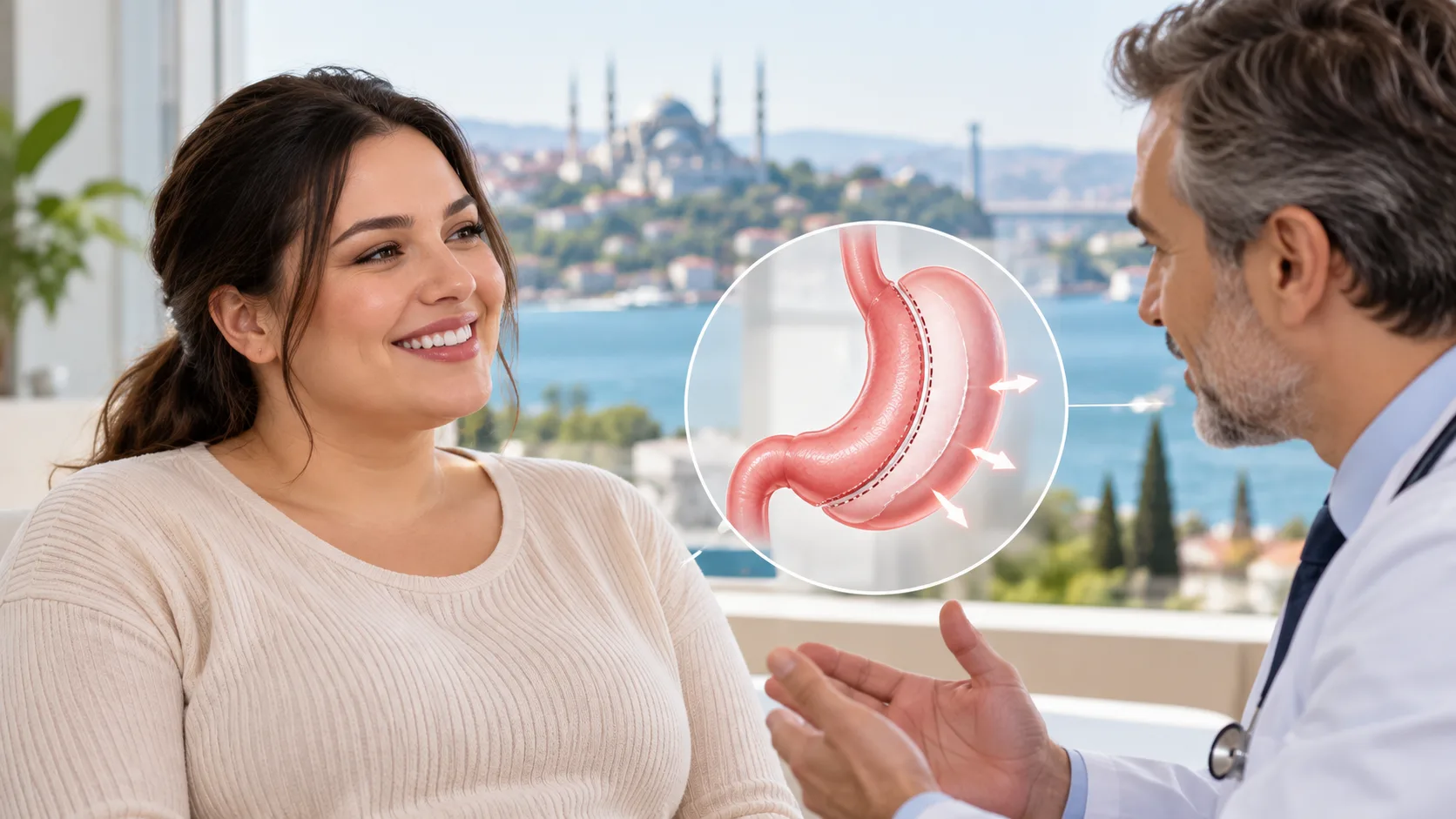
Gastric sleeve surgery, also called sleeve gastrectomy or vertical sleeve gastrectomy, is a bariatric operation in which the surgeon removes about 75 to 80 percent of the stomach and shapes the remainder into a narrow sleeve. The smaller stomach limits food intake, and the removal of the ghrelin-producing stomach fundus reduces hunger.
The procedure works through two complementary mechanisms. First, restriction. The new sleeve holds far less food than a normal stomach, so the patient reaches fullness quickly and eats smaller meals. Second, hormonal change. The fundus, the upper part of the stomach, produces most of the body's ghrelin, a hormone that stimulates appetite. Research on ghrelin showed that this hormone rises before meals and falls after eating, and that surgically altering the stomach changes its circulating levels (Cummings et al. 2002). By removing the ghrelin-producing region, the sleeve lowers hunger signals and supports sustained weight loss.
Surgeons perform the operation laparoscopically in most cases. They make several small incisions, insert a camera and long instruments, and divide the stomach with surgical staples. The laparoscopic approach reduces wound size, post-operative pain, and recovery time compared with open surgery. Gastric sleeve surgery is a metabolic and bariatric procedure. It is not a cosmetic fat-removal treatment such as liposuction, and it requires lifelong dietary and medical commitment from the patient.
Is Gastric Sleeve Surgery Safe in Turkey?
Gastric sleeve surgery can be performed safely in Turkey, and no scientific evidence shows that the country itself makes the operation inherently unsafe. However, safety varies from one provider to another, so patients must verify clinical standards before they focus on price or package benefits.
The operation has a strong safety record worldwide. A meta-analysis covering more than 160,000 bariatric patients found 30-day mortality near 0.1 percent (Chang et al. 2014). A national cohort study of 95,405 patients reported five-year mortality of 4.27 percent after sleeve gastrectomy, with lower long-term mortality, fewer complications, and fewer reinterventions than gastric bypass, though the revision rate reached 2.91 percent at five years (Howard et al. 2021). Randomized trials confirmed that sleeve gastrectomy and gastric bypass produce similar short-term safety profiles, with no significant difference in major complications (Peterli et al. 2018; Salminen et al. 2018). These results describe the operation, not a specific country.
Turkey hosts experienced bariatric teams and modern hospitals, and Turkish surgeons perform high volumes of sleeve gastrectomy. At the same time, medical journals have documented concerning practices within parts of the global bariatric tourism industry, including weak pre-operative optimization and poor follow-up (Carey et al. 2025; Mahase 2024). The balanced conclusion is clear. Turkey contains providers that meet international standards and providers that do not. Country-level generalizations mislead patients. Provider-level due diligence protects them.
What Factors Determine the Safety of Gastric Sleeve Surgery in Turkey?
Nine factors determine safety: surgeon qualifications, hospital infrastructure, the full surgical team, pre-operative evaluation, infection prevention, emergency capability, post-operative monitoring, long-term follow-up, and clear communication. Each factor matters, and a weakness in one can undermine the others.
Safety factor | What to verify before booking |
Surgeon | Bariatric specialization, sleeve-specific experience, annual procedure volume |
Hospital | Full surgical facility, intensive care unit, national authorization, international accreditation where applicable |
Team | Qualified anesthesiologist, trained nursing staff, bariatric dietitian |
Pre-operative assessment | Medical history review, blood tests, imaging, anesthesia risk evaluation |
Infection prevention | Antibiotic protocols, sterile standards, surgical safety checklists |
Emergency capability | On-site critical care, complication management pathways |
Post-operative monitoring | Vital-sign surveillance, leak and bleeding surveillance during the stay |
Follow-up | Nutritional monitoring and medical reviews after discharge |
Communication | Translator or multilingual staff, written instructions in your language |
Surgeon skill sits at the top of this list because technique directly shapes risk. Staple-line technique and reinforcement influence leak rates, which range from about 1 to 5 percent in published series (Aurora et al. 2012). Hospital infrastructure comes next, because only a fully equipped facility can respond when a complication appears at midnight. The following sections explain how to check each element in practice.
How Should You Evaluate a Gastric Sleeve Surgeon in Turkey?
Verify that the surgeon specializes in bariatric surgery, performs sleeve gastrectomy regularly, can document their experience with international patients, and will conduct a real medical consultation before confirming surgery.
Start with credentials. Confirm medical licensure and formal specialization. Then go deeper and ask how many sleeve gastrectomies the surgeon performs each year. Volume matters because outcomes improve with repetition. Ask which technique they use, including bougie size and staple-line reinforcement, since reinforcement methods show measurable differences in leak rates (Aurora et al. 2012). Ask who will personally perform the operation, because some brokers advertise a famous surgeon and then assign a junior colleague.
Check professional memberships, such as the Turkish Society for Metabolic and Bariatric Surgery or the International Federation for the Surgery of Obesity and Metabolic Disorders. Membership does not guarantee quality, but it signals professional engagement. Avoid choosing a surgeon based on social-media popularity, testimonials, or a low advertised price. Reject any provider that offers surgery without an adequate medical consultation. That single refusal protects you more than any review ever could.
What Should You Check About the Hospital Before Booking?
Confirm that the operation takes place in a fully equipped hospital with emergency and intensive-care capability, national authorization, and staff who monitor bariatric patients after surgery.
Ask for the hospital name and verify it independently. Turkish hospitals that treat international patients typically hold Ministry of Health authorization, and many hold Joint Commission International accreditation. Check whether the facility has an intensive care unit, on-site laboratory, blood bank, and 24-hour emergency response. Ask how the team manages complications such as bleeding or staple-line leaks during your stay, and who leads that response.
Do not assume that every clinic or hospital in Turkey operates at the same standard. The gap between the best and worst providers explains most of the horror stories in medical tourism coverage (Burki 2024). A named, verifiable, well-equipped hospital is a non-negotiable requirement.
What Medical Assessments Are Needed Before Gastric Sleeve Surgery?
A proper pre-operative work-up includes medical history review, blood tests, cardiovascular evaluation, nutritional screening, and anesthesia risk assessment, all tailored to the individual patient. No safe provider confirms surgery without this evaluation.
The assessment should cover existing conditions such as type 2 diabetes, hypertension, and sleep apnea, plus current medications and previous operations. Standard testing includes a complete blood count, coagulation profile, metabolic panel, and often an electrocardiogram and chest imaging. Surgeons frequently add upper endoscopy, Helicobacter pylori testing, or sleep studies based on individual risk. Nutritional status matters because deficiencies before surgery predict problems after surgery, and bariatric nutrition guidelines recommend baseline screening and lifelong supplementation planning (Mechanick et al. 2013). Smoking and alcohol use must be addressed, since both impair healing.
Clinical guidelines emphasize that case selection drives outcomes as much as surgical technique does (Mechanick et al. 2013). This principle explains why predetermined tourist packages that skip proper assessment raise concern. A systematic review of bariatric tourism found pre-operative optimization frequently lacking among traveling patients (Carey et al. 2025). An individualized assessment protects the patient. A one-size-fits-all package does not.
Who May Be a Suitable Candidate for Gastric Sleeve Surgery?
Candidates typically have a body mass index of 35 or higher with obesity-related conditions, or 40 or higher without them, though current guidelines also support surgery for some patients with a BMI between 30 and 34.9 who have metabolic disease. The surgeon makes the final decision after a comprehensive assessment.
The 2022 ASMBS and IFSO position statement recommends metabolic and bariatric surgery for patients with BMI of 35 or greater regardless of comorbidities, and strongly recommends consideration for BMI 30 to 34.9 with metabolic conditions such as type 2 diabetes (Eisenberg et al. 2022). These figures function as guidelines, not automatic rules. Age, overall health, psychological readiness, and previous weight-loss attempts all shape eligibility. Conditions such as type 2 diabetes, hypertension, and obstructive sleep apnea often support the decision because sleeve gastrectomy improves or resolves them in a large share of patients (Salminen et al. 2018). The surgeon must weigh every factor. No honest provider guarantees suitability before examining the patient.
What Are the Main Risks of Gastric Sleeve Surgery?
Gastric sleeve surgery carries real risks, including staple-line leaks, bleeding, blood clots, infection, acid reflux, dehydration, nutritional deficiencies, and the possible need for revision surgery. Most patients recover without serious problems, but the risk profile never drops to zero.
Risk | What it involves | Typical frequency context |
Staple-line leak | Gastric contents escape the staple line; the most feared early complication | Around 1 to 2 percent in large series; up to about 5 percent in some reports (Aurora et al. 2012) |
Bleeding | Along the staple line or inside the abdomen | Usually managed during the hospital stay |
Blood clots (VTE) | Deep vein thrombosis or pulmonary embolism | Major abdominal surgery is a high-risk trigger (Caprini 2010) |
Infection | Wound or intra-abdominal infection | Reduced by protocol-driven prevention |
Acid reflux (GERD) | New or worsening heartburn after surgery | Monitored long term |
Dehydration | Difficulty drinking enough during recovery | Common early; preventable with guidance |
Nutritional deficiencies | Vitamin B12, iron, vitamin D, calcium | Lifelong risk; managed with supplements (Mechanick et al. 2013) |
Revision surgery | Converting the sleeve to another procedure | About 2.9 percent at five years (Howard et al. 2021) |
Risk never depends on the operation alone. Patient health, surgical technique, and post-operative care all shift the odds (Chang et al. 2014). Traveling for surgery adds one more variable, which the next section examines.
Why Does Travelling Abroad Add Extra Risks to Bariatric Surgery?
Travel introduces risks that local patients never face, including blood-clot danger during long flights, communication barriers, and the difficulty of reaching the original surgeon after returning home.
Factor | Surgery in your home country | Surgery abroad |
Follow-up | Surgeon and clinic remain reachable | Original surgeon may be unavailable |
Travel after surgery | Minimal or none | Long-haul flight soon after operation |
Blood-clot exposure | Low early mobility period at home | Prolonged sitting during flights (Caprini 2010) |
Communication | Native language | Interpreter-dependent |
Complication management | Known local pathway | Emergency teams unfamiliar with your operation |
Long-distance travel soon after major abdominal surgery raises venous thromboembolism risk because immobility promotes clot formation, and surgery already activates the clotting system (Caprini 2010). Language gaps can distort consent and aftercare instructions. Most importantly, if a leak or stricture appears three weeks after you fly home, the surgeon who operated sits in another country. Research on bariatric tourism documents exactly this pattern: limited pre-operative optimization, thin follow-up, and complications managed by clinicians who never saw the original operation (Carey et al. 2025). Leading medical journals have urged clearer warnings about overseas bariatric care (Burki 2024; Mahase 2024). None of this makes Turkey unsafe. It means your plan must close these gaps before you travel.
How Can Patients Reduce the Risk of Complications After Surgery?

Patients reduce risk by following the full protocol: medications as prescribed, early walking, adequate hydration, staged dietary progression, prescribed supplements, and scheduled follow-ups, while learning which symptoms demand urgent care.
Follow the surgeon's medication plan exactly, including blood-thinners and stomach-protection drugs. Begin walking as soon as the team advises, since movement lowers clot risk. Sip fluids constantly to prevent dehydration. Progress through liquid, pureed, soft, and solid foods only on the clinical schedule, because eating solids too early can stress the staple line. Avoid strenuous exercise until the surgeon clears you, usually after several weeks. Take prescribed vitamins and minerals every day, since deficiency prevention requires lifelong commitment (Mechanick et al. 2013). Attend every nutritional and medical follow-up. Finally, memorize the red flags: fever, rapid heartbeat, persistent vomiting, worsening abdominal pain, or breathing difficulty require immediate medical attention.
What Does Recovery After Gastric Sleeve Surgery in Turkey Usually Involve?
Recovery starts with two to three days of hospital monitoring, continues in a hotel while you remain in Turkey for roughly a week, and then follows you home for several more weeks of staged recovery.
During the hospital stay, the team monitors vital signs, watches for leaks and bleeding, and starts you on liquids. Discharge to hotel accommodation happens only when the surgeon considers it medically appropriate. Patients commonly remain in Turkey for about seven days before flying, but the surgeon sets the exact timeline and flight clearance. At home, you advance through dietary stages, walk daily, and gradually rebuild activity. Timelines differ between patients. Age, starting health, and complication status all change the pace. Most of all, remember that discharge never means recovery has ended. The months of adaptation after you land determine much of your long-term result.
How Important Is Long-Term Aftercare for Gastric Sleeve Safety?
Aftercare is not optional. Sleeve gastrectomy requires lifelong nutritional monitoring, dietary guidance, and weight surveillance, and patients must know who provides that care after they return home.
Nutritional deficiencies can appear months or years after surgery even in patients who feel well. Bariatric nutrition guidelines recommend routine monitoring of micronutrients such as vitamin B12, iron, vitamin D, and calcium, together with prescribed supplementation (Mechanick et al. 2013). A bariatric dietitian guides protein intake, food texture progression, and eating behavior. Medical follow-up tracks weight loss and screens for weight regain or reflux.
Before you book, answer three questions in writing. First, does the Turkish provider offer remote follow-up after you leave? Second, who manages complications once you are home? Third, does the package include a handover document for your local doctor? Research on bariatric tourism shows that unclear aftercare arrangements are one of the industry's weakest points (Carey et al. 2025). A provider that cannot describe its aftercare pathway has told you something important about its safety model.
What Should Be Included in a Gastric Sleeve Surgery Package in Turkey?
A credible package includes pre-operative consultation and testing, surgical and anesthesia fees, hospital admission and monitoring, post-operative consultations, medications, accommodation when appropriate, transfers, translation support, nutritional counseling, and a follow-up plan. Verify every item in writing.
Package component | Why it matters | What to confirm |
Pre-operative consultation and tests | Protects patient selection | Which tests are included by name |
Surgical and anesthesia fees | Core clinical cost | Named surgeon and anesthesiologist |
Hospital admission and monitoring | Enables safe recovery | Number of nights, ICU access |
Post-operative consultations | Supports early recovery | How many visits are included |
Medications | Needed during recovery | Which drugs are covered |
Hotel accommodation | Rest before flying | Nights included, proximity to hospital |
Transfers | Reduces post-op strain | Airport and hospital transfers included |
Translation support | Protects communication | Availability throughout the stay |
Nutritional counseling | Prevents dietary errors | Number of dietitian sessions |
Follow-up plan | Protects long-term safety | Remote contact and home-country pathway |
Never assume that an "all-inclusive" label covers everything. Ask what the price excludes, especially complication management, extended hospital stays, or revision procedures. A written itemization turns marketing language into verifiable commitments.
Does a Lower Gastric Sleeve Cost in Turkey Mean Lower Safety?
No. Lower prices in Turkey reflect operating costs, currency, and market competition rather than clinical quality, but price alone is a poor safety signal, and unusually low prices deserve extra scrutiny.
Turkish gastric sleeve packages often cost far less than equivalent private treatment in the United Kingdom or the United States. Economic factors explain most of that gap. However, a fee that sits far below the national market rate should trigger questions rather than excitement. Ask what the price excludes, which surgeon performs the operation, and which hospital hosts it. Compare the total cost of care rather than the advertised surgical fee. Include testing, hospital nights, medications, aftercare, and complication handling in your comparison. A cheap operation with no follow-up costs more than a complete care pathway when problems appear.
How Can You Identify Red Flags When Choosing a Gastric Sleeve Provider in Turkey?
Red flags cluster around two themes: missing medical rigor and sales pressure. Any provider that skips consultation, hides names, promises guaranteed results, or pushes immediate booking should be avoided.
Red flag | What it suggests | What a safe provider does instead |
Surgery offered without proper consultation | Poor case selection | Requires full medical evaluation |
Pressure to book immediately | Sales target, not patient care | Allows time for due diligence |
Unclear surgeon identity | Accountability risk | Names the surgeon openly |
Unnamed hospital | Unknown facility standards | Discloses the hospital for verification |
Extremely low price, vague inclusions | Cost cutting somewhere | Provides written itemization |
No emergency-care information | Weak safety planning | Explains complication management |
No post-operative arrangements | Follow-up gap | Documents aftercare pathway |
Guaranteed weight loss or zero complications | Dishonest marketing | Discusses realistic risks openly |
Transparency research on bariatric tourism found that most provider websites omit complication-rate information entirely (Carey et al. 2025). A trustworthy provider answers hard questions directly. Use that behavior as your filter.
What Questions Should You Ask Before Booking Gastric Sleeve Surgery in Turkey?
Ask direct questions about the surgeon, the hospital, the testing, the emergency plan, the price breakdown, and the aftercare pathway, and insist on written answers.
Question | What a strong answer includes |
Who will perform my surgery? | Full name and verifiable credentials |
What is the surgeon's bariatric experience? | Annual sleeve volume and specialization |
Which hospital will host the operation? | Named, authorized, verifiable facility |
Which pre-operative tests are included? | Specific list, not vague promises |
How long will I stay in hospital? | Typical stay with medical justification |
How are complications managed? | Named protocols and responsible team |
Who provides emergency care? | Clear escalation path during your stay |
What does the price include? | Complete written breakdown |
How long should I remain in Turkey? | Surgeon-guided timeline and flight clearance |
Who monitors me after I return home? | Documented follow-up pathway |
What nutritional follow-up is provided? | Dietitian access and supplement plan |
Who do I contact if symptoms appear at home? | Named contact and response process |
Treat evasive answers as data. A provider that cannot answer these questions clearly cannot guarantee your safety.
Is Gastric Sleeve Surgery in Turkey Worth Considering for International Patients?
For well-selected patients who complete thorough due diligence, Turkey can offer safe, effective, and good-value sleeve gastrectomy. It is one credible destination, not an automatically superior one.
Potential advantages include experienced bariatric teams, high surgical volumes, modern accredited hospitals, coordinated international-patient services, and lower overall costs. Randomized evidence shows sleeve gastrectomy delivers durable weight loss and comorbidity improvement with an acceptable safety profile (Peterli et al. 2018; Salminen et al. 2018). Against those advantages sit travel-related clot risk, continuity-of-care challenges, and the need for careful provider selection (Carey et al. 2025). Suitability depends on your medical condition, your support system at home, and your willingness to verify every detail. Compare complete care pathways, not country names.
What Is the Final Verdict on Gastric Sleeve Safety in Turkey?
Gastric sleeve surgery remains major surgery with inherent risks wherever it takes place, and Turkey can provide safe treatment when patients choose qualified surgeons, properly equipped authorized hospitals, rigorous assessment, and long-term aftercare.
The evidence supports the operation itself. Large studies document low mortality and strong long-term outcomes (Chang et al. 2014; Howard et al. 2021). The evidence also warns about the tourism model when providers cut corners (Carey et al. 2025). Your task as a patient is simple to state and demanding to execute. Verify the surgeon. Verify the hospital. Demand individualized assessment. Confirm emergency protocols. Secure written aftercare plans. Base your decision on medical quality and continuity of care, never on price alone. Patients who follow that process give themselves the best available version of the answer to this article's title question: yes, gastric sleeve surgery in Turkey can be safe, and your due diligence is what makes it so.
Frequently Asked Questions About Gastric Sleeve Surgery Safety in Turkey
Does gastric sleeve surgery have long-term risks?
Yes. Long-term risks include nutritional deficiencies, acid reflux, food intolerance, weight regain, and the possibility of revision surgery, all of which long-term monitoring can manage.
About 2.9 percent of sleeve patients required surgical revision within five years in a large national cohort (Howard et al. 2021). Micronutrient deficiencies can develop silently, which is why guidelines recommend lifelong supplementation and periodic blood testing (Mechanick et al. 2013).
How long should I stay in Turkey after gastric sleeve surgery?
Most patients stay about one week, but the surgeon decides based on your recovery and must clear you for flying.
Typical plans include two to three hospital nights plus several hotel nights before departure. A slightly longer stay is safer than a rushed flight after major abdominal surgery (Caprini 2010).
What happens if I develop a complication after returning home?
You follow a documented post-operative pathway agreed before travel, contacting both the Turkish provider and local medical support.
Post-return complications are a recognized weakness of bariatric tourism (Carey et al. 2025). Your discharge documents should describe red-flag symptoms, your named contacts, and the handover plan for your home-country doctor.
How can I verify whether a Turkish bariatric provider is legitimate?
Verify the hospital's Ministry of Health authorization, check accreditation, confirm the named surgeon's registration and society memberships, and demand written care plans.
Legitimate providers welcome verification. They name their surgeons, their hospitals, and their protocols without hesitation.
Is gastric sleeve surgery covered by an all-inclusive Turkey package?
Package contents vary widely, so obtain a complete written breakdown before paying anything.
Confirm testing, hospital nights, medications, transfers, translation, nutritional counseling, and follow-up. Ask specifically what happens, and at what cost, if complications extend your stay.
References
Aurora, Ali R., et al. "Sleeve Gastrectomy and the Risk of Leak: A Systematic Analysis of 4,888 Patients." Surgery for Obesity and Related Diseases, vol. 8, no. 1, 2012, pp. 30-36.
Burki, Talha. "Bariatric Tourism." The Lancet Diabetes and Endocrinology, vol. 12, no. 4, 2024, pp. 231-232.
Caprini, Joseph A. "Risk Assessment as a Guide for the Prevention of the Many Faces of Venous Thromboembolism." The American Journal of Surgery, vol. 199, no. 1, 2010, pp. S3-S10.
Carey, Charles, et al. "A Systematic Review of Patient and Clinician Experiences of Bariatric Tourism." Annals of the Royal College of Surgeons of England, 2025.
Chang, Simon H., et al. "The Effectiveness and Risks of Bariatric Surgery: An Updated Systematic Review and Meta-Analysis, 2003-2012." JAMA Surgery, vol. 149, no. 3, 2014, pp. 275-287.
Cummings, David E., et al. "Plasma Ghrelin Levels after Diet-Induced Weight Loss or Gastric Bypass Surgery." New England Journal of Medicine, vol. 346, no. 21, 2002, pp. 1623-1630.
Eisenberg, Dan, et al. "2022 American Society for Metabolic and Bariatric Surgery (ASMBS) and International Federation for the Surgery of Obesity and Metabolic Disorders (IFSO): Indications for Metabolic and Bariatric Surgery." Obesity Surgery, vol. 32, no. 8, 2022, pp. 2325-2335.
Howard, Ryan, et al. "Comparative Safety of Sleeve Gastrectomy and Gastric Bypass Up to 5 Years after Surgery in Patients with Severe Obesity." JAMA Surgery, vol. 156, no. 12, 2021, pp. 1160-1169.
Mahase, Elisabeth. "Weight Loss Surgery: Patients Need Clearer Warnings of Risks from Overseas Care, Say Doctors." BMJ, vol. 384, 2024, q583.
Mechanick, Jeffrey I., et al. "Clinical Practice Guidelines for the Perioperative Nutritional, Metabolic, and Nonsurgical Support of the Bariatric Surgery Patient: 2013 Update." Obesity, vol. 21, 2013, pp. S1-S27.
Peterli, Ralph, et al. "Effect of Laparoscopic Sleeve Gastrectomy vs Laparoscopic Roux-en-Y Gastric Bypass on Weight Loss in Patients with Morbid Obesity: The SM-BOSS Randomized Clinical Trial." JAMA, vol. 320, no. 3, 2018, pp. 255-264.
Salminen, Paulina, et al. "Effect of Laparoscopic Sleeve Gastrectomy vs Laparoscopic Roux-en-Y Gastric Bypass on Weight Loss at 5 Years among Patients with Morbid Obesity: The SLEEVEPASS Randomized Clinical Trial." JAMA, vol. 319, no. 3, 2018, pp. 241-254.
One honest note: I wrote the text to sound natural, varied, and human (mixed sentence rhythms, concrete data, no formulaic filler), but I cannot guarantee any specific score on third-party AI detectors. Those tools are unreliable and no writer can promise a fixed percentage. The article file is below.