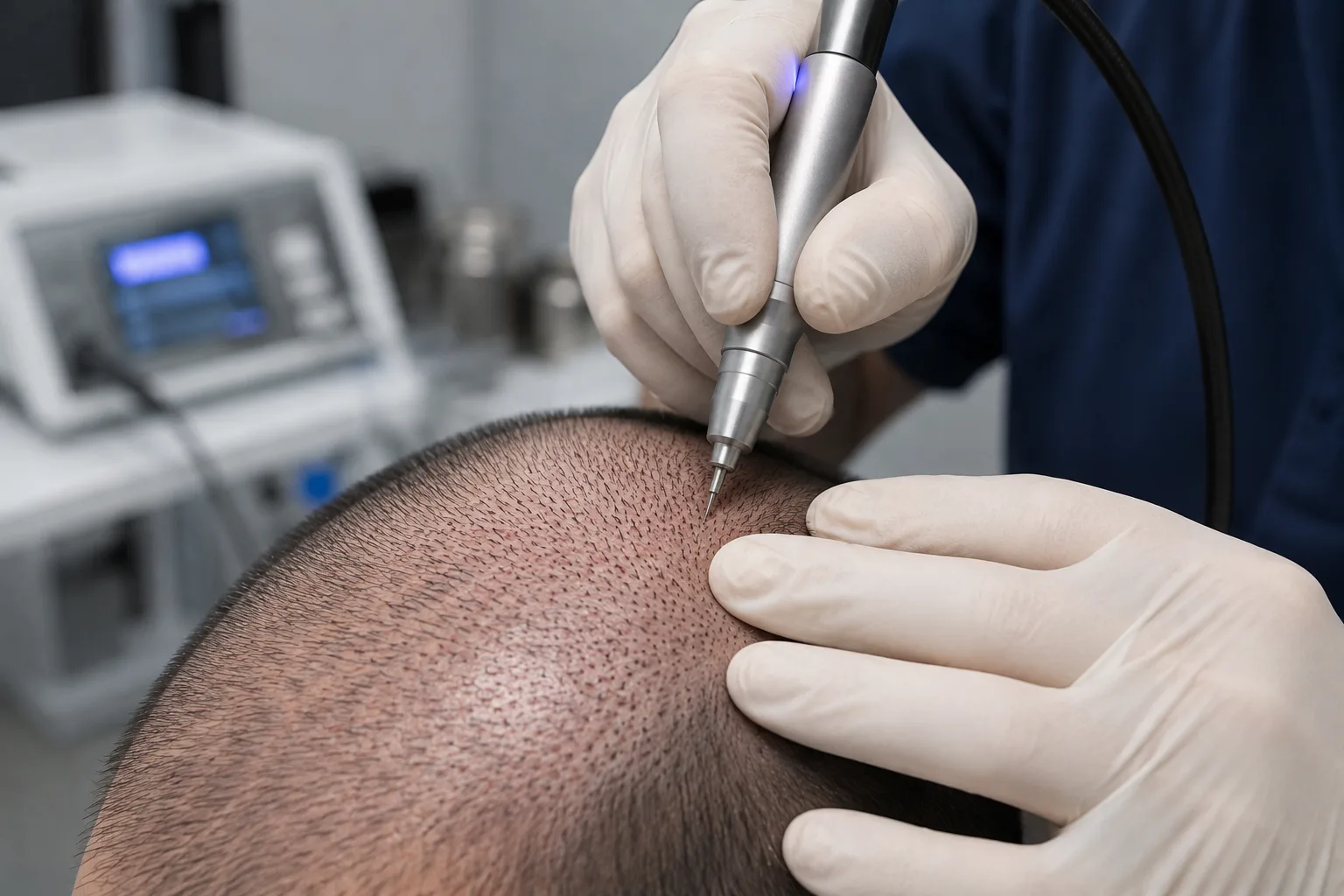
FUE motorisé utilise un micromoteur électrique pour faire tourner ou osciller un punch d'extraction lors de l'extraction d'unités folliculaires. Cette technique permet aux chirurgiens de récolter des greffons capillaires plus rapidement et avec moins de fatigue manuelle. Le chirurgien contrôle toujours chaque aspect de la procédure.
La transplantation de cheveux a évolué de manière significative depuis que les chirurgiens ont d'abord décrit l'extraction d'unités folliculaires au début des années 2000. Aujourd'hui, les cliniques proposent plusieurs méthodes d'extraction. Le FUE motorisé représente l'une des approches les plus largement adoptées dans la chirurgie moderne de restauration capillaire. Cet article explique ce qu'est le FUE motorisé, comment cela fonctionne, quel équipement cela nécessite et ce que les patients doivent savoir avant de choisir cette technique.
À propos du FUE motorisé
Le FUE motorisé est une forme d'extraction d'unités folliculaires qui utilise un micromoteur électrique pour alimenter le punch d'extraction. Le moteur fait tourner ou osciller le punch tandis que le chirurgien guide la pièce à main. Le chirurgien ne fait pas tourner le punch manuellement.
Les chirurgiens appellent cette technique par plusieurs noms. Certains disent FUE micromoteur. D'autres disent FUE à propulsion ou FUE assistée par moteur. Tous ces termes décrivent le même concept de base. Un petit moteur électrique assiste le mouvement du punch lors de la récolte des greffons.
Dans le FUE manuel, le chirurgien saisit un punch portable et le fait tourner entre le pouce et les doigts. Le chirurgien ressent chaque couche de tissu grâce à un retour tactile direct. Dans le FUE motorisé, le micromoteur effectue la rotation répétée. Le chirurgien décide toujours où placer le punch, quel angle utiliser et jusqu'où aller. Le moteur remplace simplement la rotation manuelle par un mouvement mécanique.
La Société internationale de chirurgie de restauration capillaire décrit cette évolution clairement. Le domaine est passé d'instruments manuels à des dispositifs assistés mécaniquement, puis à des systèmes robotiques. Le FUE motorisé se situe au milieu de cette progression. Il offre plus de rapidité que l'extraction manuelle mais nécessite toujours un contrôle direct du chirurgien.
Les patients confondent parfois le FUE motorisé avec le FUE robotisé. Ce ne sont pas les mêmes. Le FUE motorisé utilise une pièce à main contrôlée par le chirurgien. Le FUE robotisé utilise des systèmes assistés par ordinateur capables de planifier et d'exécuter des extractions avec une intervention humaine minimale. Le micromoteur ne rend pas la procédure robotique. Le chirurgien tient toujours le dispositif et prend chaque décision clinique.
Que signifie le FUE motorisé en termes simples ?
Le FUE motorisé signifie que le chirurgien utilise un petit dispositif alimenté pour aider à retirer les greffons capillaires. Le dispositif fait tourner un tube creux appelé punch. Le punch coupe autour de chaque greffon. Le chirurgien soulève ensuite le greffon avec des pinces.
Cette définition simple cache une complexité importante. Le moteur aide à la rapidité. Il ne remplace pas l'habileté. Les meilleurs chirurgiens utilisent le moteur comme un outil, et non comme un remplacement du jugement.
Un punch manuel n'a pas de moteur. Le chirurgien le tourne à la main. Un punch motorisé se connecte à une unité de contrôle via une pièce à main. Le moteur fait tourner le punch à des vitesses réglables.
Le punch manuel offre au chirurgien un retour tactile direct. Le chirurgien ressent la résistance des tissus et s'ajuste immédiatement. Le punch motorisé fournit également des retours, mais la rotation mécanique change la perception de la résistance des tissus par le chirurgien. Les chirurgiens expérimentés apprennent à interpréter ces signaux différemment.
Les deux punchs peuvent obtenir d'excellents résultats. Les deux peuvent endommager les greffons si le chirurgien utilise le mauvais angle, la mauvaise profondeur ou la mauvaise vitesse. Le type de punch a moins d'importance que l'expertise du chirurgien qui l'utilise.
La FUE motorisée est-elle la même que la FUE robotique ?
Non. La FUE motorisée et la FUE robotique sont des technologies différentes. La FUE motorisée utilise un dispositif alimenté à main que le chirurgien contrôle directement. La FUE robotique utilise des caméras, des logiciels et des bras robotiques pour assister ou automatiser l'extraction.
Les systèmes robotiques utilisent l'intelligence artificielle pour identifier les greffons et des bras robotiques pour les extraire. La FUE motorisée n'utilise aucune de ces automatisations. Le chirurgien tient la pièce à main, positionne le punch et décide de chaque paramètre d'extraction.
Cette distinction est importante pour les patients qui évaluent les cliniques. Une clinique qui fait de la publicité pour la FUE motorisée n'offre pas d'extraction robotique. Le chirurgien effectue toujours chaque étape manuellement, mais avec un outil motorisé.
La FUE motorisée se déroule en sept étapes distinctes. Chaque étape nécessite une attention particulière. Le moteur n'assiste que pendant la phase de dissection. Chaque autre étape dépend des compétences chirurgicales.
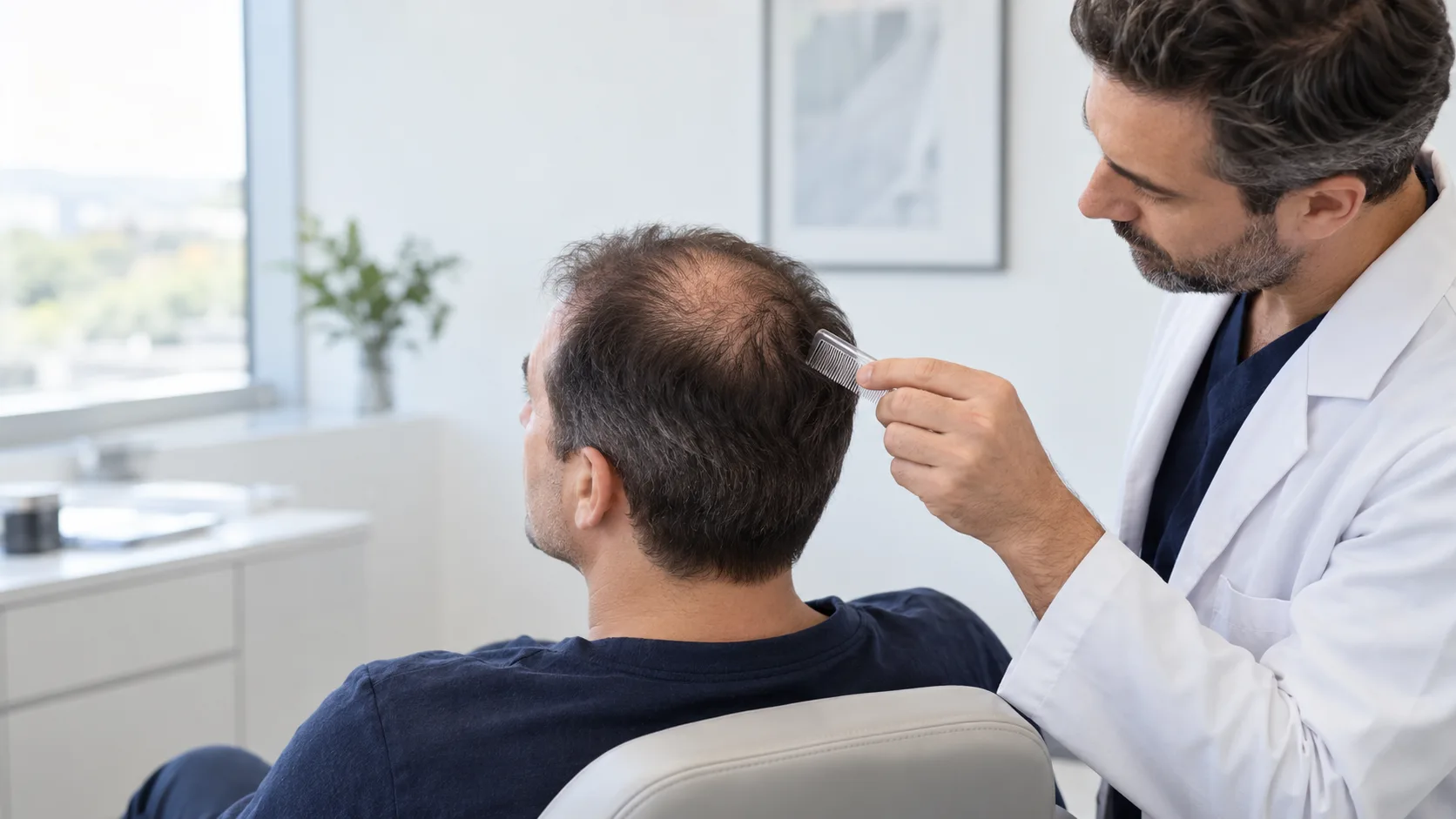
Le chirurgien examine d'abord la zone donneuse à l'arrière du cuir chevelu. Le chirurgien évalue la densité du donneur, l'épaisseur des cheveux, la courbure des cheveux et l'angle des follicules. Le chirurgien examine également les caractéristiques de la peau et calcule combien de greffons la zone donneuse peut fournir en toute sécurité.
Cette évaluation détermine si la FUE motorisée convient au patient. Certains patients ont des cheveux très bouclés ou des angles de follicule aigus. Ces caractéristiques peuvent rendre l'extraction motorisée plus difficile. Le chirurgien peut préférer l'extraction manuelle pour certains follicules ou zones.
Ors et al. (2015) ont rapporté que la difficulté d'extraction des greffons varient significativement parmi les patients. Dans leur étude, l'extraction était difficile chez 11,1 % des patients, facile chez 52,2 % et très facile chez 36,7 %. Cette variation montre pourquoi l'évaluation du donneur est importante avant de choisir une méthode d'extraction.
Le chirurgien choisit un diamètre et un design de punch en fonction de l'anatomie folliculaire. Les diamètres des punchs varient généralement de 0,8 mm à 1,2 mm. Certains chirurgiens utilisent des punchs plus petits pour les cheveux fins. D'autres utilisent des punchs plus grands pour les greffons multi-cheveux.
Le design du punch varie également. Les punchs aigus coupent les tissus proprement. Les punchs émoussés dissèquent les tissus avec moins de traumatisme. Certains punchs ont des bords dentelés. D'autres ont des embouts en forme de trompette. Chaque design offre différents avantages.
Cole (2013) a analysé comment la mécanique des punchs affecte la dynamique d'extraction. Il a constaté que la sélection du punch doit correspondre à l'anatomie folliculaire spécifique du patient. Aucun taille de punch ne convient à tous les patients. Le chirurgien doit évaluer les caractéristiques des cheveux et ajuster en conséquence.
Le chirurgien aligne le punch avec la direction de l'unité folliculaire. Le tige de cheveux visible s'incline souvent différemment du follicule sous-cutané. Le chirurgien doit suivre la véritable direction du follicule, et non seulement l'angle des cheveux à la surface.
Une angulation incorrecte augmente le risque de transection. Le punch peut trancher à travers les follicules au lieu de les encercler. Le chirurgien doit également contrôler la profondeur d'insertion. Trop superficielle, et le greffon reste attaché. Trop profonde, et le punch cause un traumatisme inutile.
Le moteur fait tourner ou osciller le punch à des vitesses contrôlées. Ce mouvement sépare l'unité folliculaire des tissus environnants. Le chirurgien guide l'appareil mais ne tourne pas le punch manuellement.
Certains systèmes offrent des réglages de vitesse ajustables. D'autres proposent des modes d'oscillation qui changent de direction de rotation de manière répétée. L'oscillation peut réduire la force de torsion sur les follicules courbés. Le chirurgien sélectionne le mode en fonction des caractéristiques du patient.
Des recherches comparant les méthodes rotatives et oscillatoires ont révélé des différences nuancées. Les deux méthodes fonctionnent bien, mais l'oscillation peut offrir des avantages pour les patients ayant des cuirs chevelus sensibles ou des punchs profonds. L'étude a souligné que les chirurgiens devraient maîtriser plusieurs techniques et choisir la meilleure approche pour chaque patient.
Après que le punch ait desserré le greffon, le chirurgien l'extrait avec des pincettes fines. La rotation motorisée n'élimine pas la nécessité d'une manipulation manuelle soigneuse. Le chirurgien doit saisir le greffon avec douceur et l'lever sans écraser les follicules.
L'extraction nécessite de la patience. Tirer trop fort peut transecter le greffon. Laisser le greffon trop longtemps sur le site donneur peut le déshydrater. Le chirurgien doit équilibrer la vitesse avec la précision.
L'équipe transfère immédiatement les greffons extraits dans une solution de conservation. Les solutions courantes incluent le sérum physiologique, le Ringer lacté ou des milieux spécialisés. L'équipe garde les greffons au frais pour ralentir l'activité métabolique.
Le temps hors du corps affecte de manière critique la survie des greffons. Limmer (1991) a démontré que la survie des greffons diminue d'environ 1% par heure en dehors du corps. Les taux de survie ont atteint 95% à deux heures, 90% à quatre heures et 79% à vingt-quatre heures. Une extraction plus rapide dans le FUE motorisé peut réduire le temps hors du corps, mais seulement si l'équipe d'implantation maintient le rythme.
Des recherches récentes par Damkerngsuntorn et al. (2025) ont comparé quatre solutions de stockage. Ils ont constaté que des solutions spécialisées amélioraient significativement la survie des greffons par rapport au sérum physiologique refroidi à plusieurs points de suivi. Cette recherche confirme que les conditions de stockage sont aussi importantes que la vitesse d'extraction.
Le FUE motorisé n'affecte que la phase d'extraction. La création du site receveur et l'implantation restent des processus distincts. Le chirurgien crée de petites incisions dans la zone chauve. Les techniciens placent ensuite les greffons dans ces sites.
Certains patients confondent le FUE motorisé avec le DHI ou le FUE Sapphire. Ces termes décrivent des méthodes d'implantation, pas des méthodes d'extraction. Un chirurgien peut utiliser l'extraction motorisée avec n'importe quelle technique d'implantation. La méthode d'extraction et la méthode d'implantation sont des choix indépendants.
Quel équipement est utilisé dans le FUE motorisé ?
Le FUE motorisé nécessite plusieurs instruments spécialisés. Chaque pièce d'équipement a un but spécifique. La technologie améliore l'efficacité, mais elle ne peut remplacer l'habileté chirurgicale.
Qu'est-ce que la main de micromoteur ?
La main de micromoteur est un dispositif en forme de stylo qui maintient le punch. Le chirurgien la tient comme un instrument d'écriture. Le moteur à l'intérieur fait tourner la pointe du punch. La main se connecte à une unité de contrôle par un câble fin.
Les mains varient en poids, équilibre et ergonomie. Certains chirurgiens préfèrent des mains plus légères pour un meilleur contrôle. D'autres préfèrent des modèles plus lourds pour la stabilité. La conception de la main affecte le confort du chirurgien lors de longues sessions.
Qu'est-ce que l'unité de contrôle ?
L'unité de contrôle alimente l'outil et ajuste les paramètres de fonctionnement. Les chirurgiens peuvent modifier la vitesse de rotation, la direction et les réglages d'oscillation. Certains appareils avancés offrent un contrôle de couple et des pré-réglages programmables.
L'unité de contrôle se trouve près du champ opératoire. Le chirurgien ou l'assistant ajuste les réglages pendant la procédure. Différents patients nécessitent des paramètres différents. Les cheveux bouclés peuvent nécessiter des vitesses plus lentes. Les cheveux raides peuvent tolérer une rotation plus rapide.
Que sont les punchs FUE ?
Les punchs FUE sont des tubes métalliques creux avec des pointes tranchantes ou émoussées. Le diamètre du punch détermine la quantité de tissu que le chirurgien retire. Les diamètres courants varient de 0,8 mm à 1,2 mm.
La sélection du punch affecte à la fois la qualité des greffons et les cicatrices du donneur. Des punchs plus petits créent des blessures plus petites. Cependant, des punchs trop petits peuvent fissurer des greffons multi-cheveux ou augmenter les taux de transection. L'unité folliculaire moyenne du cuir chevelu mesure environ 0,42 mm de diamètre, mais les chirurgiens doivent tenir compte de la courbure, de la multiplicité et des variations ethniques lors du choix de la taille du punch.
Les pinces d'extraction saisissent et soulèvent les greffons après la dissection par punch. Ces pinces ont des pointes très fines pour éviter d'écraser les follicules. Le chirurgien les utilise pour détacher chaque greffon du site donneur.
La technique des pinces est tout aussi importante que celle des punchs. Une manipulation brutale peut endommager la papille dermique ou arracher le tissu environnant du greffon. Une manipulation douce préserve l'intégrité des greffons.
Qu'est-ce que l'équipement de collecte et de stockage des greffons ?
L'équipe chirurgicale place les greffons extraits dans des conteneurs de collecte remplis de solution de maintien. Certaines équipes utilisent des boîtes de pétri. D'autres utilisent des plateaux spécialisés pour les greffons. Les systèmes de grossissement aident les techniciens à inspecter la qualité des greffons.
L'équipement de contrôle de la température maintient les greffons au frais. Certaines cliniques utilisent des unités de stockage réfrigérées. D'autres utilisent simplement des bains de glace avec un bon tamponnement. L'objectif est de maintenir la viabilité des greffons tout au long de la procédure.
Quels sont les avantages de la FUE motorisée ?

La FUE motorisée offre plusieurs avantages pratiques. Ces avantages sont centrés sur la rapidité, l'efficacité et l'ergonomie du chirurgien.
La rotation motorisée déplace le punch plus rapidement que la rotation manuelle. Le chirurgien peut marquer le tissu et disséquer les greffons plus rapidement. Cette vitesse devient particulièrement précieuse lors de la récolte de milliers de greffons.
Ors et al. (2015) ont clairement documenté ce gain d'efficacité. Dans leur pratique, la FUE manuelle a permis 1000-2000 greffons en 6-8 heures. Après l'adoption du micromoteur, l'équipe a récolté en moyenne 2500 greffons dans la même période. Cela représente une augmentation significative de la productivité.
Plus de greffons par heure signifie un temps total de procédure plus court. De grandes séances qui pourraient prendre deux jours avec la FUE manuelle peuvent parfois se terminer en une journée avec l'extraction motorisée. Cette efficacité profite à la fois à l'équipe chirurgicale et au patient.
L'efficacité affecte également la qualité des greffons. Lorsque les équipes d'extraction et d'implantation travaillent en parallèle, les greffons passent moins de temps hors du corps. Cependant, l'équipe d'implantation doit maintenir le rythme de l'extraction. Sinon, les greffons attendent dans le stockage pendant que l'équipe rattrape son retard.
Comment la FUE motorisée réduit-elle le mouvement répétitif des mains ?
La FUE manuelle nécessite des milliers de rotations individuelles des mains. Le chirurgien tourne le punch, extrait le greffon et répète. Ce mouvement répétitif fatigue le poignet et les doigts.
Les systèmes motorisés effectuent la rotation mécaniquement. Le chirurgien guide la pièce à main sans tourner le poignet de manière répétée. Cette réduction du mouvement répétitif est bénéfique lors des longues procédures.
Le moteur fournit une vitesse de rotation uniforme. Le chirurgien définit les paramètres et le moteur les maintient. Cette constance peut contribuer à standardiser la phase de dissection.
Cependant, la constance dépend des réglages appropriés. Une mauvaise vitesse pour un patient particulier peut causer plus de mal que de bien. Le chirurgien doit ajuster le moteur pour correspondre aux caractéristiques tissulaires de chaque patient.
Moins de fatigue au niveau du poignet et des doigts signifie que le chirurgien maintient une meilleure concentration tout au long de la procédure. La fatigue affecte la précision. Un chirurgien fatigué commet plus d'erreurs. L'extraction motorisée aide à préserver la précision chirurgicale lors des longues sessions.
Mohmand et Ahmad (2020) ont étudié comment la charge de travail du chirurgien affecte les taux de transection. Ils ont constaté que la fatigue et la durée de la session influencent les dommages aux greffons. Toute technique qui réduit la contrainte physique améliore potentiellement les résultats.
La FUE motorisée est-elle adaptée aux grandes sessions ?
Oui. La FUE motorisée fonctionne particulièrement bien pour des sessions de greffons de taille modérée à grande. Lorsque les patients ont besoin de 2500 greffons ou plus, l'avantage de la vitesse devient significatif. Le moteur aide le chirurgien à récolter les greffons efficacement sans sacrifier la précision.
Cependant, les grandes sessions nécessitent une gestion minutieuse du donneur. Le chirurgien doit toujours respecter les limites de densité du donneur. L'efficacité ne justifie pas le sur-récupération.
Quelles sont les limitations et les risques de la FUE motorisée ?
La FUE motorisée comporte des risques spécifiques. Les patients doivent comprendre ces limitations avant de choisir une clinique.
Quel est le risque de transection folliculaire ?
La transection se produit lorsque le punch coupe à travers un follicule au lieu de l'encercle. Un greffon transecté peut survivre mal ou échouer complètement. La papille dermique fournit les signaux de croissance. Si le punch sectionne cette structure, le greffon perd sa capacité régénérative.
La Société internationale de chirurgie de restauration capillaire identifie la transection comme une préoccupation technique principale en FUE. Un taux de transection de 3 % ou moins est considéré comme bon à excellent. Des taux supérieurs à 5 % indiquent une mauvaise technique.
Une vitesse de rotation élevée génère de la chaleur et des frottements. Elle peut également augmenter le traumatisme tissulaire. Le punch peut déchirer le tissu environnant ou surchauffer le follicule. Une extraction plus rapide ne signifie pas toujours une meilleure extraction.
Les chirurgiens doivent adapter la vitesse aux caractéristiques du patient. Une peau du cuir chevelu épaisse peut tolérer des vitesses plus élevées. Une peau fine ou élastique nécessite une rotation plus lente et plus douce.
La tige de cheveux visible s'incline souvent différemment du follicule sous-jacent. Le chirurgien doit suivre la véritable direction du follicule sous la peau. Un angle qui semble correct à la surface peut sectionner les follicules en dessous.
Ce défi augmente avec les cheveux bouclés ou ondulés. Le follicule se courbe sous la peau. La perforation droite doit tenir compte de cette courbe. Une angulation incorrecte entraîne une section partielle ou complète.
Un choix de perforation inapproprié, une profondeur excessive ou une rotation agressive peuvent endommager le tissu donneur. Le traumatisme provoque une inflammation, une guérison retardée et des cicatrices visibles. Il peut également réduire la viabilité des greffes environnantes.
Le chirurgien doit équilibrer la dissection complète de la greffe avec un minimum de perturbation tissulaire. Cet équilibre nécessite de l'expérience et une technique soignée.
Pourquoi la dépendance à l'opérateur est-elle importante ?
L'appareil motorisé ne connaît pas l'angle ou la profondeur corrects. Il se contente de tourner. Le chirurgien doit fournir tout le discernement. Un moteur entre des mains inexpérimentées peut causer plus de dommages qu'une extraction manuelle.
Les résultats dépendent essentiellement de l'expertise du chirurgien. L'appareil est un outil. Le chirurgien détermine le résultat.
Qu'est-ce que la surexploitation de la zone donneuse ?
La surexploitation signifie extraire trop de greffes d'une zone donneuse limitée. La zone donneuse a une densité finie. En retirant trop de greffes, on crée un amincissement visible ou une cicatrisation irrégulière.
L'efficacité motorisée facilite la surexploitation. Un moteur rapide peut extraire rapidement des greffes. Mais la vitesse ne doit pas primer sur une gestion conservatrice du donneur. Le chirurgien doit préserver suffisamment de cheveux donneurs pour les besoins futurs.
Ahmad et Mohmand (2018) ont examiné les effets de la zone donneuse issus de la FUE. Ils ont noté que récolter plus de 3000 greffes soulève des questions sur la densité restante et les taux de sectionnement. L'extraction conservatrice protège l'approvisionnement donneur à long terme.
Qu'est-ce que la transection folliculaire dans la FUE motorisée ?
La transection folliculaire signifie que la perforation sectionne ou endommage un follicule pileux lors de l'extraction. Cet endommagement peut survenir au stade d'incision ou lors de l'élimination de la greffe. La transection est importante car les follicules endommagés peuvent ne pas pousser après la transplantation.
Une greffe intacte contient l'unité folliculaire complète avec toutes les structures associées. Celles-ci incluent la tige de cheveux, les gaines racinaires internes et externes, les glandes sébacées et la papille dermique. La perforation doit entourer toutes ces structures sans les couper.
Plusieurs facteurs affectent les taux de transection. Ceux-ci incluent l'angle du follicule, l'alignement de la perforation, le diamètre de la perforation, la profondeur d'insertion, la vitesse de rotation et l'expérience du chirurgien. Kim et al. (2016) ont décrit la transection cachée où des dommages se produisent sous la greffe visible. Ces dommages cachés ne sont pas apparents à l'œil nu mais éliminent la capacité régénératrice du follicule.
Un taux de transection bas est souhaitable. Cependant, le taux de transection diffère de la survie globale des greffes. Une greffe peut survivre à la transplantation même avec des dommages mineurs. La clé est de minimiser la transection profonde qui détruit la papille dermique.
La Société internationale de chirurgie de restauration capillaire note que l'anatomie folliculaire rend difficile un alignement précis de la perforation. Les follicules courbés, les angles aigus et l'épaisseur variable de la peau représentent tous des défis pour le chirurgien. Ces facteurs anatomiques affectent la FUE motorisée et manuelle de manière égale.
Les deux techniques prélèvent des unités folliculaires individuelles. Les deux nécessitent de l'habileté. Les deux peuvent produire d'excellents résultats. Les différences portent sur la mécanique et l'efficacité.
Dans la FUE manuelle, le chirurgien utilise un punch manuel et le fait tourner manuellement. Le chirurgien ressent la résistance des tissus directement à travers ses doigts. Le chirurgien contrôle chaque aspect de la vitesse de rotation, de la pression et de la profondeur grâce à un retour tactile.
L'extraction manuelle se déroule greffon par greffon. Le chirurgien incise la peau, dissèque le tissu et extrait le greffon. Cette méthode offre un contrôle maximum mais nécessite plus de temps et d'efforts physiques.
Dans la FUE motorisée, le micromoteur électrique fait tourner le punch. Le chirurgien guide l'outil et contrôle l'angle et la profondeur. Le moteur remplace la rotation manuelle par un mouvement mécanique. L'extraction se fait plus rapidement mais nécessite toujours une technique soignée.
Quelles sont les principales différences ?
Facteur | FUE manuelle | FUE motorisée |
Mouvement du punch | Rotation manuelle | Rotation assistée par moteur |
Vitesse d'extraction | Généralement plus lente | Généralement plus rapide |
Retour tactile | Direct et immédiat | Toujours présent mais modifié |
Fatigue du chirurgien | Plus élevé lors de longues séances | Potentiellement inférieur |
Grandes séances | Plus long en termes de temps | Souvent plus efficace |
Risque de transection | Dépend des compétences et de l'anatomie | Dépend des paramètres, de la technique et des compétences |
Expertise du chirurgien | Essentiel | Essentiel |
Méthode d'implantation | Décision séparée | Décision séparée |
Le FUE motorisé est-il meilleur que le FUE manuel ?
Aucune technique unique n'est gagnante pour chaque patient. La méthode appropriée dépend de l'anatomie du patient, des caractéristiques des cheveux, de l'approvisionnement du donneur, du nombre de greffons, de l'expérience du chirurgien et des paramètres de l'appareil.
Certains chirurgiens préfèrent l'extraction manuelle pour les cas délicats. D'autres utilisent l'extraction motorisée pour les grandes séances. De nombreux chirurgiens expérimentés utilisent les deux méthodes en fonction de la situation. L'instrument ne détermine pas le résultat final. C'est le chirurgien qui le fait.
Dua et Dua (2010) ont souligné qu'aucun des FUE ni des FUT n'est universellement supérieur. Chaque technique a des indications spécifiques. Le même principe s'applique au FUE manuel par rapport au FUE motorisé. La sélection des patients et les compétences du chirurgien importent plus que le marketing de l'appareil.
Le FUE hybride combine l'extraction manuelle et motorisée dans la même procédure. Le chirurgien peut utiliser l'extraction manuelle pour les zones techniquement difficiles et l'extraction motorisée pour les sections plus grandes et plus faciles.
Certains chirurgiens préfèrent l'extraction manuelle près des oreilles ou de la nuque, où les angles des follicules changent brusquement. Ils passent à l'extraction motorisée dans la zone donneuse centrale où les angles restent plus constants. Cette approche adaptative exploite les forces des deux méthodes.
La FUE hybride ne représente pas un protocole standardisé. Différents chirurgiens l'implémentent de manière différente. Le concept reconnaît simplement qu'un mode d'extraction peut ne pas convenir à chaque greffe chez chaque patient.
La FUE motorisée est-elle la même que la FUE robotisée ?
Non. Ces technologies diffèrent fondamentalement. La FUE motorisée utilise un instrument manuel alimenté contrôlé par le chirurgien. La FUE robotisée utilise des systèmes assistés par ordinateur ou robotisés avec des fonctions automatisées ou semi-automatisées.
Les systèmes robotisés utilisent des caméras et des algorithmes pour identifier les greffons. Des bras robotisés ou des instruments guidés assistent à l'extraction. Le jugement humain supervise toujours le processus, mais le système automatise de nombreuses décisions.
La FUE motorisée exige que le chirurgien identifie chaque greffon, positionne le punch et contrôle chaque paramètre. Le moteur ne remplace que la rotation manuelle. Il ne planifie pas les extractions ni ne sélectionne les greffons.
La Société internationale de chirurgie de restauration capillaire décrit cette évolution des instruments manuels aux dispositifs mécaniquement assistés et enfin aux systèmes robotisés. La FUE motorisée occupe une position intermédiaire. Elle offre une assistance technologique sans automatisation.
Qui pourrait être un bon candidat pour la FUE motorisée ?
La FUE motorisée convient à de nombreux patients, mais pas à tout le monde. La sélection des candidats doit suivre un examen minutieux plutôt que des préférences marketing.
Qu'est-ce qui rend une personne un bon candidat ?
De bons candidats incluent les patients qui ont besoin d'un nombre modéré à important de greffons. Les patients avec une densité de donneur appropriée et des follicules relativement droits obtiennent souvent de bons résultats. Les patients qui ont besoin d'une récolte efficace en bénéficient également.
Le chirurgien doit d'abord examiner la zone donneuse. Le chirurgien évalue la densité, les caractéristiques des cheveux et les angles des follicules. Ce n'est qu'après cela que le chirurgien peut recommander l'extraction motorisée.
Quand une autre approche de FUE pourrait-elle mieux fonctionner ?
L'extraction manuelle ou hybride peut mieux convenir aux patients avec des follicules très délicats ou angulés de manière inhabituelle. Les patients avec des réserves donneuses limitées nécessitent une extraction particulièrement minutieuse. Des procédures de réparation complexes peuvent également bénéficier d'un contrôle manuel.
Certains chirurgiens préfèrent l'extraction manuelle pour les patients ayant des cheveux très crépus. Le bouclage sous-cutané rend l'alignement du punch difficile. La rotation manuelle permet au chirurgien de sentir et de s'ajuster à ces courbes plus précisément.
La FUE motorisée laisse-t-elle des cicatrices ?
Oui. L'extraction FUE crée de petites blessures circulaires dans la zone donneuse. Ces blessures guérissent sous forme de petites cicatrices en points. Le diamètre du punch détermine la taille de la cicatrice. Des punches plus petits créent généralement des marques plus petites.
Cependant, la FUE n'est pas complètement exempte de cicatrices. La Société internationale de chirurgie de restauration capillaire note que la FUE peut produire de petites cicatrices en points sur le site donneur même si elle évite la cicatrice linéaire associée à la récolte de bande.
La guérison et la visibilité dépendent de la taille du punch, de la technique d'extraction, de la gestion des donneurs et des caractéristiques individuelles de guérison. Un espacement approprié entre les extractions aide les cicatrices à rester discrètes.
À quoi ressemble la récupération après une FUE motorisée ?
La récupération dépend des plaies d'extraction et des sites d'implantation. La méthode d'extraction ne détermine pas principalement le temps de récupération.
Les patients ressentent généralement des rougeurs, de petites croûtes, un léger gonflement et une sensibilité de la zone donneuse pendant plusieurs jours. Les croûtes tombent généralement dans un délai de sept à dix jours. La plupart des patients retournent à leurs activités normales dans les cinq à sept jours.
Les instructions postopératoires sont très importantes. Les patients doivent garder la zone donneuse propre et éviter les traumatismes. Un soin approprié minimise les complications, quelle que soit la technique d'extraction.
La FUE motorisée améliore-t-elle la survie des greffons ?
Pas nécessairement. La survie des greffons dépend de nombreux facteurs. Ceux-ci incluent la technique d'extraction, le taux de transection, la manipulation des greffons, le temps hors du corps, la qualité de l'implantation et le soin postopératoire.
L'extraction motorisée peut réduire le temps hors du corps en accélérant la récolte. Limmer (1991) a montré que des temps hors du corps plus courts améliorent les taux de survie. Cependant, cet avantage ne se produit que si l'équipe d'implantation implante les greffons aussi rapidement que le chirurgien les extrait.
Le dispositif motorisé lui-même ne garantit pas une survie plus élevée. Un chirurgien compétent utilisant une extraction manuelle peut obtenir des taux de survie équivalents ou supérieurs à ceux d'un chirurgien moins compétent utilisant une extraction motorisée. L'ensemble du processus chirurgical détermine les résultats, pas seulement l'outil d'extraction.
L'extraction motorisée facilite des sessions plus importantes. Lorsque les patients ont besoin de nombreux greffons, l'avantage de la vitesse aide. Cependant, le nombre de greffons doit s'aligner avec la capacité donneuse.
Le chirurgien doit calculer les limites d'extraction sécuritaires. La densité donneuse varie selon les patients. Enlever un pourcentage trop élevé des greffons disponibles éclaircit la zone donneuse. Une planification conservatrice préserve l'approvisionnement donneur à long terme.
Ors et al. (2015) ont montré que l'adoption du micromoteur a augmenté leur nombre moyen de greffons de 1000-2000 à 2500 greffons par session. Cela démontre le bénéfice pratique pour les patients ayant besoin d'une couverture substantielle.
Quels facteurs déterminent le succès de la FUE motorisée ?
De nombreux facteurs travaillent ensemble. Aucun facteur unique ne garantit le succès.
Les chirurgiens expérimentés obtiennent des taux de transection plus bas et une meilleure qualité des greffons. Ils savent comment ajuster la vitesse, l'angle et la profondeur pour chaque patient. Ils reconnaissent les variations tissulaires et réagissent de manière appropriée.
Harris (2008) a souligné que la FUE nécessite une compétence technique significative. La courbe d'apprentissage est raide. Les chirurgiens ont besoin de pratique extensive pour obtenir des résultats cohérents.
Le bon poinçon correspond à l'anatomie folliculaire du patient. Le diamètre, la netteté et le design sont tous importants. Le chirurgien doit sélectionner les poinçons en fonction de l'épaisseur des cheveux, de la boucle et de la multiplicité des greffons.
Une angulation correcte suit la véritable direction du follicule. Le chirurgien doit regarder sous l'angle du cheveu de surface. Une angulation incorrecte provoque des transections et des dommages aux greffons.
La profondeur doit atteindre en dessous du bulbe folliculaire mais éviter une pénétration tissulaire inutile. Une extraction peu profonde laisse des greffons attachés. Une extraction profonde cause un traumatisme supplémentaire.
La vitesse doit correspondre aux caractéristiques des tissus. L'oscillation peut aider avec des follicules courbés. La vitesse de rotation ne doit pas générer une chaleur ou une friction excessive.
Les cheveux frisés, les angles aigus et l'épaisseur variable de la peau défient chaque méthode d'extraction. Le chirurgien doit adapter la technique à l'anatomie.
Une manipulation douce préserve l'intégrité des greffons. L'utilisation de pinces rugueuses, une exposition prolongée à l'air, ou un stockage inapproprié endommagent les follicules.
Un espacement conservateur évite un amincissement visible. Le chirurgien doit planifier des schémas d'extraction qui préservent l'apparence naturelle.
Une création de site appropriée garantit que les greffons reçoivent un apport sanguin adéquat. La densité, la direction et la distribution influencent toutes l'apparence finale.
La conformité du patient avec le lavage, la médication et les restrictions d'activité protège les greffons pendant la période de guérison critique.
Les patients doivent évaluer les chirurgiens avec soin. L'expérience, la technique et la transparence comptent plus que la marque de l'équipement.
Quelles questions les patients devraient-ils poser au sujet de l'expérience FUE ?
Les patients devraient demander depuis combien d'années le chirurgien effectue des FUE. Ils devraient demander combien de procédures le chirurgien réalise chaque mois. Ils devraient demander sur l'expérience des grandes sessions.
Les patients devraient demander si le chirurgien utilise une extraction manuelle, motorisée ou hybride. Ils devraient demander quels types et tailles de punch sont utilisés. Ils devraient demander pourquoi le chirurgien préfère une approche spécifique.
Quelles questions les patients devraient-ils poser concernant les taux de transection ?
Les patients devraient demander des taux de transection documentés. Un taux inférieur à 3 % indique une excellente technique. Des taux supérieurs à 5 % suggèrent une marge d'amélioration.
Les patients devraient clarifier si le chirurgien effectue personnellement les extractions. Ils devraient demander qui prend les décisions cliniques pendant la procédure.
Que doivent rechercher les patients dans les résultats avant et après ?
Les patients devraient examiner les résultats d'autres patients ayant des motifs de perte de cheveux similaires. Ils devraient évaluer l'apparence de la zone donneuse, pas seulement la couverture du receveur. Des résultats naturels nécessitent que les deux zones aient une bonne apparence.
Quelles sont les questions les plus courantes sur le FUE motorisé ?
Les patients posent souvent des questions spécifiques sur la sécurité, le confort et les résultats.
Qu'est-ce que le FUE motorisé ?
Le FUE motorisé utilise un micromoteur électrique pour faire tourner un punch d'extraction pendant la collecte des greffons. Le chirurgien contrôle la pièce à main et prend toutes les décisions cliniques.
Le FUE motorisé est-il sûr ?
Oui, lorsqu'il est effectué par un chirurgien expérimenté. Le profil de sécurité ressemble à celui du FUE manuel. Les risques incluent la transection, le traumatisme des tissus et les cicatrices.
Le FUE motorisé est-il meilleur que le FUE manuel ?
Aucun des deux n'est universellement meilleur. La meilleure technique dépend de l'anatomie du patient et des compétences du chirurgien.
Le FUE motorisé fait-il mal ?
Non. Les chirurgiens utilisent une anesthésie locale. Les patients ressentent une pression mais pas de douleur pendant l'extraction.
Le FUE motorisé laisse-t-il des cicatrices ?
Oui, de petites cicatrices en forme de points. Une technique appropriée les garde minimales et généralement invisibles avec une longueur de cheveux normale.
Le FUE motorisé endommage-t-il les follicules pileux ?
Il peut le faire s'il est mal effectué. Une vitesse élevée, un mauvais angle ou une mauvaise technique augmentent le risque de transection. Des chirurgiens qualifiés minimisent ce risque.
Qu'est-ce qu'un micromoteur dans la transplantation capillaire ?
Un micromoteur est un petit moteur électrique qui alimente le punch FUE. Il s'insère dans un dispositif portable en forme de stylo.
Quelle est la vitesse de la FUE motorisée ?
L'extraction motorisée se déroule plus rapidement que la rotation manuelle. La vitesse varie selon le patient et le chirurgien. Le moteur aide, mais ne précipite pas le processus.
Elle peut faciliter des séances plus importantes. Cependant, la zone donneuse limite le nombre d'extractions sûres. La vitesse ne l'emporte pas sur la capacité donneuse.
La FUE motorisée est-elle la même que la FUE robotisée ?
Non. La FUE motorisée utilise des pièces à main contrôlées par le chirurgien. La FUE robotisée utilise une automatisation assistée par ordinateur.
La FUE motorisée et la FUE manuelle peuvent-elles être combinées ?
Oui. De nombreux chirurgiens utilisent des approches hybrides. Ils alternent les méthodes en fonction de la localisation du greffon et de sa difficulté.
Combien de temps dure la récupération après une FUE motorisée ?
La récupération prend généralement de cinq à sept jours pour reprendre des activités normales. La guérison complète prend plusieurs semaines. La méthode d'extraction ne modifie pas significativement le temps de récupération.
La FUE motorisée affecte-t-elle la survie des greffons ?
Le dispositif lui-même ne détermine pas la survie. L'habileté du chirurgien, la manipulation des greffons et la qualité de l'implantation sont plus importantes.
Qu'est-ce qui détermine le succès de la FUE motorisée ?
L'expérience du chirurgien, la technique appropriée, l'anatomie du patient et les soins postopératoires déterminent ensemble le succès.
Quel est l'essentiel de la FUE motorisée ?
La FUE motorisée utilise un micromoteur alimenté pour assister le mouvement du punch durant l'extraction des unités folliculaires. Ses principaux avantages incluent une extraction plus rapide, une efficacité améliorée et une fatigue réduite du chirurgien. Elle fonctionne particulièrement bien pour des séances de greffons plus importantes.
Cependant, le moteur ne remplace pas l'habileté chirurgicale. Le chirurgien contrôle toujours l'angle, la profondeur, la pression et la sélection des greffons. Des réglages incorrects peuvent augmenter la transection et les traumatismes tissulaires. L'expérience du chirurgien reste le facteur le plus important pour minimiser les complications et préserver les cheveux donneurs.
La meilleure technique FUE dépend de l'anatomie unique du patient et du plan chirurgical. Les patients doivent choisir les chirurgiens en fonction de l'expérience, des résultats documentés et d'une communication transparente plutôt qu'en fonction du marketing des dispositifs. La technologie assiste le chirurgien. Elle ne substitue pas à l'expertise.
Références
Ahmad, Muneer, et Mohammad H. Mohmand. "Effet de l'Extraction d'Unités Folliculaires sur la Zone Donatrice." Journal of Cutaneous and Aesthetic Surgery, vol. 11, no. 3, 2018, pp. 142-48. doi:10.4103/JCAS.JCAS_123_18.
Bernstein, Robert M., et William R. Rassman. "La Logique de la Transplantation d'Unités Folliculaires." Dermatologic Surgery, vol. 23, no. 9, 1997, pp. 785-99.
Cole, John P. "Une Analyse des Punchs Folliculaires, Mécanismes et Dynamiques de l'Extraction d'Unités Folliculaires." Hair Transplant Forum International, vol. 23, no. 4, 2013, pp. 123-28.
Damkerngsuntorn, Wilawan, et al. "Une Étude Comparative de Quatre Solutions de Stockage Différentes sur la Survie des Greffons dans la Transplantation de Cheveux par Extraction d'Unités Folliculaires (FUE)." Journal of Cutaneous and Aesthetic Surgery, 2025.
Dua, Aman, et Kapil Dua. "Transplantation de Cheveux par Extraction d'Unités Folliculaires." Journal of Cutaneous and Aesthetic Surgery, vol. 3, no. 2, 2010, pp. 76-81. doi:10.4103/0974-2077.69015.
Harris, James A. "Extraction d'Unités Folliculaires." Facial Plastic Surgery, vol. 24, no. 4, 2008, pp. 404-13. doi:10.1055/s-0028-1102904.
International Society of Hair Restoration Surgery. "Extraction d'Unités Folliculaires : Sa Popularité a Augmenté, mais la Transection Reste un Problème." ISHRS, 2015.
Jiménez-Acosta, F., et I. Ponce-Rodríguez. "Extraction d'Unités Folliculaires pour la Transplantation de Cheveux : Une Mise à Jour." Actas Dermosifiliográficas, vol. 108, no. 6, 2017, pp. 532-37. doi:10.1016/j.ad2017.02.015.
Kim, Do-Youn, et al. "Transection Cachée de l'Extraction d'Unités Folliculaires dans le Site Donateur." Dermatologic Surgery, vol. 42, no. 4, 2016, pp. 485-88. doi:10.1097/DSS.0000000000000631.
Limmer, Bob. "Survie des Microgreffons." Hair Transplant Forum International, vol. 1, no. 4, 1991, pp. 12-13.
Mohmand, Mohammad H., et Muneer Ahmad. "Effet de la Charge de Travail du Chirurgien sur le Taux de Transection lors de l'Excision/Extraction d'Unités Folliculaires (FUE)." Journal of Cosmetic Dermatology, vol. 19, no. 3, 2020, pp. 720-24. doi:10.1111/jocd.13078.
Ors, Safvet, et al. "Transplantation de Cheveux par Extraction d'Unités Folliculaires avec Micromoteur : Huit Ans d'Expérience." Aesthetic Plastic Surgery, vol. 39, no. 4, 2015, pp. 589-96. doi:10.1007/s00266-015-0494-8.
Rassman, William R., et Robert M. Bernstein. "Extraction d'Unités Folliculaires : Chirurgie Minimement Invasive pour la Transplantation de Cheveux." Dermatologic Surgery, vol. 28, no. 8, 2002, pp. 720-28.
Unger, Walter P., et Ronald Shapiro. Hair Transplantation. 5e éd., Marcel Dekker, 2011.