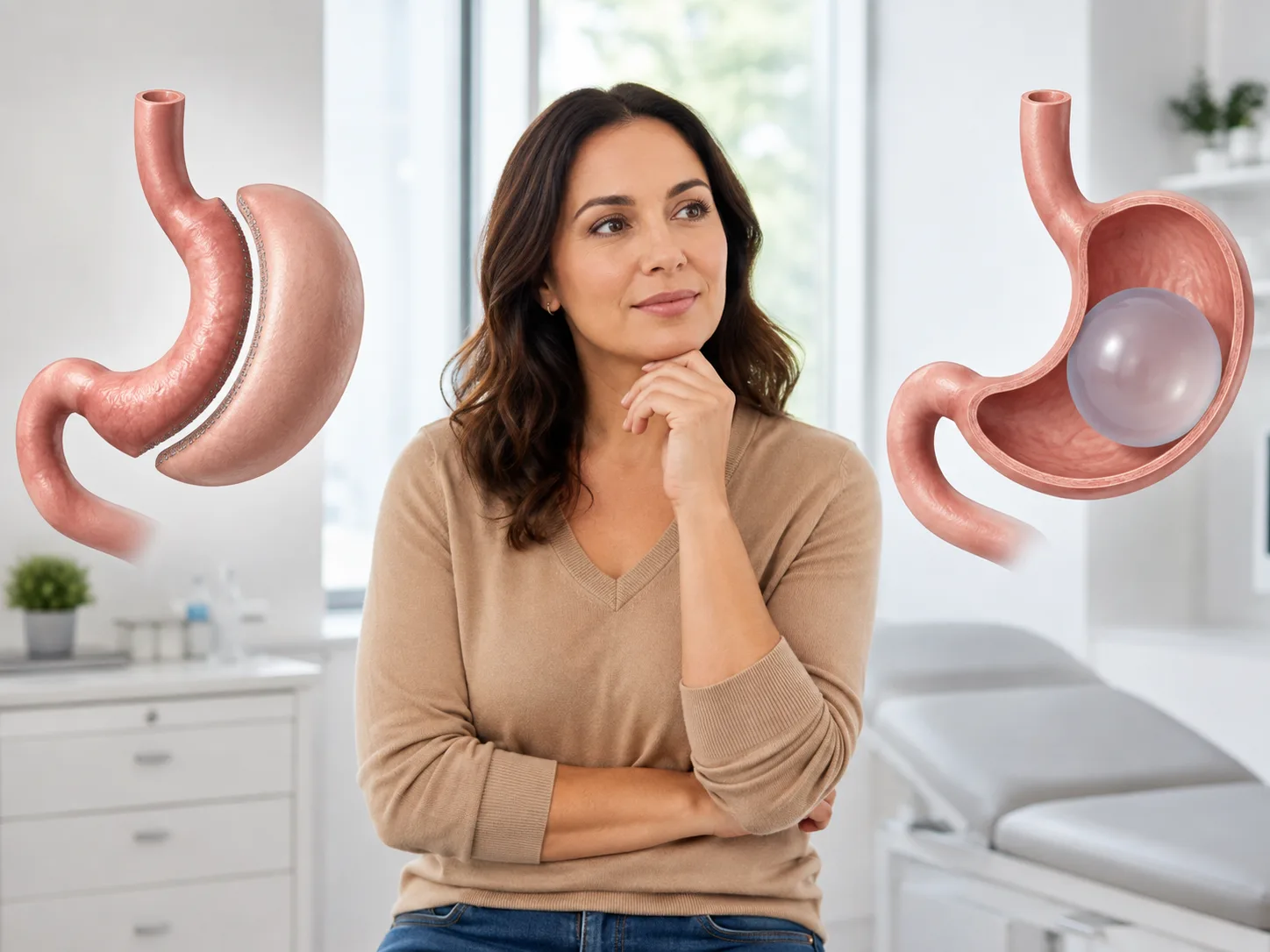
L'obésité est une maladie chronique. Elle affecte des millions de personnes dans le monde. La science médicale propose aujourd'hui plusieurs traitements prouvés pour cette maladie. Deux des options les plus discutées sont chirurgie de la sleeve gastrectomie et ballon gastrique pose. Les patients se demandent souvent quelle option est la plus efficace. Les médecins débattent également de quel traitement correspond aux profils spécifiques des patients. Cet article compare les deux procédures en utilisant des preuves scientifiques réelles. Nous examinons les mécanismes, l'éligibilité, les résultats de perte de poids, la sécurité, la récupération et les résultats à long terme. Le choix du traitement dépend de l'IMC, des maladies liées à l'obésité, du risque chirurgical et de l'engagement de mode de vie. Ce guide aide les patients et les cliniciens à prendre des décisions éclairées et fondées sur des preuves.
La chirurgie de la sleeve gastrectomie est une intervention chirurgicale de perte de poids. Les médecins l'appellent également gastrectomie en manchon ou gastrectomie verticale en manchon. Les chirurgiens retirent environ 80 % de l'estomac lors de cette opération. Ils laissent derrière eux un estomac étroit en forme de tube. Ce nouvel estomac ressemble à une banane ou à une manchon. La procédure change de manière permanente l'anatomie de l'estomac. Les patients ne peuvent pas inverser cette chirurgie.
McCarty et al. (2020) expliquent que la gastrectomie en manchon réduit le volume de l'estomac et modifie les hormones intestinales. La chirurgie enlève le fundus de l'estomac. C'est la principale zone qui produit de la ghréline. La ghréline est l'hormone de la faim. Lorsque les chirurgiens retirent cette zone, les niveaux de ghréline chutent fortement. Les patients ressentent moins de faim après la chirurgie. La procédure augmente également le GLP-1 et le PYY. Ces hormones favorisent la satiété. L'effet combiné crée à la fois une restriction et un changement métabolique. Les patients mangent moins parce que leur estomac est plus petit. Ils se sentent également moins affamés parce que leurs hormones changent.
La chirurgie utilise une approche laparoscopique. Les chirurgiens pratiquent plusieurs petites incisions dans l'abdomen. Ils insèrent une caméra et des instruments chirurgicaux à travers ces incisions. Les patients reçoivent une anesthésie générale. La plupart des patients restent à l'hôpital pendant un à trois jours. La récupération prend plusieurs semaines. Les patients passent des liquides aux aliments mous, puis aux aliments solides. Un suivi à long terme des vitamines et des minéraux est essentiel. L'apport en protéines devient une priorité. La capacité de l'estomac passe d'environ 1500 millilitres à environ 100 à 150 millilitres.
Un ballon gastrique est un dispositif temporaire de perte de poids. Les médecins l'appellent un ballon intragastrique ou IGB. Le dispositif occupe de l'espace à l'intérieur de l'estomac. Il favorise un sentiment de satiété précoce et réduit l'apport alimentaire. Le ballon ne retire aucun tissu de l'estomac. Il ne modifie pas de manière permanente la forme de l'estomac. Les médecins placent le ballon par endoscopie ou par un système de capsule à avaler.
Amaral et al. (2025) ont réalisé une revue systématique des essais contrôlés randomisés. Ils ont constaté que les ballons intragastriques produisent une perte de poids significative par rapport à la thérapie médicale standard. Le ballon fonctionne par occupation physique de l'espace. Il remplit une partie de l'estomac. Les patients se sentent rassasiés après avoir mangé des portions plus petites. Certaines recherches suggèrent que le ballon peut également affecter la vidange gastrique et la régulation de l'appétit. Cependant, ces effets sont temporaires. Le ballon reste en place pendant six à douze mois. Les médecins l'enlèvent ensuite.
La procédure de placement prend environ 20 à 30 minutes. Les patients reçoivent une sédation pour les ballons endoscopiques conventionnels. Certains nouveaux systèmes utilisent des ballons à avaler qui ne nécessitent pas d'endoscopie. Après le placement, les patients suivent un régime liquide pendant plusieurs jours. Ils passent progressivement à des aliments mous puis à des aliments normaux. Le conseil nutritionnel et le soutien comportemental sont cruciaux pendant le traitement. Le ballon quitte l'estomac après la période prescrite. Les patients doivent continuer à gérer leur mode de vie après le retrait.
Ces deux traitements diffèrent de manière fondamentale. Le sleeve gastrique est chirurgical. Le ballon gastrique est non chirurgical ou peu invasif. Le sleeve gastrique crée des modifications anatomiques permanentes. Le ballon gastrique fournit une occupation temporaire de l'espace.
Le tableau suivant résume les principales différences :
Facteur | Sleeve gastrique | Ballon gastrique |
Type de traitement | Chirurgical | Non chirurgical ou endoscopique |
Altération de l'estomac | Permanente | Temporaire |
Tissu gastrique retiré | Oui | Non |
Anesthésie | Anesthésie générale | Sédation pour la pose conventionnelle |
Hospitalisation | Généralement requise | Généralement en ambulatoire |
Période de récupération | Plus longue | Plus courte |
Réversible | Non | Oui |
Potentiel de perte de poids | Généralement plus important et plus durable | Généralement plus modeste |
Mécanisme principal | Réduction du volume de l'estomac plus effets métaboliques | Occupation de l'espace gastrique plus satiété précoce |
Suivi à long terme | Requis | Requis |
La gastroplastie nécessite une anesthésie générale et une salle d'opération. La pose du ballon gastrique utilise la sédation et se déroule dans une salle d'endoscopie ou en ambulatoire. Les patients ayant subi une sleeve ont besoin d'un à trois jours à l'hôpital. Les patients avec ballon rentrent généralement chez eux le jour même. La récupération après la chirurgie de sleeve prend quatre à six semaines. Les patients avec ballon reprennent souvent leurs activités normales en quelques jours.
Quelle procédure produit une perte de poids plus importante ?
Les résultats de perte de poids diffèrent entre ces traitements. Les scientifiques mesurent la perte de poids en utilisant le pourcentage de perte de poids total (%TWL) et le pourcentage de perte de poids excédentaire (%EWL). Ces mesures permettent une comparaison équitable entre différents groupes de patients.
La gastrectomie en manche produit généralement une perte de poids plus importante. Chang et al. (2014) ont signalé que la chirurgie bariatrique entraîne une réduction du poids substantielle et durable. Les patients ayant subi une gastrectomie en manche atteignent typiquement entre 50 et 70 % de perte de poids excédentaire (EWL) dans les 18 à 24 mois. Sohan (2024) note que la gastrectomie en manche présente une large gamme de résultats. La perte de poids se situe généralement entre 30 et 80 % du poids excédentaire dans les 18 à 24 mois suivant l'opération. Cinq ans après la chirurgie, les patients maintiennent souvent environ 23,4 % de leur perte de poids initiale.
Le ballon gastrique produit des résultats plus modestes. Amaral et al. (2025) ont trouvé que le ballon intragastrique atteignait une %EWL moyenne de 30,37 % à six mois. Le %TWL était d'environ 11 % à six mois. Ces résultats sont significatifs mais inférieurs à ceux des résultats chirurgicaux. Popov et al. (2017) ont confirmé que les ballons intragastriques améliorent les conditions liées à l'obésité. Cependant, les bénéfices dépendent du degré et de la durabilité de la perte de poids.
La reprise de poids est une préoccupation pour les deux traitements. Après le retrait du ballon, certains patients reprennent du poids sans gestion continue de leur mode de vie. Après la chirurgie de sleeve, une reprise de poids à long terme peut également se produire. Sohan (2024) souligne que l'activité physique régulière et l'adhésion diététique prédisent le succès à long terme. Les patients qui marchent environ 28 miles par semaine sont plus susceptibles de maintenir leur perte de poids.
Les deux traitements peuvent améliorer les conditions liées à l'obésité. Celles-ci incluent le diabète de type 2, l'hypertension, la dyslipidémie, l'apnée du sommeil obstructive et les maladies hépatiques métaboliques. L'amélioration est généralement liée au degré et à la durabilité de la perte de poids.
La gastrectomie en manche produit de forts effets métaboliques. Courcoulas et al. (2024) ont comparé la gestion médicale avec la chirurgie bariatrique chez les patients de type 2 diabétiques. La chirurgie a produit de meilleurs résultats à long terme. Après sept ans, le groupe ayant subi une chirurgie bariatrique a atteint 19,9 % de perte de poids contre 8,3 % dans le groupe médical. Après douze ans, la chirurgie a maintenu 19,3 % de perte de poids contre 10,8 % avec la gestion médicale. Le taux de rémission du diabète à 12 mois après une gastrectomie en manche varie de 50 à 75 % dans diverses études.
Le ballon gastrique améliore également la santé métabolique. Popov et al. (2017) ont mené une revue systématique et une méta-analyse. Ils ont constaté que les ballons intragastriques améliorent les comorbidités liées à l'obésité. Cependant, les améliorations sont généralement moins prononcées qu'avec la chirurgie. La nature temporaire du ballon signifie que les bienfaits durables nécessitent une gestion continue du poids après son retrait.
La comparaison suivante montre les améliorations typiques :
État | Impact de la Sleeve Gastrique | Impact du Ballon Gastrique |
Diabète de type 2 | Taux de rémission élevés (50-75 %) | Amélioration modérée |
Hypertension | Réduction significative | Réduction légère à modérée |
Dyslipidémie | Amélioration marquée | Amélioration modérée |
Apnée du sommeil | Se résout souvent ou s'améliore | Peut s'améliorer avec une perte de poids |
Maladie du foie métabolique | Amélioration significative | Amélioration variable |
Quels sont les risques et effets secondaires de chaque procédure ?
Chaque procédure médicale comporte des risques. Les patients doivent comprendre ces risques avant de prendre des décisions.
Les risques de la sleeve gastrique incluent des saignements, des infections, des fuites de ligne de suture, des caillots sanguins, des strictures, des reflux gastro-œsophagiens et des carences nutritionnelles. Chang et al. (2014) ont analysé les risques dans leur revue systématique. Ils ont confirmé que la chirurgie bariatrique est efficace mais comporte des risques opératoires. Une fuite de ligne de suture se produit dans environ 1 à 3 % des cas. Les carences nutritionnelles à long terme nécessitent une supplémentation à vie. Certains patients développent une maladie de reflux gastro-œsophagien après la chirurgie. La reprise de poids à long terme affecte un sous-groupe de patients.
Les effets secondaires du ballon gastrique incluent des nausées, des vomissements, des douleurs abdominales et des reflux gastro-œsophagiens. Les complications graves sont rares mais incluent dégonflage du ballon, migration, ulcération, pancréatite et perforation gastrique. Amaral et al. (2025) ont noté que des événements indésirables surviennent mais sont généralement gérables. Les lignes directrices cliniques de l'AGA par Muniraj et al. (2021) fournissent des recommandations de sécurité détaillées. Ils soulignent l'importance d'une bonne sélection des patients et des suivis.
Une invasion moindre ne signifie pas zéro risque. Les deux procédures nécessitent une évaluation rigoureuse des patients. L'état de santé individuel influence le risque pour chaque patient. Une équipe médicale qualifiée doit évaluer chaque cas de manière individuelle.
Qui devrait envisager la chirurgie de la sleeve gastrique ?

La sleeve gastrique convient à des profils de patients spécifiques. Les médecins recommandent généralement cette chirurgie pour les patients ayant des valeurs d'IMC plus élevées. La plupart des orientations suggèrent la gastrectomie en sleeve pour les patients ayant un IMC de 40 ou plus. Les patients ayant un IMC de 35 ou plus avec des maladies liées à l'obésité peuvent également être qualifiés.
La gastrectomie en sleeve convient aux patients qui souhaitent une perte de poids durable. Elle convient à ceux qui acceptent des modifications anatomiques permanentes. Les patients doivent tolérer une chirurgie majeure et l'anesthésie. Ils doivent s'engager à un suivi postopératoire à long terme. Cela inclut des tests sanguins réguliers pour détecter des carences nutritionnelles. Les patients doivent prendre des suppléments vitaminiques et minéraux à vie.
La chirurgie de sleeve aide également les patients atteints de maladies métaboliques sévères. Ceux atteints de diabète de type 2 incontrôlé peuvent atteindre la rémission. Les patients souffrant d'apnée du sommeil sévère peuvent voir leur condition se résoudre. Les bienfaits métaboliques vont au-delà de la simple perte de poids. McCarty et al. (2020) ont démontré que les changements hormonaux après la gastrectomie en sleeve contribuent à ces bienfaits.
Qui devrait envisager un ballon gastrique ?
Le ballon gastrique convient à une population de patients différente. Il convient aux patients ayant des plages d'IMC plus basses. De nombreux programmes proposent des ballons aux patients ayant un IMC entre 30 et 40. Certains programmes acceptent des patients ayant un IMC supérieur à 40 qui ont besoin d'une intervention temporaire.
Le ballon attire les patients qui souhaitent éviter la chirurgie. Il convient à ceux qui préfèrent des traitements temporaires. Les patients qui craignent des changements anatomiques permanents peuvent préférer cette option. Le ballon fonctionne également comme un pont vers la chirurgie. Loo et al. (2022) ont réalisé une revue systématique sur ce sujet. Ils ont constaté que le ballon intragastrique avant la chirurgie bariatrique réduit l'IMC d'une moyenne de 6,6 kg/m². Cette perte de poids préopératoire peut améliorer la préparation chirurgicale chez les patients super-obèses.
Les patients doivent s'engager à apporter des changements de mode de vie durant le traitement par ballon. Ils doivent assister à des consultations nutritionnelles. Ils doivent suivre des recommandations diététiques. Sans ces changements, la perte de poids est limitée. Après le retrait, une gestion continue est essentielle. La reprise de poids est fréquente sans soutien continu.
Quelles modifications alimentaires et de mode de vie les deux procédures exigent-elles ?
Aucune des deux procédures ne remplace la modification du mode de vie. Les deux nécessitent des changements alimentaires, de l'activité physique et un soutien comportemental.
Après une sleeve gastrique, les patients progressent à travers des étapes alimentaires. Ils commencent par des liquides clairs. Ils passent aux liquides complets, aux aliments mixés, aux aliments mous, et enfin aux textures régulières. Les tailles des portions restent petites à vie. L'apport en protéines doit atteindre 60 à 80 grammes par jour. Les patients prennent des multivitamines, du calcium, de la vitamine D, et de la vitamine B12. Ils évitent de boire pendant les repas. Ils mangent lentement et mastiquent minutieusement.
Avec le ballon gastrique, les patients commencent également par des liquides. Ils passent progressivement à des aliments mous puis à des aliments réguliers. Le contrôle des portions est essentiel. Les patients doivent manger lentement. Les aliments volumineux ou fibreux peuvent provoquer de l'inconfort. Le soutien nutritionnel se poursuit tout au long du traitement.
L'exercice est important pour les deux traitements. L'activité physique préserve la masse musculaire durant la perte de poids. Elle améliore la santé métabolique. Elle aide à maintenir la perte de poids à long terme. Le soutien comportemental aborde l'alimentation émotionnelle, la gestion du stress et le changement d'habitudes. La qualité du sommeil et la santé psychologique influencent également les résultats. Un suivi à long terme avec une équipe pluridisciplinaire produit les meilleurs résultats.
Les coûts varient largement selon le pays, le prestataire et la couverture d'assurance. Aucun prix universel n'existe pour l'une ou l'autre des procédures.
La sleeve gastrique implique des coûts initiaux plus élevés. Les patients paient pour l'évaluation préopératoire, la chirurgie, l'anesthésie, l'hospitalisation et le suivi. Les coûts à long terme comprennent les suppléments nutritionnels et le suivi de laboratoire. Cependant, la perte de poids durable peut réduire les dépenses médicales à long terme pour les maladies liées à l'obésité.
Le ballon gastrique a des coûts initiaux plus bas. Les patients paient pour l'évaluation, la pose du ballon, la sédation et le retrait. Certains programmes incluent le soutien nutritionnel dans le forfait. La nature temporaire signifie que les patients peuvent avoir besoin de traitements supplémentaires plus tard. La pose répétée du ballon ou une chirurgie éventuelle augmente les coûts à vie.
Le temps d'absence au travail diffère. Les patients ayant subi une sleeve ont généralement besoin de deux à quatre semaines d'absence. Les patients avec un ballon peuvent revenir dans quelques jours. La profession et le mode de vie influencent cette décision. Les patients ayant des emplois physiquement exigeants ont besoin de plus de temps de récupération après la chirurgie.
Que dit la littérature scientifique sur l'efficacité à long terme ?
Les revues systématiques et les méta-analyses fournissent les preuves les plus solides. Ces études regroupent des données de nombreux patients.
La gastrectomie en sleeve démontre une perte de poids durable. Sohan (2024) rapporte que les patients maintiennent une perte de poids substantielle pendant des années. Après cinq ans, les patients conservent environ 23,4 % de la perte de poids initiale. Après dix ans, les patients conservent de 50 à 60 % de la perte de poids excessif. La procédure est devenue la chirurgie bariatrique la plus courante dans le monde.
Les preuves concernant le ballon gastrique montrent des résultats significatifs mais moins durables. Amaral et al. (2025) ont analysé 15 essais contrôlés randomisés portant sur 1961 patients. Ils ont trouvé une perte de poids supérieure avec le ballon comparé à la thérapie médicale standard. Cependant, les bénéfices sont temporaires par conception. Après le retrait du ballon, la reprise de poids se produit sans interventions de maintien. Muniraj et al. (2021) recommandent des interventions ultérieures après le retrait du ballon. Celles-ci peuvent inclure des programmes diététiques, une pharmacothérapie, la répétition du ballon ou une chirurgie bariatrique.
Fehervari et al. (2023) ont étudié les résultats de la gastroplastie transorielle par sleeve. Bien que cela diffère de la gastrectomie en sleeve chirurgicale, cela fournit un contexte pour les approches endoscopiques. Ils ont rapporté une perte de poids totale de 16,2 % au bout d'un an et de 15,4 % à moyen terme. Diab et al. (2024) ont directement comparé la gastroplastie par sleeve endoscopique avec le ballon intragastrique. Ils ont constaté que la gastroplastie par sleeve endoscopique produisait une plus grande perte de poids. Cela suggère que même parmi les options endoscopiques, les ballons produisent des résultats plus modestes.
La décision nécessite une évaluation approfondie. Les patients doivent considérer plusieurs facteurs.
Tout d'abord, évaluer l'IMC et la gravité de l'obésité. Un IMC plus élevé favorise généralement les options chirurgicales. Deuxièmement, évaluer les maladies liées à l'obésité. Un diabète sévère ou une apnée du sommeil peuvent pousser vers la chirurgie. Troisièmement, définir les objectifs de perte de poids. Une perte de poids plus importante et plus durable favorise la gastrectomie en sleeve. Quatrièmement, considérer les risques chirurgicaux et liés à l'anesthésie. Les patients à haut risque peuvent préférer le ballon. Cinquièmement, choisir entre un traitement permanent et temporaire. Certains patients préfèrent fortement la réversibilité.
Les tentatives de perte de poids précédentes comptent. Les patients ayant échoué plusieurs régimes et médicaments peuvent avoir besoin de chirurgie. La capacité à suivre les recommandations est cruciale. Les deux procédures nécessitent une adhésion alimentaire. La volonté d'assister à un suivi à long terme est essentielle. L'historique gastro-intestinal individuel influence également la décision. Une chirurgie antérieure de l'estomac peut compliquer l'une ou l'autre des procédures.
La décision finale doit suivre l'évaluation par une équipe qualifiée en médecine bariatique ou en obésité. Cette équipe comprend généralement des chirurgiens, des endoscopistes, des diététiciens, des psychologues et des infirmières. La prise de décision partagée produit les meilleurs résultats.
Conclusion : Quel traitement est fait pour vous ?
La sleeve gastrique et le ballon gastrique représentent deux approches différentes pour le traitement de l'obésité. La sleeve gastrique offre une réduction permanente du volume de l'estomac. Elle produit une perte de poids plus importante et plus durable. Cela implique une chirurgie, une anesthésie générale et un changement anatomique permanent. Le ballon gastrique permet une occupation temporaire de l'espace gastrique. Il évite la chirurgie et les changements permanents. Il produit une perte de poids modeste et nécessite une gestion continue du mode de vie.
Aucun « meilleur » procédé universel n'existe. Le traitement approprié dépend des caractéristiques cliniques individuelles. L'IMC, les comorbidités, la tolérance au risque et l'engagement envers un mode de vie sont tous importants. Une consultation basée sur des éléments probants avec une équipe pluridisciplinaire est essentielle. Le suivi à long terme détermine le succès des deux traitements. Les patients qui s'engagent à changer leur alimentation, à pratiquer une activité physique et à effectuer un suivi médical obtiennent les meilleurs résultats.
Références
Amaral, G. O., et al. "Ballon Intragastrique pour le traitement de l'obésité : Revue systématique et méta-analyse d'essais contrôlés randomisés."Endoscopy International Open , 2025.
Chang, S. H., et al. "L'efficacité et les risques de la chirurgie bariatrique : une revue systématique et méta-analyse mise à jour, 2003–2012."JAMA Surgery , vol. 149, no. 3, 2014, pp. 275-287.
Courcoulas, A. P., et al. "Résultats à long terme de la gestion médicale par rapport à la chirurgie bariatrique dans le diabète de type 2."JAMA , vol. 331, no. 8, 2024, pp. 654-664.
Diab, A. F., et al. "La bataille des thérapies bariatriques endoscopiques pour l'obésité : Gastroplastie par sleeve endoscopique versus ballon intragastrique inséré par endoscopie - Une méta-analyse paire des études comparatives."Surgical Laparoscopy, Endoscopy & Percutaneous Techniques , vol. 34, no. 6, 2024, pp. 638-646.
Fehervari, M., et al. "Perte de poids à moyen terme et rémission des comorbidités après gastroplastie par sleeve endoscopique : une revue systématique et méta-analyse."Obesity Surgery , vol. 33, 2023, pp. 3527-3538.
Loo, J. H., et al. "Ballon Intragastrique comme Thérapie de Pont Avant la Chirurgie Bariatrique pour les Patients avec Obésité Sévère (IMC ≥ 50 kg/m2) : Une Revue Systématique et une Méta-Analyse."Chirurgie de l'Obésité, vol. 32, no. 2, 2022, pp. 489-502.
McCarty, Thomas R., et al. "Effet de la Gastrectomie en Manchon sur la Ghreline, GLP-1, PYY, et les Hormones Intestinales GIP : Une Revue Systématique et une Méta-Analyse."Annales de la Chirurgie, vol. 272, no. 1, 2020, pp. 68-74.
Muniraj, T., et al. "Directives de Pratique Clinique AGA sur les Ballons Intragastriques dans la Gestion de l'Obésité."Gastroentérologie, vol. 160, no. 5, 2021, pp. 1799-1808.
Popov, V. B., et al. "L'Impact des Ballons Intragastriques sur les Co-Morbidités Liées à l'Obésité : Une Revue Systématique et une Méta-Analyse."Journal Américain de Gastroentérologie, vol. 112, no. 3, 2017, pp. 429-439.
Sohan, P. R. "Efficacité et Résultats à Long Terme de la Chirurgie Bariatrique."Cureus, vol. 16, no. 3, 2024, e55383.