Why Density Matters in Hair Transplant
Density determines whether a hair transplant looks natural or artificial. It is not simply about placing the maximum number of grafts in the smallest possible space. Density is a calculated balance between graft survival, visual perception, donor capacity, and long-term planning. Understanding density helps patients set realistic expectations and helps surgeons deliver results that age well.
What Does Hair Density Mean in Hair Transplantation?
Hair density means the number of follicular units or individual hairs present within a defined area of scalp, typically measured per square centimeter.
In clinical practice, surgeons distinguish between two measurements. Hair density counts individual hair shafts per cm². Graft density counts follicular units per cm². One follicular unit may contain one, two, three, or four hairs. This distinction matters because two patients can receive the same number of grafts yet achieve very different visual results depending on how many hairs each graft carries (Jimenez and Ruifernández 1999).
Native hair density in non-balding adults ranges from roughly 65 to 85 follicular units per cm², with total hair counts between 124 and 200 hairs per cm² (Jimenez and Ruifernández 1999). Transplanted graft density typically falls between 30 and 50 grafts per cm². Surgeons must evaluate density quantitatively rather than visually. The human eye cannot accurately estimate graft counts or hair caliber without instruments. Quantitative measurement prevents overestimation of available donor supply and prevents underestimation of recipient area needs.
Why Is Density Important for a Natural-Looking Hair Transplant?
Density creates the visual impression of fullness, but strategic placement matters more than raw numbers.
The relationship between density and scalp coverage is direct: more grafts in a given area produce more coverage. However, the eye perceives fullness through a combination of density, hair caliber, color contrast, and growth angle. Strategic placement can create the appearance of greater density than the actual graft count suggests. Restoring 100% of original native density is usually unnecessary and often biologically impossible in a single session. The human visual system fills gaps when hair shafts overlap and block light. Density also plays a critical role in blending transplanted hair with existing native hair. A sudden jump from sparse native hair to dense transplanted hair creates an obvious boundary. Gradual density transitions produce seamless, natural-looking results.
How Does Graft Density Differ From Hair Density?
Graft density measures follicular units per cm². Hair density measures individual hairs per cm². These two metrics produce different clinical pictures.
A follicular unit containing three hairs contributes three times the visual coverage of a single-hair unit. This means two patients receiving 2,000 grafts can achieve completely different results. Patient A with mostly three-hair units receives approximately 6,000 total hairs. Patient B with mostly single-hair units receives only 2,000 total hairs. Graft count alone does not predict visual density. Hair count per follicular unit determines the final cosmetic outcome. Surgeons calculate the ratio of hairs to grafts during donor assessment. This ratio guides decisions about whether a patient needs more grafts to achieve the same visual result as someone with naturally multi-hair units.
How Much Density Can a Hair Transplant Safely Achieve?
Most surgeons target 35 to 50 grafts per cm² for optimal results, but no universal ideal density exists.
Biological limitations constrain recipient tissue. Each transplanted follicular unit functions as a micro-organ implant. It must establish a new capillary network within days to survive. Densities above approximately 50 to 60 grafts per cm² risk overwhelming the dermal blood supply. This competition for perfusion increases the risk of localized ischemia and subsequent graft failure (Mayer and Perez 2004; Beehner 2005). Higher density does not automatically mean a better result. Survival rates at 30 grafts per cm² approach near-complete take, while rates at 50 grafts per cm² drop to approximately 84% (Beehner 2005). Factors that determine maximum achievable density include scalp vascularity, graft size, instrument caliber, and surgeon technique. Advanced techniques using smaller recipient sites may allow selective dense packing, but biological vascular limits remain constant.
What Happens When Too Many Grafts Are Placed in One Area?
Overpacking reduces graft survival and increases inflammation.
Dense packing or overpacking describes placing grafts at densities that exceed the recipient area's vascular capacity. Each follicle requires oxygen and nutrients during the critical neovascularization period of 2 to 5 days post-transplantation. When too many grafts compete for the same blood supply, oxygen delivery drops below survival thresholds. The result is inflammation, delayed healing, and reduced graft survival. Aggressive packing can produce poorer rather than denser results because failed grafts create gaps. The surviving grafts must then compensate for the lost units. Conservative, well-vascularized placement consistently outperforms overpacking in long-term density outcomes.
How Does Donor Hair Density Affect Hair Transplant Potential?
Donor density sets the absolute ceiling on how many grafts a patient can receive.
The back and sides of the scalp serve as the primary donor area because follicles there resist androgen-driven miniaturization. Mean follicular unit density in the donor area ranges from 65 to 85 units per cm² in most populations (Chouhan 2019). The donor supply is finite. Overharvesting a low-density donor area leaves visible thinning, mottling, or a see-through appearance. Surgeons calculate safe excision limits based on baseline donor density. A patient with 70 FU/cm² can safely donate more grafts than a patient with 50 FU/cm². Preserving donor density matters for future hair loss. Androgenetic alopecia progresses over decades. A patient who uses all available grafts in the first procedure may lack reserves for subsequent thinning.
Which Patient Factors Influence the Appearance of Hair Density?
Hair characteristics modify how the eye perceives density. Three factors dominate: shaft thickness, texture, and color contrast.
How Does Hair Shaft Thickness Affect Perceived Density?
Thicker shafts create greater visual fullness than thin shafts at the same graft density.
Hair caliber, or shaft diameter, directly impacts scalp coverage. A single coarse hair with a diameter of 80 microns covers more surface area than two fine hairs of 40 microns each. Robbins (2012) demonstrated that increasing hair shaft diameter offsets decreasing hair density through the mid-30s. After that point, declining diameter combined with reduced density creates noticeable thinning. Patients with fine hair require higher graft densities to achieve the same visual fullness as patients with coarse hair. Surgeons assess caliber during preoperative planning and adjust density targets accordingly.
How Does Hair Texture Change the Visual Result?
Curly and wavy hair creates more visual coverage than straight hair at identical graft densities.
Straight hair lies flat against the scalp. Light passes between shafts easily, revealing the underlying skin. Wavy and curly hair creates volume through shaft curvature. The same number of grafts produces a fuller appearance in curly-haired patients. Hair direction also affects coverage. Natural growth angles that sweep across the scalp block more light than perpendicular placement. Identical graft densities can look completely different between patients based solely on texture and growth pattern.
How Does Hair and Scalp Contrast Affect Fullness?
High contrast between hair color and scalp color makes thinning more visible.
Dark hair on light skin creates the highest contrast. Every gap shows clearly. Light hair on light skin, or dark hair on dark skin, reduces contrast and hides gaps. Visual density often matters more than numerical density. A patient with dark hair, light skin, and fine shafts may need 45 grafts per cm² to look full. A patient with light hair, dark skin, and coarse shafts may look equally full at 30 grafts per cm². Surgeons factor contrast into density planning.
Does Every Scalp Area Require the Same Density?
No. Different scalp zones require different density strategies.
How Should Density Be Planned at the Hairline?
The hairline needs the highest density in the frontal zone but uses single-hair grafts at the leading edge.
A natural hairline transitions gradually from forehead to scalp. Surgeons place single-hair follicular units at the very front to create a soft, feathered edge. Behind this transition zone, density increases using two-hair and three-hair units. An overly dense or perfectly straight hairline looks artificial. Natural hairlines contain micro-irregularities and macro-irregularities. Density must follow this pattern of organized disorder. Garg and Singhal (2019) placed 35 to 40 grafts per cm² in the frontal area and achieved high patient satisfaction by mimicking natural transition zones.
What Density Is Appropriate for the Mid-Scalp?
The mid-scalp typically receives moderate density, bridging the hairline and crown.
This area benefits from overlapping coverage from the denser frontal zone. Surgeons usually target 30 to 45 grafts per cm² in the mid-scalp. The exact number depends on surrounding native hair density. If native hair remains thick behind the hairline, lower transplant density blends naturally. If native hair has thinned significantly, higher density restores continuity. Balancing mid-scalp density with donor conservation remains essential. The mid-scalp covers a large surface area. Excessive graft use here depletes reserves needed for the crown or future procedures.
Why Does the Crown Require a Different Density Strategy?
The crown needs lower density and must account for future hair loss progression.
The vertex covers a larger restoration area than the frontal third. Its natural whorl and spiral growth direction require careful angle matching. The crown is visible from multiple angles, including from above. However, packing the crown at high density consumes grafts rapidly. More importantly, crown hair loss often continues after transplantation. Transplanting the crown before stabilization creates the "island effect": a dense patch surrounded by future baldness. Strategic placement at 20 to 35 grafts per cm² produces better long-term results than maximum density placement (Garg and Singhal 2019).
How Do Surgeons Measure Hair Density Before a Transplant?
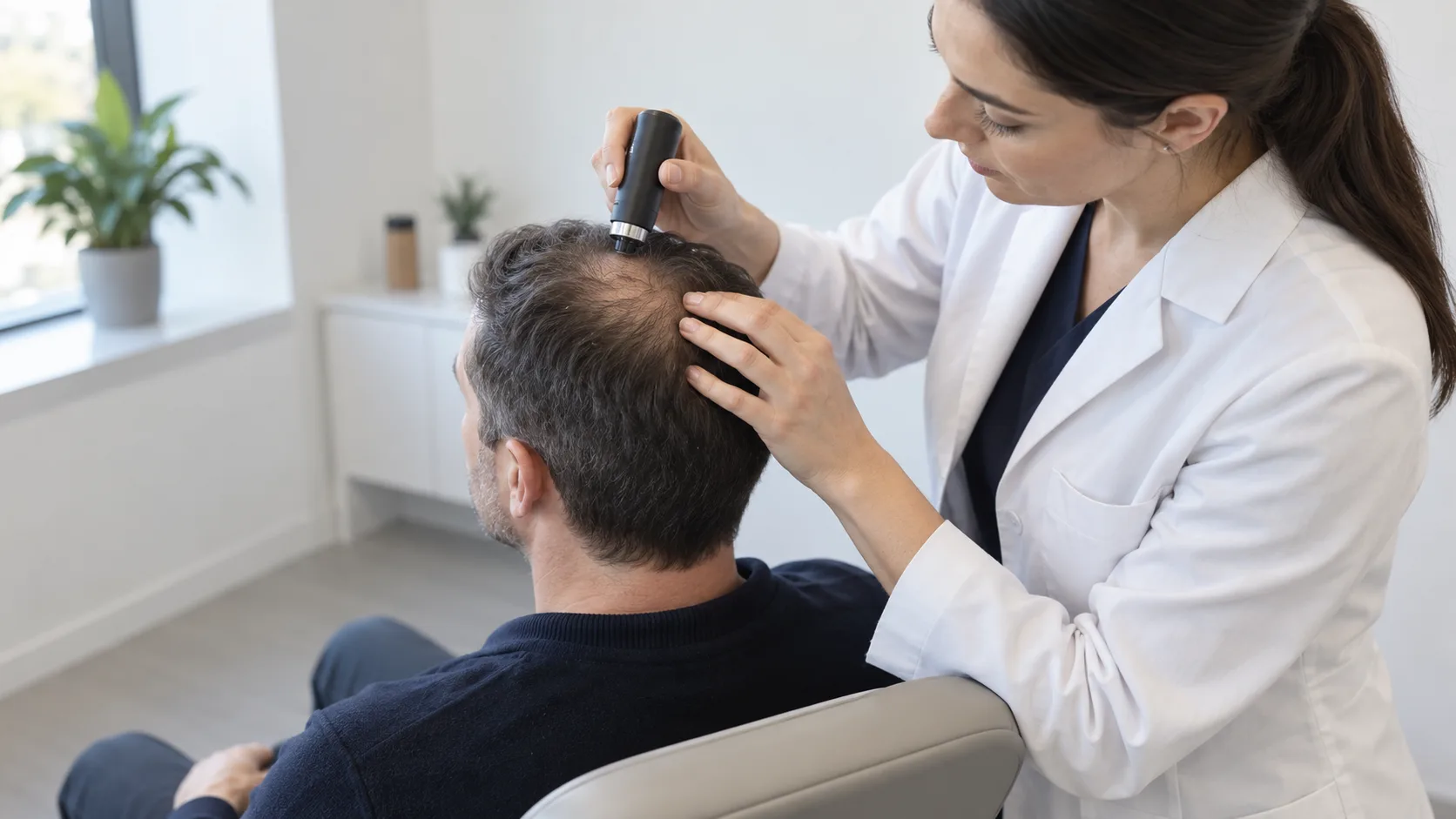
Surgeons use clinical examination, trichoscopy, phototrichography, and digital analysis.
Clinical scalp examination provides a preliminary estimate. The surgeon parts the hair and visually assesses density, caliber, and miniaturization. Trichoscopy and dermoscopy offer magnified views of the scalp surface. These tools reveal follicular unit structure, hair shaft diameter, and early miniaturization. Phototrichography captures standardized photographs for longitudinal comparison. Digital hair-density analysis automates counting and measurement. Park and Choi (2025) developed an automated phototrichogram pipeline that segments individual hair shafts and measures projected apparent width with high accuracy. Surgeons measure both donor and recipient areas. They assess miniaturization patterns to predict future hair loss. They use these measurements to estimate graft requirements precisely.
How Does Hair Loss Severity Change Density Planning?
Advanced hair loss reduces the donor-to-recipient ratio and forces strategic compromises.
Progressive thinning reduces native recipient density. The Norwood classification guides treatment planning by defining the pattern and extent of loss. Diffuse thinning complicates planning because the recipient area lacks clear boundaries. Large areas of baldness require more grafts than the donor area can supply in one session. Surgeons must balance coverage with limited donor resources. Future hair loss must be considered before maximizing density in any single zone. A patient with Norwood Class VI balding cannot achieve full coverage at high density. The surgeon must choose between high density in a smaller area or lower density across a larger area.
Does a Higher Graft Count Always Produce a Denser Result?
No. Graft distribution and quality matter more than total count.
Graft quantity does not guarantee density if distribution is poor. A surgeon who places 3,000 grafts uniformly across the scalp may produce less visual density than one who concentrates 2,500 grafts in the frontal third. Recipient-area size determines whether a given graft count looks dense or sparse. Follicular-unit composition affects the total hair count. Hair caliber and texture modify visual perception. Most importantly, graft survival determines final density. A procedure with 95% survival of 2,000 grafts produces more hair than one with 70% survival of 3,000 grafts. Strategic placement consistently outperforms simply increasing graft numbers.
How Does Surgical Technique Influence Achievable Density?
Technique affects graft survival, placement precision, and final density.
Recipient-site creation determines how closely grafts can be placed. Smaller sites allow denser packing with less trauma. Precision of graft placement affects angle, depth, and direction. Graft handling and protection during extraction and implantation minimize follicular trauma. Placement angle and direction determine how light interacts with hair shafts. Flat angles create shadow-blocking that increases perceived density. Surgeon experience affects consistency across hundreds or thousands of grafts. However, technique alone cannot overcome biological limitations. Even the most skilled surgeon cannot safely exceed vascular capacity in the recipient tissue.
Can Dense Packing Be Used in Previously Transplanted Areas?
Secondary density enhancement is possible but requires conservative planning.
Scarred or previously operated recipient tissue has reduced vascularity. Existing follicles must be preserved during revision procedures. Recipient-site vascular considerations limit how many additional grafts can be placed. Revision procedures require lower density targets than virgin scalp. The surgeon must navigate around existing grafts without causing collateral damage. Blood supply in scarred tissue is less robust than in untouched skin. Conservative planning protects both new and existing follicles.
How Long Does It Take for Transplanted Density to Become Visible?
Final density becomes apparent between 12 and 18 months post-procedure.
Initial postoperative shedding occurs within the first month. Up to 90% of transplanted hair shafts fall out. This is normal effluvium, not graft failure. Early regrowth begins around month 3. Hair shaft maturation continues through month 12. Progressive increase in visual fullness occurs as shafts thicken and lengthen. The early postoperative appearance does not represent final density. Patients should wait for sufficient maturation before judging results. Typical assessment milestones include 3 months for early growth, 6 months for 50 to 60% of final density, 9 to 12 months for 60 to 80% of final result, and 12 to 18 months for complete maturation.
Can Hair Density Be Improved Without Adding More Grafts?
Yes. Adjunctive treatments protect native hair and enhance visual density.
Protecting existing native hair is the first priority. Medical hair-loss treatments like finasteride reduce DHT levels and slow miniaturization. Studies show patients using finasteride post-transplant achieve 94% visible improvement versus 67% without it. PRP serves as an adjunctive treatment. A 2025 systematic review confirmed PRP improves hair density, follicle survival, and earlier regrowth when combined with transplantation. Scalp micropigmentation creates the illusion of density by tattooing pigment between existing hairs. Emerging regenerative treatments show promise but remain investigational. Adjunctive treatments do not replace appropriate surgical planning. They complement sound graft placement and distribution strategy.
What Are the Most Common Misconceptions About Hair Transplant Density?
Patients often misunderstand how density works in transplantation.
Does More Grafts Always Mean More Density?
No. Survival rate and distribution determine final density. A high graft count with poor survival produces less actual hair than a moderate count with excellent survival.
Can a Transplant Recreate Natural Scalp Density?
No. Native scalp holds 80 to 100 follicular units per cm². Transplanted density typically reaches 35 to 50 grafts per cm². Strategic placement and favorable hair characteristics can produce the visual impression of full coverage without matching native numbers.
Is the Same Density Appropriate for Every Scalp Zone?
No. The hairline needs higher density than the crown. The mid-scalp sits between these extremes. Uniform density across all zones is both biologically unsafe and aesthetically suboptimal.
Can Every Patient Receive a High-Density Hair Transplant?
No. Donor density, recipient area size, and hair characteristics limit achievable density. Patients with low donor density or extensive baldness cannot safely receive high-density placement across large areas.
Does the Number of Grafts Matter More Than Their Placement?
No. Placement determines visual outcome. Angle, direction, and zone-specific density targets create natural results. Raw graft count without strategic placement wastes donor supply.
How Can Patients Evaluate Whether a Hair Transplant Has Good Density?
Patients should assess density using multiple criteria.
Compare the result with the original treatment goal. Assess coverage across different scalp zones. Look at hairline transition and irregularity. Evaluate scalp visibility under different lighting conditions. Consider hair caliber and styling options. Assess donor-area preservation. Wait for sufficient maturation before judging the final result. Review standardized before-and-after photography under consistent lighting and angles.
What Determines the Right Density for an Individual Hair Transplant?
Ten factors guide personalized density planning.
Factor | Why It Matters |
Donor density | Sets the absolute graft supply ceiling |
Recipient-area size | Determines total grafts needed |
Degree and pattern of hair loss | Defines coverage priorities |
Hair caliber | Thick hair looks fuller at lower densities |
Hair texture and color | Curly hair and low contrast hide gaps better |
Scalp characteristics | Vascularity and skin thickness affect survival |
Existing native hair | Provides blending and reduces transplant density needs |
Long-term hair-loss progression | Requires conservation for future procedures |
Patient's aesthetic goals | Frames density targets around personal priorities |
Number of procedures planned | Affects how aggressively to use donor reserves |
Frequently Asked Questions About Hair Transplant Density
What is considered good density after a hair transplant?
Good density means visible scalp coverage that looks natural under normal lighting. Most patients achieve satisfactory results at 35 to 50 grafts per cm² in the frontal zone.
How many grafts per cm² are used in a hair transplant?
Surgeons typically use 35 to 50 grafts per cm² in the hairline, 30 to 45 in the mid-scalp, and 20 to 35 in the crown.
Can a hair transplant achieve the same density as natural hair?
No. Natural density ranges from 80 to 100 follicular units per cm². Transplanted density is lower but can appear full through strategic placement.
Does dense packing increase graft survival?
No. Dense packing above 50 grafts per cm² reduces survival due to vascular competition.
Why does my hair transplant look thin even though many grafts were implanted?
Early shedding, low survival rate, fine hair caliber, or poor distribution can cause thin appearance. Final density requires 12 to 18 months to mature.
Can density improve after 6 months?
Yes. At 6 months, most patients see only 50 to 60% of final density. Continued maturation occurs through month 18.
Does donor density determine how many grafts I can receive?
Yes. Donor density sets the safe extraction limit. Overharvesting causes visible donor thinning.
Can another procedure increase density after a hair transplant?
Yes. Secondary procedures can add density if donor reserves remain. Scarred or previously transplanted areas require conservative planning.
Does hair thickness affect how dense a transplant looks?
Yes. Thick hair creates more visual coverage than fine hair at the same graft density.
Key Takeaways About Density in Hair Transplantation
Density is a combination of graft distribution, hair characteristics, and follicle survival. Maximum density is not necessarily the best density. Donor capacity limits how much hair can be redistributed. Different scalp zones require different planning. Individual anatomy and hair characteristics determine the appropriate target. Long-term donor preservation should remain part of every density strategy.
References
Beehner, Michael L. "Studying the Effect of FU Planting Density on Hair Survival." Hair Transplant Forum International, vol. 16, 2006, pp. 247-248.
Chouhan, K. et al. "Assessment of Safe Donor Zone of Scalp and Beard for Follicular Unit Extraction in Indian Men." Journal of Cutaneous and Aesthetic Surgery, vol. 12, no. 2, 2019, pp. 93-98.
Garg, A., and A. Singhal. "Recipient Area." Journal of Cutaneous and Aesthetic Surgery, vol. 12, no. 4, 2019, pp. 196-201.
Jimenez, F., and C. Ruifernández. "Distribution of Human Hair in Follicular Units: A Mathematical Model for Estimating the Donor Size in Follicular Unit Transplantation." Dermatologic Surgery, vol. 25, no. 4, 1999, pp. 294-298.
Keene, S. A. "Determining Safe Excision Limits in FUE: Factors That Affect, and a Simple Way to Maintain, Aesthetic Donor Density." Hair Transplant Forum International, vol. 28, no. 1, 2018, pp. 1-12.
Limmer, R. "Micrograft Survival." Hair Replacement, edited by D. Stough and R. Haber, Mosby, 1996, pp. 147-149.
Mayer, M., and D. Perez. "Comparing FU Growth with Different Planting Densities." Hair Transplantation, 4th ed., edited by W. P. Unger and R. Shapiro, Marcel Dekker, 2004, pp. 285-287.
Nakatsui, T., J. Wong, and D. Croot. "Survival of Density Packed Follicular Unit Grafts Using the Lateral Slit Technique." Dermatologic Surgery, vol. 34, no. 8, 2008, pp. 1016-1022.
Park, B. C., and S. I. Choi. "Automated Measurement of Hair Density and Projected Apparent Hair Shaft Width Using Deep Learning-Based Hair Instance Segmentation." Skin Research and Technology, 2025.
Robbins, C. et al. "What Women Want - Quantifying the Perception of Hair Amount: An Analysis of Hair Diameter and Density Changes with Age in Caucasian Women." British Journal of Dermatology, vol. 167, no. 2, 2012, pp. 224-229.
Sharma, R. "Follicular Unit Extraction (FUE) Hair Transplant: Curves Ahead." Journal of Cutaneous and Aesthetic Surgery, vol. 12, no. 3, 2019, pp. 147-154.
Unger, W. P. "Graft Survival." Hair Transplantation, edited by W. P. Unger, Marcel Dekker, 1979, pp. 123-130.